

An influencer persona is the strategic blueprint behind a recognizable creator identity. For an AI influencer, it defines more than a name or a face: it connects personality, niche, voice, visual style, audience, recurring content, and brand boundaries before the first post is generated.
That preparation keeps a virtual creator from becoming a folder of unrelated attractive images. When the persona is clear, a team can ask whether a photo, short video, caption idea, platform adaptation, or partnership belongs to the same world. The answer becomes a creative decision rather than a guess.
Build your own with our seven-step AI influencer persona tutorial, including a complete profile template and a seven-day content plan.
For a male character, our AI influencer man guide applies this blueprint to fitness, fashion, lifestyle, travel, gaming, and brand content.
Ready to make the character? Follow the from-scratch AI influencer tutorial to turn your brief into a saved identity, reviewed media, and a first-post plan.
To turn that identity into a reusable campaign asset, read our influencer model guide for the AI-versus-human distinction, production tradeoffs, and a practical creation workflow.
AI Influencer Generator helps turn that blueprint into a saved fictional adult character and consistent media drafts. It does not invent or operate the whole persona for you: the team still owns the strategy, captions, scripts, publishing, replies, analytics, claims, rights, and final approval.
What is an influencer persona?
An influencer persona is a detailed profile that explains who a creator is, what they care about, how they communicate, what they look like, who they speak to, and which stories they return to. It acts as a creative rulebook for public-facing decisions.
A profile picture answers, “What does this person look like?” A niche answers, “What broad subject do they cover?” A target audience answers, “Who is the content for?” The influencer persona connects all three and adds the behavioral, editorial, visual, and commercial rules that make the identity usable.
Not just an avatar
A face can be recognizable while the content still feels directionless.
Not just a niche
“Wellness” does not define a point of view, voice, visual system, or audience promise.
A decision system
A persona tells the team what fits, what changes by channel, and what must never be claimed.
Why an influencer persona matters more for AI influencers
A human creator naturally carries continuity from one post to the next. The same history, face, habits, experiences, and communication style appear even when the format changes. An AI character has no lived continuity unless the team deliberately defines and protects it.
Without a persona, one image may look like a luxury campaign, the next may use slapstick humor, and the next may target an entirely different audience. The face can remain similar while the creator identity drifts. A strong persona gives visual generation and editorial planning a shared center.
- Recognition: repeated visual and verbal cues make the creator easier to identify.
- Production focus: prompts begin from an established world rather than a blank page.
- Content range: recurring themes create variety without changing the creator's purpose.
- Brand fit: partnership decisions can be evaluated against documented values and audience relevance.
- Team alignment: writers, designers, reviewers, and operators use the same creative rules.
Consistency is not identical repetition. A useful AI influencer changes location, outfit, action, camera angle, emotional beat, and format while keeping the identity and point of view recognizable. The realism guide explains why coherent behavior and context matter as much as a stable face.
Create Your AI InfluencerThe seven parts of a useful influencer persona
Each element below answers a different production question. Define them together before generating a large content batch.
Personality
How the creator behaves, reacts, and makes people feel.
Niche
The focused subject area and audience promise behind the account.
Tone of voice
The vocabulary, rhythm, humor, confidence, and boundaries used in copy.
Visual style
Stable identity anchors plus the color, wardrobe, light, setting, and camera world.
Audience
The specific people, needs, aspirations, and contexts the content serves.
Posting themes
Repeatable content pillars that turn the positioning into useful stories.
Brand identity
Values, collaboration fit, disclosure rules, and topics or claims to avoid.
1. Personality
Personality describes how the influencer reacts and how the audience should feel around them. Choose three or four traits that reinforce one another—calm, curious, precise, and quietly optimistic, for example. Avoid a list of opposites that makes every creative direction technically acceptable.
Translate traits into observable behavior. “Confident” might mean direct eye contact, concise explanations, and decisive recommendations. It should not automatically become a model pose in every image. “Playful” might influence timing and word choice without requiring exaggerated facial expressions.
2. Niche
The niche explains why someone would follow. “Lifestyle” is usually too broad to guide content. “Calm, design-led wellness for busy creative professionals” gives the persona a clearer job while leaving room for routines, spaces, clothing, tools, and reflective content.
Choose a niche the character can discuss without fabricating lived experience. A fictional persona can present visible product features, creative concepts, or educational material supplied and reviewed by people. It should not invent medical outcomes, personal recovery, financial success, or an independent customer testimonial.
3. Tone of voice
Tone of voice is a human editorial system, not an automatic Studio feature. Define sentence length, vocabulary, humor, emotional intensity, preferred openings, phrases to avoid, and how uncertainty is expressed. Add two short examples of “sounds like us” and “does not sound like us.”
4. Visual style
Lock the character anchors first: apparent adult age, face shape, complexion, hair, proportions, and one or two signature details. Then define the wider art direction—palette, wardrobe logic, environmental texture, lighting, lens behavior, framing, and visual energy.
A strong visual system describes a world, not a beauty filter. “Natural window light, slate and muted lavender, lived-in modern interiors, candid mid-distance framing” offers more direction than “luxury, beautiful, 8K.”
5. Audience
Describe the audience through a need or aspiration, not only age and location. What do they want to learn, feel, change, or discover? What would make them save a post? Which claims would they reasonably interpret as expert or personal advice? These answers shape both content value and risk.
6. Posting themes
Choose three to five content pillars that can sustain distinct stories for at least twelve weeks. Each pillar should support several formats. A “morning clarity” pillar could become a quiet kitchen photo, a short preparation sequence, a carousel about a simple planning ritual, or a brand-safe product-in-context concept.
7. Brand identity
Brand identity defines what the persona represents commercially. Record suitable categories, excluded categories, visual conflicts, claim boundaries, disclosure language, product-interaction rules, and the person accountable for final approval. A collaboration is credible only when the product has a reason to exist inside the creator's world.
A copyable influencer persona brief
The brief should be short enough to use and specific enough to reject weak ideas. Copy this structure into the team's planning document:
- One-sentence promise
- Who the influencer helps or entertains, and why they should return.
- Fictional identity
- Name, clearly adult age, role, location world, and transparent synthetic status.
- Personality
- Three or four compatible traits plus observable behaviors.
- Niche and audience
- Focused subject, audience need, and topics outside the role.
- Voice
- Vocabulary, rhythm, humor, preferred hooks, banned phrases, and example lines.
- Visual anchors
- Face, hair, complexion, signature detail, palette, wardrobe, light, lens, and settings.
- Content system
- Three to five pillars and recurring formats for each channel.
- Commercial rules
- Suitable partners, exclusions, claim limits, rights, disclosures, and reviewer.
Do not fill the brief with generic adjectives. Every field should influence a prompt, content choice, review decision, or partnership boundary. If removing a sentence would not change the work, it probably does not belong.

Practical example: build the Nova Vale persona
Nova Vale is an illustrative fictional adult persona created for this guide. She is not a real influencer, customer, account, or claim about a generated result. The example shows how strategic decisions become usable production rules.
Positioning
A calm future-wellness editor helping busy creative professionals build more intentional routines.
Personality
Calm, observant, precise, quietly optimistic. Never breathless, chaotic, or falsely authoritative.
Voice
Concise sentences, thoughtful questions, restrained humor, no invented personal outcomes or clinical advice.
Visual world
Deep brown complexion, short waved black hair, silver ring earrings, slate blue, charcoal, muted lavender, tactile modern interiors.
Audience
Design-aware adults who want realistic routines, thoughtful tools, and a calmer relationship with productivity.
Content pillars
Morning clarity, future beauty, calm productivity, and evening reset.
Brand fit
Design-led wellness accessories, apparel, workspaces, and authorized routine products with factual claims.
Boundaries
No health outcomes, invented use testimony, undisclosed sponsorship, unsafe trends, or identity ambiguity.
Turn the persona into a consistent AI character
Start with the persona's stable visual anchors, not a long list of unrelated aesthetics. In AI Influencer Generator, create or save a clearly fictional adult identity in Characters, review it, and then use that saved character as the starting point for relevant photo and short-video workflows.
- Establish the identity. Confirm face shape, adult age, complexion, hair, proportions, and the signature earrings before expanding the wardrobe or setting.
- Create a small test set. Generate a portrait, a candid routine, a seated conversation frame, and one simple action. Test different lighting without changing the person.
- Review the physical details. Inspect eyes, teeth, hands, hair edges, earrings, reflections, object contact, clothing structure, and background geometry.
- Save only approved results. Use History to find outputs and prior tasks; keep an external approval record for brand and publishing decisions.
- Expand one variable at a time. Change the action, environment, outfit, or format while checking whether Nova remains recognizable.
The consistent character generator, AI influencer image generator, and AI influencer video generator provide focused entry points. For the full launch sequence, use the practical AI influencer launch workflow.
Create Your AI InfluencerReuse one persona across photos, video, social platforms, and campaigns
Reuse does not mean exporting the same composition everywhere. The persona stays stable while each format gets a native job, pace, and framing.
| Format | Useful role | What stays consistent |
|---|---|---|
| Photos | Natural routines, editorial portraits, product-in-context scenes | Face, apparent adult age, hair, earrings, palette, and physical logic |
| Short video | A single action, gesture, transition, or concise story beat | Point of view, movement quality, wardrobe world, and review rules |
| Editorial carousels, recurring visual series, considered captions | Recognizable visual language and content pillars | |
| TikTok | Faster hooks, movement-led moments, native trend adaptation | The same personality and audience promise—not identical editing |
| Brand campaign | Approved product context and campaign-specific creative | Brand fit, truthful claims, rights, disclosure, and human approval |
For channel-specific planning, the AI social media influencer strategy explains how Instagram, TikTok, YouTube, and X should play different roles. The Instagram account guide covers profile and publishing decisions outside the generation workspace.
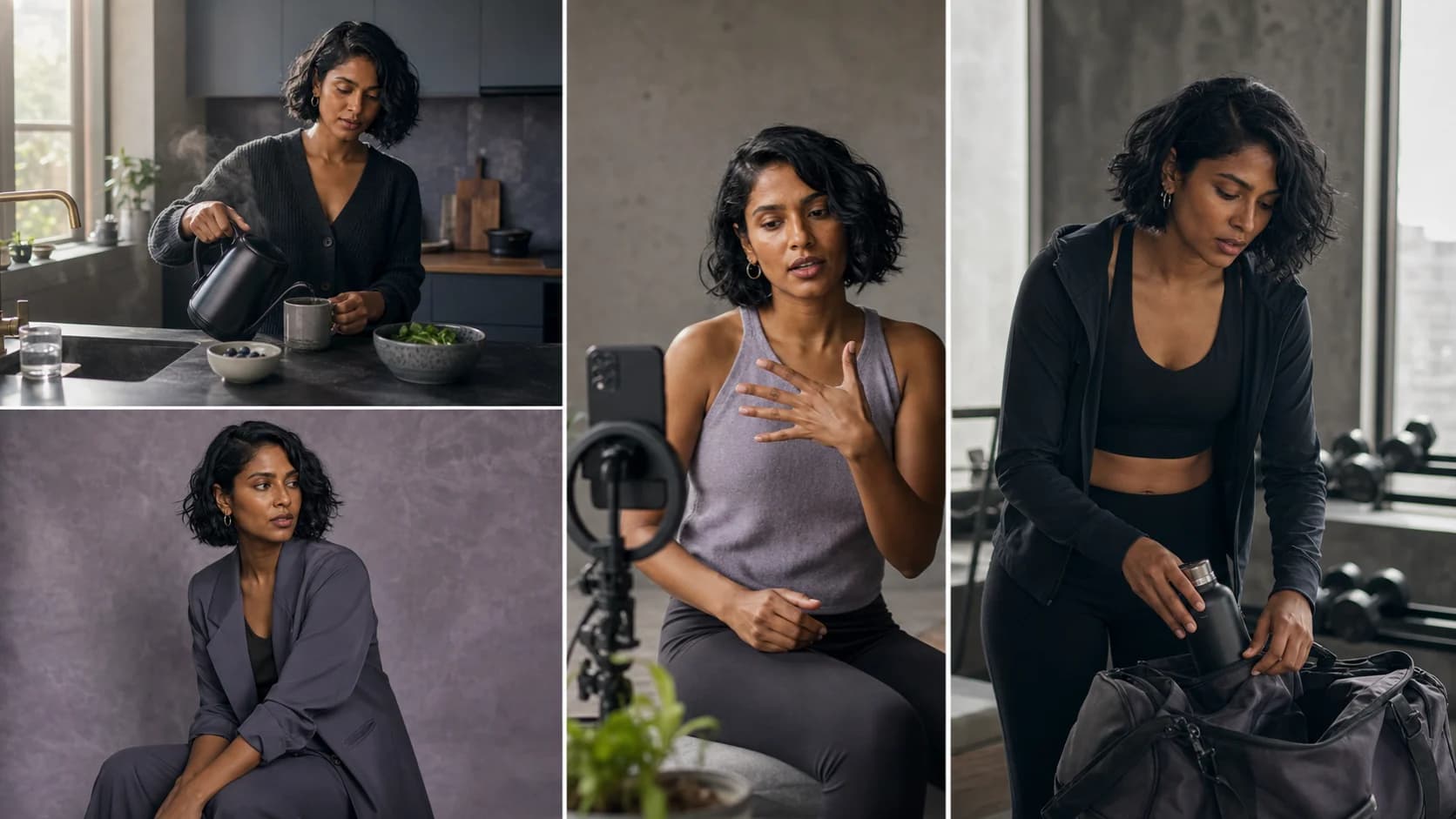
Build a content system around the persona
A strong AI influencer is not built from isolated visuals. Turn each posting theme into repeatable formats with different stories. Nova's “morning clarity” pillar might include a quiet routine photo, a three-step short-video concept, a workspace observation, and a product-in-context scene. “Future beauty” could cover visual research, materials, design ideas, and factual feature demonstrations without pretending the character has skin sensations or treatment results.
- Routine posts: a credible action in a lived-in environment.
- Point-of-view posts: one observation that fits the persona's established role.
- Tip formats: useful information reviewed by a human subject owner.
- Story moments: small fictional scenes clearly presented as part of the character world.
- Trend adaptations: a recognizable trend reshaped to fit the persona rather than copied blindly.
- Product-in-context concepts: an authorized product used coherently without invented testimony.
Captions and scripts should be written or approved outside Studio against the voice rules. Publishing, comment replies, direct messages, community management, and analytics also remain human or external-platform responsibilities.
Use a persona consistency check before publishing
- Identity: does the face, apparent adult age, hair, complexion, and signature detail still match?
- Purpose: does the post serve the persona's niche and audience promise?
- Voice: would the wording sound recognizable without the image?
- Content pillar: does the idea belong to an established theme or a deliberate new one?
- Physical reality: do hands, eye line, object contact, light, reflections, and motion make sense?
- Brand fit: is there a credible reason for this product or message to appear?
- Truth and rights: are claims sourced, inputs authorized, and disclosures ready?
- Human ownership: has a named reviewer approved the final asset and context?
If a post fails several checks, changing the caption is rarely enough. Return to the brief or regenerate the scene. A recognizable persona is protected through selection as much as generation.
Brand partnerships, disclosure, and long-term trust
Brand identity makes collaborations easier to evaluate. Ask whether the category fits Nova's audience, whether the campaign can live inside her visual world, whether the message sounds natural in her voice, and whether the product can be shown without implying a real experience that never occurred.
The FTC's influencer disclosure guidance explains that material connections should be clear and hard to miss. Platforms can add other requirements: Meta describes its approach to AI-generated media labels , while TikTok documents labels for AI-generated content . Teams should check the current rule at publication time.
Platform labels do not replace sponsorship disclosure, and a profile bio does not automatically make every realistic commercial post clear. The operator remains responsible for transparent fiction, accurate product claims, authorized inputs, brand safety, corrections, and audience treatment. Review the site's commercial-use guidance and AI influencer legal guide before commercial publication.
From persona blueprint to virtual influencer
The strongest influencer persona is not the longest document. It is the one that makes everyday decisions easier: which idea fits, how the character should look and sound, what the audience receives, which partnership belongs, and where the team must say no.
Define the identity before producing at scale. Build one small, varied test set. Keep only the outputs that preserve the character and the purpose. Then expand the same persona across relevant photos, short videos, platforms, and campaigns with human review at every handoff.
Create Your AI InfluencerFrequently asked questions
What is an influencer persona?
An influencer persona is the strategic blueprint for a creator identity. It defines the creator's personality, niche, tone of voice, visual style, audience, posting themes, and brand identity so that content decisions feel connected rather than random.
How do you create an influencer persona for an AI influencer?
Start with one audience promise, then define a small set of personality traits, a focused niche, voice rules, visual anchors, content pillars, brand-fit boundaries, and prohibited claims. Turn the brief into a fictional adult character and test it across several realistic content situations before launch.
Is an influencer persona the same as a target audience?
No. The persona describes who the creator is and how the creator behaves. The target audience describes the people the creator aims to help, entertain, or influence. The two should fit each other, but they are different parts of the strategy.
Can AI Influencer Generator guarantee perfect persona consistency?
No. AI Influencer Generator can save a reusable fictional adult character and help create consistent photos and short-video drafts, but individual outputs can still drift. Human reviewers must check identity, anatomy, styling, message, rights, and brand fit.
Can one influencer persona be reused across Instagram, TikTok, and brand campaigns?
Yes, when the stable identity and point of view stay fixed while the format changes. Instagram may emphasize editorial storytelling, TikTok may use faster motion and hooks, and a brand campaign may use approved product context. Captions, publishing, community management, and analytics remain separate human or external-tool responsibilities.
Plan Content
Measure Engagement
Build Your Profile
Price Your Work
Write Post Copy
Brand Partnerships