
Who Is Magnus Brick?
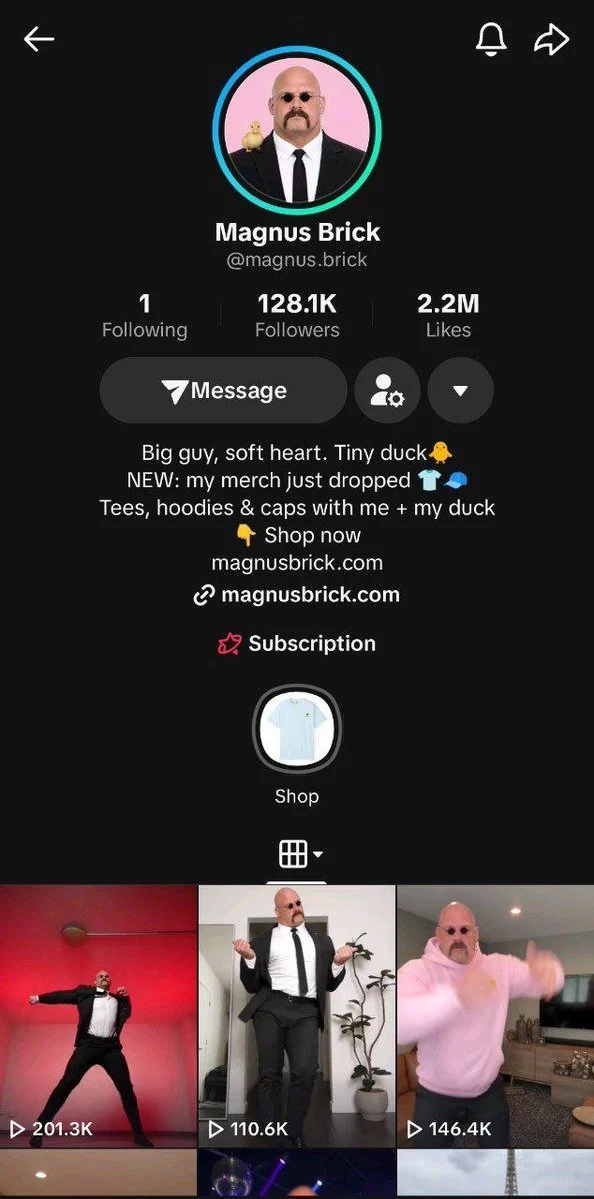
Magnus Brick is an AI-generated bodyguard persona, not a real security professional. The official About page gives him a compact personality: he guards the door, never smiles, loves dancing, and considers the duck his best friend. His TikTok bio compresses that into “Big guy, soft heart. Tiny duck.”
An October 15 X post by @reMugi3 introduced the account as a friend's AI project. It reported 128K followers, 2.2M likes, roughly 13.8M views across ten videos, and more than $100,000 earned in two weeks. That post is the starting lead for this AI influencer case study, rather than financial proof.
A character you can describe in one sentence
The bald head, oversized dark suit, horseshoe moustache and tiny sunglasses communicate toughness. The duck changes how you read that toughness: he protects something small rather than simply intimidating people.
The bio then supplies an action and a destination: watch the character, notice the recurring duo, visit the shop. Recognition, entertainment and a purchasable symbol are connected.
That connection is the useful lesson. Copying Magnus's face, duck, name or merchandise is neither necessary nor the strategy we recommend.
What the Public Numbers Actually Prove
Public counters establish reach; they do not establish income. We checked the original profile and storefront on October 15, 2026, keeping the supplied screenshot, third-party claims and current observations separate.
| Measure | Evidence | What it means |
|---|---|---|
| 128.1K followers / 2.2M likes | Visible in the supplied screenshot; the X post rounds followers to 128K. | A historical profile snapshot, not a dated growth curve. |
| 133.5K followers / 2.3M likes | Original TikTok profile, checked October 15. | A later observation. Screenshot timing is unknown, so no daily growth rate is calculated. |
| About 13.8M views / 10 videos | Reported by @reMugi3. | Not independently reconciled across the original videos; not unique viewers. |
| $100K+ / two weeks | The same third-party post. | No order ledger, payment statement, revenue mix or cost breakdown obtained. Unverified. |
| Paid products | Merchandise and dance offers on the official shop. | Offers exist. Listed prices do not show how many people bought. |
The website's own About page displayed older, cross-platform audience figures and an “Updated 13 days ago” note. Those are not comparable to a current TikTok-only counter. Browser-extension estimates were excluded from our evidence.
“Made $100K” also leaves basic accounting questions unanswered: gross sales or profit, which currency, which products, which dates, and how much was spent on fulfillment, refunds, advertising and generation? Without those answers, a verified “$100K business” headline would overstate what we know.
Why a Giant Bodyguard and a Tiny Duck Are Memorable
The duck turns an appearance into a relationship. An exaggerated bodyguard is recognizable; a bodyguard emotionally attached to a fragile companion has a story viewers can grasp before reading a caption. The following mechanisms are editorial interpretations, not measured explanations of TikTok's recommendations.
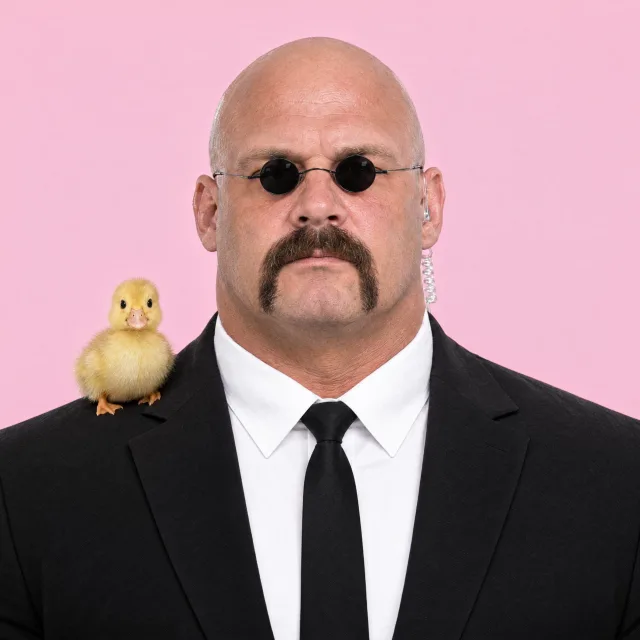
- Scale contrastA broad body and tiny companion create an immediate visual mismatch.
- Identity shorthandBald head, moustache and round shades make a compact recognition system.
- Emotional reversalA serious protector with a soft attachment gives the audience a personality to anticipate.
Keep the face serious; change the situation
Humor can come from the gap between a character's role and behavior. The official description sets up a strict doorman; dance clips violate that expectation without needing a new identity. Ordinary rooms, a gym or a playful hoodie can supply the variation while the same face and silhouette carry recognition.
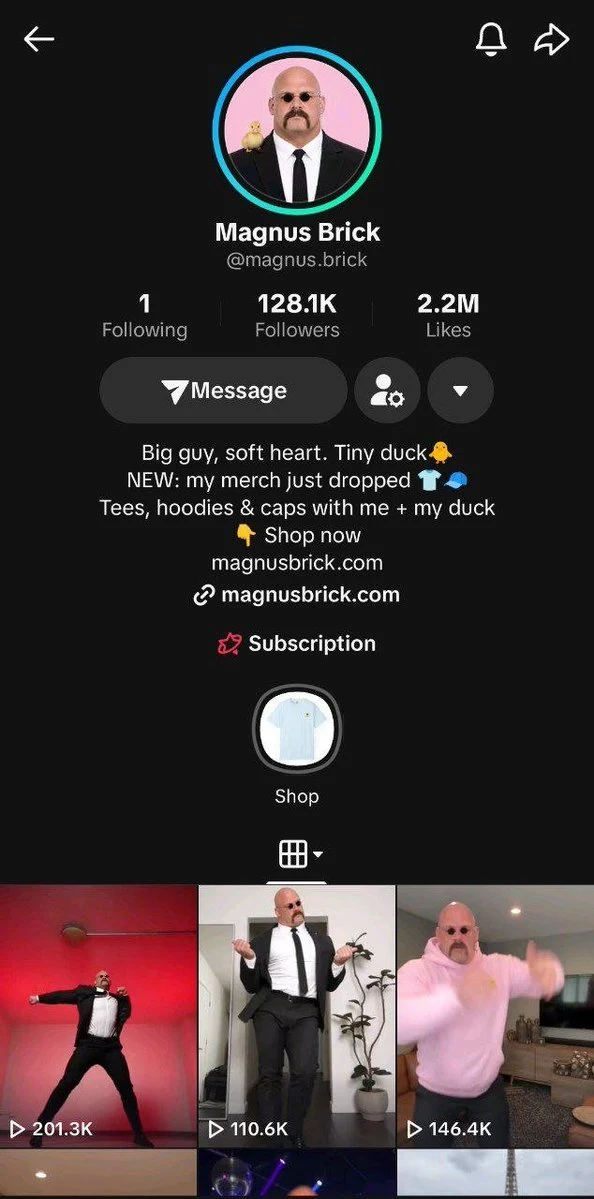
Historical video thumbnails from the supplied screenshot, shown as crops. Related original post: “Big guy dance moves”. Full original playback was unavailable during this check; thumbnails do not establish motion quality or retention.
The recurring companion can become the product
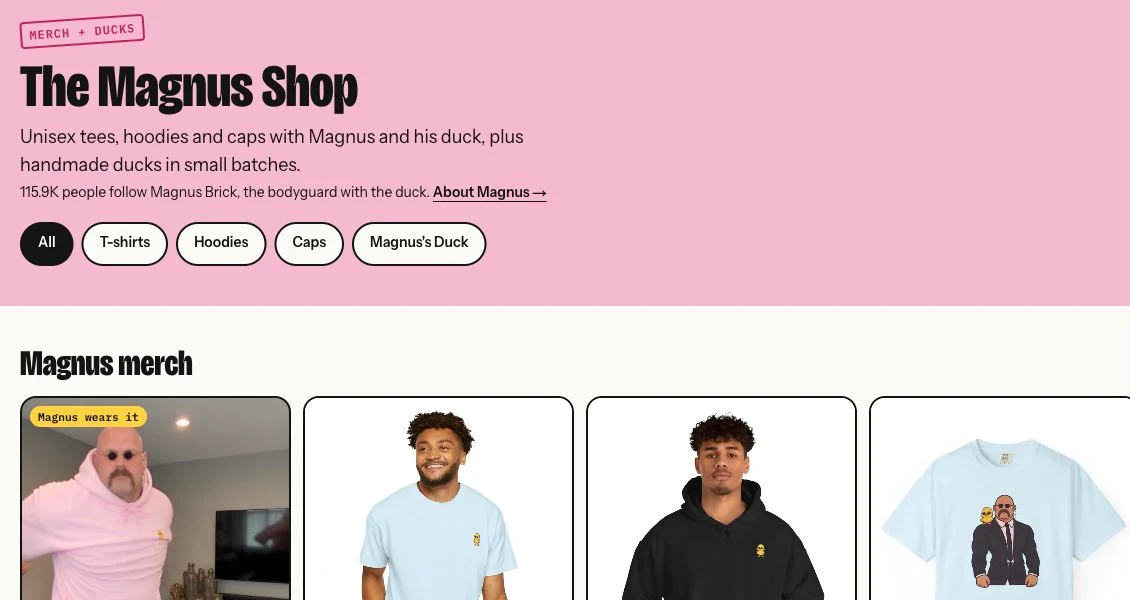
The duck is small enough to survive as an embroidered emblem. A fan can wear a duck cap without putting a large portrait on their chest. The shop's “Front: the duck. Back: Magnus” tee translates the same relationship into product design. This is a coherent audience-to-merchandise bridge, although its conversion rate is unknown.
Short videos also travel without much language: body size, a deadpan face and an unexpected dance are readable across captions. They may invite sharing or repeat viewing, but we have no retention curve, controlled hook test or traffic-source breakdown proving that mechanism caused this account's reach.
The Reported Tool Stack—and a Workflow You Can Test
The post names tools, not a reproducible production log. It credits ChatGPT and Claude for ideas, Dream AI for character images, and Higgsfield for animation, followed by testing different scenes. It does not establish the exact models, prompts, settings or number of discarded attempts.
1. Write a character rule before an image prompt
Use ChatGPT or Claude to explore a role, a contradiction and a recurring behavior. Ask for scenes that express the same personality in different situations. A useful rule for Magnus is “looks intimidating, cares deeply, dances seriously.” The one-sentence rule keeps scripts from becoming unrelated AI spectacles.
2. Approve an identity and build a Character Sheet
The post names “Dream AI” without identifying a model or version. In a practical image workflow, first approve the face, proportions, clothing and companion. Then collect front, three-quarter and full-body references in a Character Sheet. We did not obtain Magnus's actual sheet; this is our recommendation for managing continuity.
3. Separate identity from movement
A scene image establishes appearance and framing. Ordinary image-to-video can invent movement from a prompt; motion transfer uses a reference performance. Higgsfield's Motion Control documentation describes the image-plus-video approach. That confirms the capability, not the exact method used for every Magnus clip.
Use an owned or authorized dance reference, keep the full body visible, and inspect small companions separately. A shoulder duck can drift, disappear or lose believable contact when the body turns. A strong first frame does not prove an entire clip is usable.
4. Edit, review and test a single variable
Keep the identity stable while testing a location, opening pose or action. Inspect hands, feet, face and companion contact before adding captions and cleared audio. Record which versions were published and which were rejected. The post says scenes were tested, but it does not provide the account's experiment design or success rate.
How Magnus Brick Connects Attention to Revenue Opportunities
The visible business model sells participation in the character's world. Merchandise offers a symbol to wear; personal videos offer a moment featuring a name; custom dances let a customer contribute the action. None of these observations confirms the reported earnings.
| Channel | Observed offer | Evidence boundary |
|---|---|---|
| Merchandise | Detail Tee $32; Detail Hoodie $59; Duck Cap $28, in USD. | Listed products; order volume and margins unknown. |
| Personal dance | €9, choose a dance and add a name. | Advertised ordering flow; no purchase made or delivery tested. |
| Custom dance | €24.99; up to 10 seconds, advertised within 48 hours. | Seller's specifications, not our fulfillment result. |
| Duckling | €14.99 handmade duck, listed separately. | A physical extension of the companion motif. |
| Subscription | Entry visible in the supplied TikTok screenshot. | No verified tiers, members, recurring revenue or active availability. |
| Brand work | “Work with Magnus” contact on the About page. | Open for inquiries; no signed sponsorship verified. |
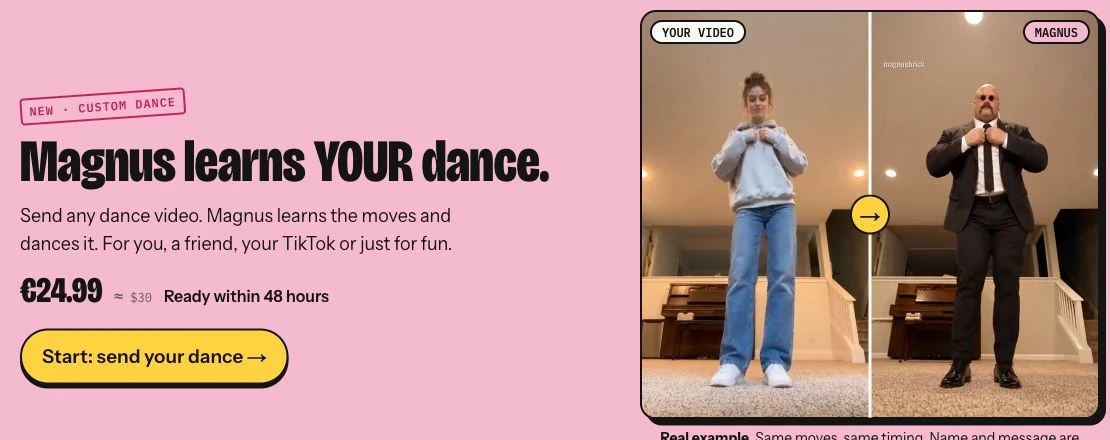
The custom offer requests one full-body dancer and says it uses up to ten seconds, with optional name/message and no music. A narrow brief makes the deliverable easier to explain and price. Its promise still requires generation, review, customer support and handling failed references.
- RecognizeBodyguard + duck
- FollowMore of the same personality
- VisitBio → official shop
- ChooseMerch or personal video
A sensible creator budget separates sales from contribution: order revenue minus production, fulfillment, payment fees, refunds and acquisition costs. A €24.99 listing tells us none of those quantities. The website also promotes a forthcoming meme coin; no token valuation or trading activity is treated here as operating revenue.
For a broader model, see how to make money with AI influencers. Start with one deliverable you can fulfill reliably before assuming several monetization channels will work.
Create Your Own Original Character in AI Influencer Generator
Copy the design principle, then change the creative ingredients. For example: an adult night-train conductor in an oxblood uniform, square silver glasses and a tiny mechanical moth clipped to the lapel, who performs meticulous ticket inspections and unexpected tap routines. This is an original written concept, not a generated or tested result.
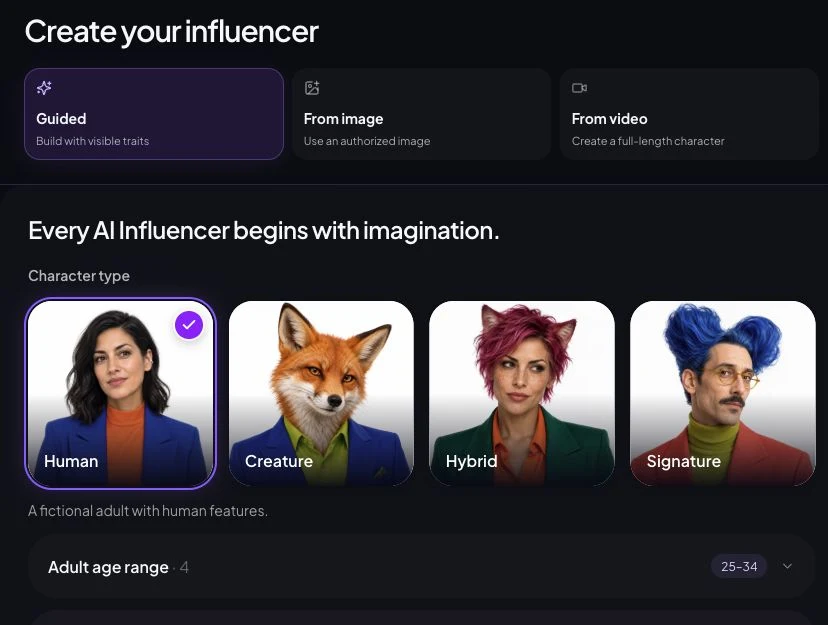
1. Create and save the identity
Open Create your influencer and use Guided, or From image with an image you are authorized to use. Set Creator Direction, audience and platform, then define the adult appearance. Approve the face and proportions before building a recurring series.
2. Reuse it with Consistent Character
In Consistent Character Photo, select the saved identity and describe a new scene. Keep the defining cues explicit while changing the setting or action. Compare supporting images with the saved Character Sheet; the feature helps reuse an identity but does not guarantee every detail will stay unchanged.
3. Choose AI Video or Motion Transfer
Use AI Video for a short action guided by your image and instructions. Use Motion & Dance → Motion Transfer when an authorized reference supplies the choreography. Select the character and reference video through the actual controls. Motion Transfer uses a built-in instruction; ordinary @ text does not attach a file.
Our Motion Control dance tutorial shows the actual workspace, models and review process. Video generation requires a paid plan; check the displayed credit quote before generating. Motion Transfer and Video Remake are separate modes.
4. Review before publishing or selling
Reject face drift, broken hands, sliding feet and an accessory that floats or changes position. Keep a small reference set of approved views instead of accepting every output. Add cleared music in your editor and use the destination platform's required AI disclosure. Build an original brand rather than suggesting affiliation with Magnus.
A Six-Video Test for the Character Strategy
Test recognition and demand before expanding production. The following is a proposed experiment for your character, not Magnus's unpublished strategy or a guaranteed route to viral reach.
| Pair | Keep fixed | Change one thing | Inspect |
|---|---|---|---|
| Videos 1–2 | Identity, action, duration | Opening pose | Early retention; whether viewers recognize the character |
| Videos 3–4 | Winning opening and persona | Location | Watch time and shares per reached viewer, where available |
| Videos 5–6 | Format and production quality | One clear offer invitation | Profile visits, tracked shop visits, orders and contribution |
Log platform, date, duration, hook, production cost and the same observation window for each post. Organic distribution is not randomized, so a better result is a clue to retest, not proof of causation. Compare with your own baseline rather than importing an arbitrary industry “viral” threshold.
Read comments for character recognition and requests, while using actual order records for demand. Likes are not customers. A small audience ordering a deliverable you can profitably fulfill can be more useful than a large view count without a clear offer.
Compare the Baki AI influencer case study for a recurring training story, Jean Phil for a signature action, and Uncle Grandpa for a character-to-offer path. Magnus adds a distinct lesson: the companion is both a storytelling relationship and a portable merchandise motif.
Magnus Brick AI Influencer FAQ
Who is Magnus Brick?
Magnus Brick is the fictional AI-generated bodyguard behind @magnus.brick on TikTok. His official website describes a serious bodyguard who loves dancing and treats the tiny duck on his shoulder as his best friend. The account is the subject of this independent case study, not an AI Influencer Generator customer testimonial.
Did Magnus Brick make $100K in two weeks?
An October 15, 2026 X post by @reMugi3 claims a friend earned more than $100,000 with Magnus Brick in two weeks. We verified advertised merchandise and paid video offers, but obtained no sales ledger, payment statement, order count or cost breakdown substantiating that claim. Revenue, cash collected and profit remain unverified.
How many followers and views does Magnus Brick have?
The supplied historical TikTok screenshot shows 128.1K followers and 2.2M likes; its capture date is unknown. The original profile displayed 133.5K followers and 2.3M likes when checked on October 15, 2026. Roughly 13.8M views across 10 videos is a claim in the X post, not an independently reconciled view total. Public counters are rounded and change.
Which AI tools were reportedly used to make Magnus Brick?
The X post attributes ideas to ChatGPT and Claude, character images to Dream AI, and animation to Higgsfield. We did not obtain the creator's prompts, model versions, Character Sheet, project files or task records. The proposed production workflow in this article is a practical reconstruction, not a verified account of every production step.
How does Magnus Brick monetize its audience?
The official site advertises merchandise, a €9 personal dance and a €24.99 custom dance. The supplied TikTok screenshot also contains a Subscription entry, and the official About page accepts brand inquiries. Listed offers and entry points do not establish completed sales, subscription income or signed sponsorships.
Can I create a similar original AI influencer?
You can test the strategy of a recognizable adult character, a contrasting personality and a recurring visual cue. Develop your own face, name, companion and story. In AI Influencer Generator, create and save an identity, reuse it for consistent photos, and choose AI Video or Motion Transfer for the action. Inspect each result; neither identity consistency nor viral reach is guaranteed.
Sources and Research Method
Checked October 15, 2026. We read the original X post in Chrome, inspected the TikTok profile and bio-linked store, and compared those observations with the supplied screenshot. We did not access private analytics, payments, creator project files or customer records. No order, subscription, contact message or generation was submitted.
- Mugi's original post: secondary reach, tool and income claims.
- @magnus.brick on TikTok: dated public profile counters.
- Supplied historical screenshot: bio, counters, thumbnails and Subscription entry.
- Official shop, personal dance, custom dance and About page: advertised offers and character description.
- Magnus Brick terms: seller's character ownership and offer conditions.
- Higgsfield Motion Control article: general capability explanation, not a Magnus production record.
Case images belong to their respective rights holders and are reproduced for this requested editorial analysis, with attribution. Magnus Brick is not presented as our customer, our output or an endorsement. Creative explanations are hypotheses; the strongest supported conclusion is that a recognizable character and coherent offers coexist, while actual commercial performance remains unknown.
Build a character people can recognize—and a promise you can keep
Start with a clear personality, a repeatable visual cue and one short content test. Save the identity, inspect the outputs and learn what your audience wants before scaling the business.
Create Your Original AI Influencer
Plan Content
Measure Engagement
Build Your Profile
Price Your Work
Write Post Copy
Brand Partnerships