

AI influencers give creators, brands, and agencies a way to build a clear digital persona without photo shoots, travel plans, or creator schedules. The goal is not just a good-looking face. It is a repeatable fictional persona with a clear look, content style, and purpose. This guide shows how to make influencer AI content that feels steady, useful, and ready for responsible brand work.
Creating an AI influencer takes more than picking an avatar and posting images. You need an identity system, visual rules, a small content flow, and ethical boundaries that help people understand what they are seeing. For the broader definition, read what an artificial intelligence influencer is; this page focuses on the practical launch workflow.
Start with a purpose, audience, and point of view
The strongest AI personas start with strategy. Before opening a creation tool, decide why the influencer exists. Are they a fictional wellness host, a streetwear editor, a travel-style guide, a software educator, or a brand-owned creative character? A clear purpose shapes the wardrobe, settings, visual mood, and the content the character can credibly make.
Write one sentence that answers three questions: who is this for, what does the character help them notice or do, and what will the character never pretend to know? That boundary prevents a virtual persona from becoming a generic collection of faces and posts.
Build a character brief before creating assets
A believable influencer has traits people can spot again and again. That does not mean every post should look identical. It means viewers should recognize the same person across photos and short videos while the story, environment, and action change.
Identity anchors
Apparent adult age, face, hair, proportions, signature accessories, and baseline style.
Content role
Niche, audience job, point of view, useful topics, and topics that remain out of scope.
Visual rules
Settings, lighting, wardrobe logic, camera behavior, and the quality bar for hands and object contact.
Use a fictional adult persona when possible. If you begin from a real person’s image or video, use only material you own or are authorized to use, and document consent and usage rights before publication.
Create Your AI InfluencerLock identity before expanding into new scenes
Once the brief is ready, create and save one approved character. In Studio, a guided character can become a reusable starting point for new images, and an authorized source image can begin a private reusable character workflow. Do not promote every output into a reference: check the face, hairstyle, apparent age, body proportions, lighting, hands, and contextual fit first.
Keep a small internal record of the approved identity anchors and the reasons an asset was accepted or rejected. The record can be simple, but it helps a later campaign preserve continuity instead of drifting toward random variations.
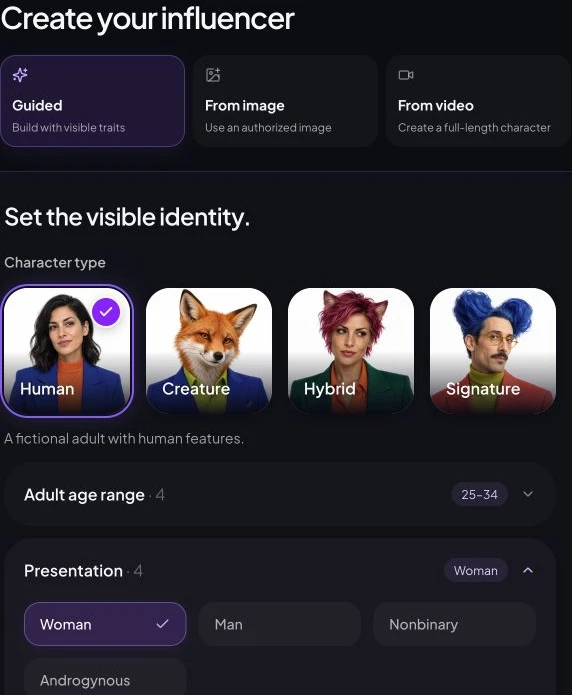
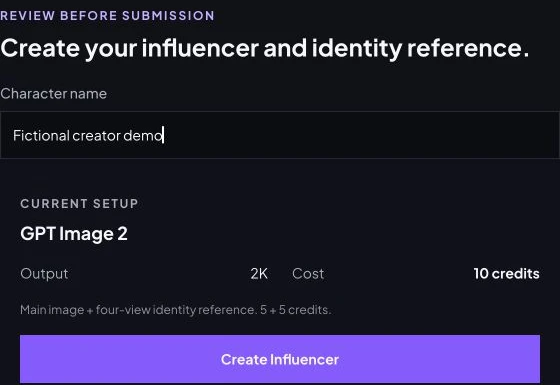
Current October 9 preparation: open Character Builder, choose Guided, define an original adult identity, then review the main-image and identity-reference stages. The current complete quote is 10 site credits. These real screenshots are unsubmitted controls, not proof of a finished character or launch.
Make a small first batch of photos and short videos
For still images, describe the character, wardrobe, purposeful action, location, lighting, camera position, and mood. Generate a small set of clearly different scenes rather than repeating one pose. A saved character can then move into consistent photos and short-form video concepts without changing the identity anchors.
Review every asset for visual quality and truthful context. Reject merged fingers, implausible product contact, repeated backgrounds, generic poses, accidental logos, malformed text, or anything that could be mistaken for a customer result or real social proof.
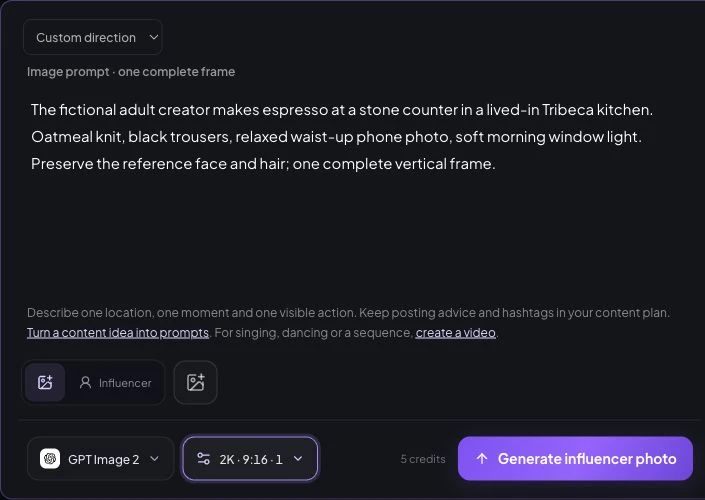
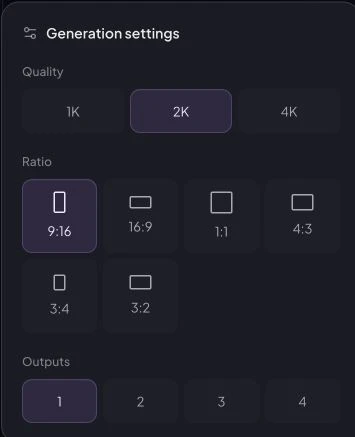
In Create Photos, choose the saved character, add one scene in Direction, then select GPT Image 2. In Generation settings use 2K, 9:16 and one output for a 5-site-credit first attempt. The espresso-form example below was not submitted. Compare the complete output with the saved reference before downloading from History.
For a traceable July identity-to-scene-and-motion chain, inspect the NYC archive with original prompts and settings. It is not a launched creator account, an engagement test or a monetization result. Customer charges and retries remain unknown.
Choose content pillars and reusable formats
One AI influencer can support several content types, but it needs a repeatable system. Content pillars give the persona a consistent reason to appear. A fictional lifestyle creator might document routines, explain a creative process, and share a seasonal story. A software-oriented character might focus on feature education and workflow ideas without pretending to be an independent customer.
- One useful education format that gives the audience a clear takeaway.
- One creator-perspective format that makes the character’s visual world memorable.
- One campaign or interaction format with an appropriate, transparent call to action.
Templates help you test one variable at a time. Reuse a clear structure—such as a short educational sequence or a seasonal visual story—while changing the hook, setting, and audience question. Do not turn a template into a fake review, before-and-after claim, or fabricated result.
Create Your AI InfluencerReview for quality, disclosure, and brand safety
AI influencer content can be creative and efficient, but it should not mislead. Be clear when a synthetic persona could reasonably be taken for a real person with real lived experience or independent opinions. Use extra care in health, finance, politics, children’s content, legal topics, and personal-change claims.
For U.S.-facing paid endorsements, use the FTC’s disclosure guidance. Teams managing generative-media risk can also use the NIST AI Risk Management Framework and the C2PA Content Credentials standard as primary references.
Publish, measure, and improve the system
Once the first batch is live, treat the persona like any other content channel. Track which stories earn useful comments, saves, qualified clicks, or clear audience questions. Views and likes can be signals, but they do not prove that a character has earned trust or that a commercial claim is working.
Improve the creative system based on evidence: update a content pillar, retire a weak visual convention, or refine a call to action. Keep the identity anchors stable while you learn what role the character can actually play for an audience.
A lean first launch plan
Write a one-page persona brief
Define the role, audience, content boundaries, adult identity anchors, and three visual rules.
Save one approved character
Use that character as the starting point for consistent scene variations.
Pick two or three content pillars
Choose formats the persona can sustain without inventing personal stories or results.
Produce a small balanced batch
Create original photos and short-form concepts with different scenes and purposeful actions.
Check every asset before publishing
Review identity, anatomy, claims, disclosure, context, and brand fit.
Publish with a clear next step
Use channel-appropriate context and a destination that matches the audience need.
Measure useful audience signals
Record feedback that helps you decide what to keep, change, or stop.
Improve deliberately
Expand only after the character, content system, and trust boundaries are working together.
For a broader build tutorial, continue with How to Create an AI Influencer. For channel and commercial planning, see the AI influencer Instagram account guide and our AI influencer monetization case study.
Create Your AI InfluencerFrequently asked questions
What is the first step when you make an AI influencer?
Start with a short persona brief. Define the audience, role, niche, adult identity anchors, point of view, visual rules, content pillars, and boundaries before creating any images or videos.
How can an AI influencer stay visually consistent?
Save an approved reusable character, then keep its face, hair, proportions, signature styling, and apparent adult age stable while changing scenes, outfits, poses, and story angles. Review every new asset before it becomes a reference.
Can an AI influencer be used in commercial campaigns?
A fictional creator can support brand-owned creative campaigns when the role, claims, licensing, and disclosure are reviewed for the specific market. It should not imply a real customer experience, independent endorsement, or unsupported result.
What is a lean way to launch an AI influencer?
Create one clear persona, two or three content pillars, and a small first batch of original photos and short videos. Publish with transparent context where needed, collect useful audience feedback, then improve the creative system before expanding it.
Plan Content
Measure Engagement
Build Your Profile
Price Your Work
Write Post Copy
Brand Partnerships