
To connect tool choice with sponsorships, subscriptions, platform programs and operating costs, read can AI influencers make money and what tools are required?
Once you have chosen a tool, follow the from-scratch AI influencer tutorial for character setup, consistent photos, video and final review.
Choosing your first tool? Our beginner comparison of setup, presets and trial costs focuses on getting started, with separately dated official sources and verification limits. If identity reuse is the deciding factor, compare the mechanisms in our consistent character tools guide.
The best AI influencer generator is not the one with the flashiest single image. It is the one that can keep a chosen character recognizable while you make the exact kind of content your account needs: stills, short motion, talking video, product-led clips, or a repeatable mix of formats. That is a workflow decision, not a beauty contest.
This guide compares eight commonly short-listed platforms. Choose the system that fits your identity, outputs, review process, and budget—not a universal “winner.”
Quick answer: start with the job, then test consistency
For a fictional creator you want to use across several content formats, prioritize a saved-character workflow and test the same person in at least five meaningfully different scenes. For a real founder or presenter who needs more on-camera output, a digital-clone product can be a better fit than a synthetic-persona studio. For a fashion-heavy image account, controllable posing and composition can matter more than a large template library. For a video-first feed, evaluate whether the platform can carry the character from a strong still into motion without losing the identity.
AI Influencer Generator is the strongest fit when your process begins with a reusable fictional adult character and continues into focused image, influencer-video, UGC, dance, motion, and talking-video tasks in one Studio. RYLA and MakeInfluencers are dedicated no-code alternatives to review when a guided all-in-one persona workflow is the priority. Higgsfield is a relevant comparison for creators who put cinematic motion and visual direction first. RenderNet is relevant when precise still-image control is the critical bottleneck. Argil is a different fit: it is principally useful for a real person who wants to scale a digital version of their own presence.
Build a consistent AI influencerWhat counts as an AI influencer generator?
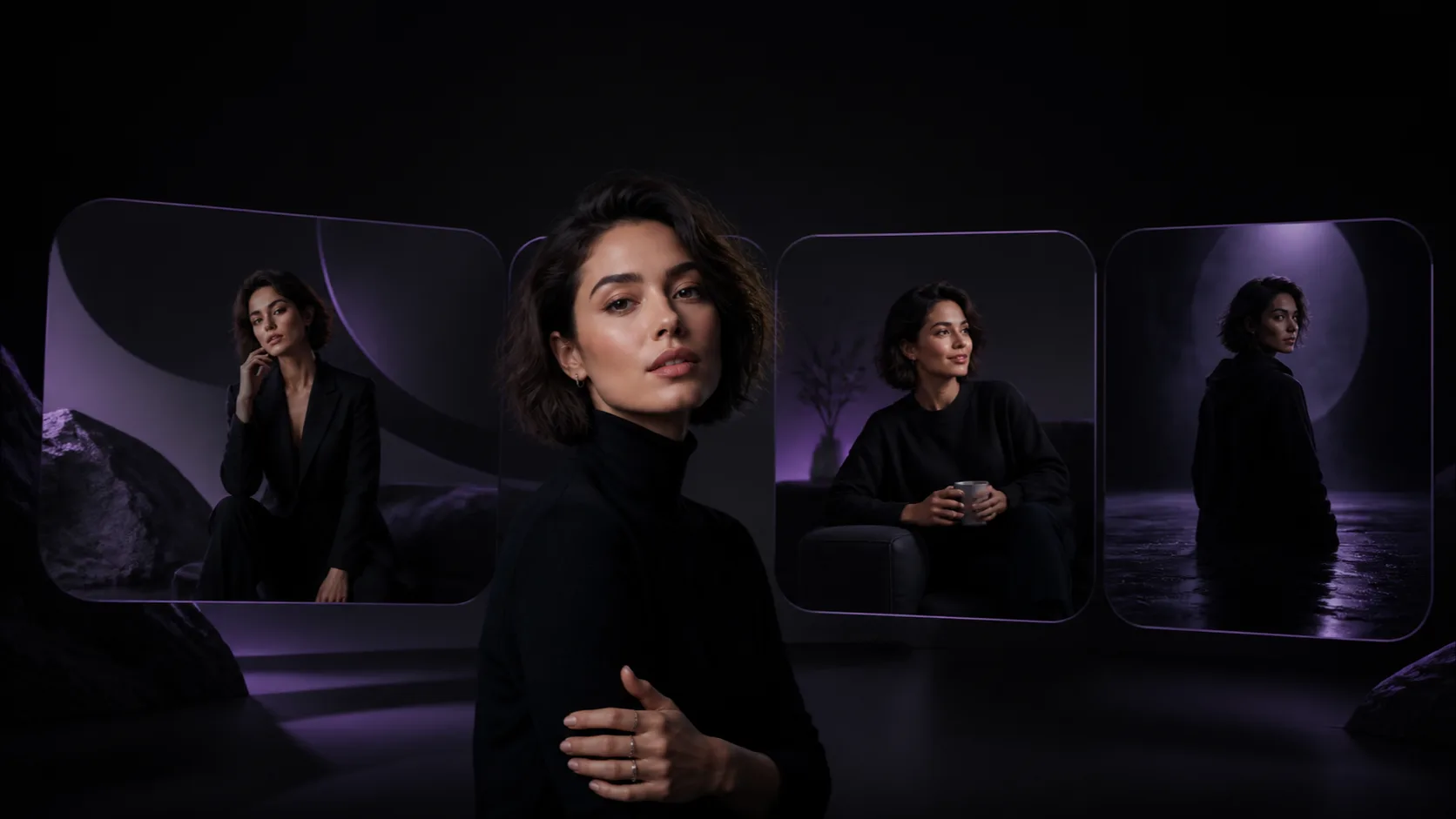
An AI influencer generator creates or maintains a recognizable digital persona for recurring social content. A single convincing portrait is not enough. The character has to remain recognizable when the outfit, location, angle, crop, expression, and content format change. That is why identity continuity, not a one-off image demo, is the most useful buying criterion.
The category is often blurred with adjacent products. A talking-avatar tool can turn a script into a presenter-led video, but it may not provide a flexible fictional character for lifestyle images. A UGC ad generator can make fast product ads, but it may rely on stock actors rather than an identity you control. An influencer marketing platform can help discover and manage real creators, but it does not produce your virtual character. All are useful in the right workflow; none is automatically a substitute for the others.
Use a generator when the business need is an owned, clearly disclosed virtual host, a recurring social character, a digital fashion or lifestyle concept, or creative exploration that requires the same person across a small content series. Use a creator-discovery or campaign-management product when the actual need is to hire, contract, measure, or report on human influencers. The distinction keeps procurement, content claims, and disclosure responsibilities much clearer.

How we compared the tools
We used six buyer-facing questions. First, can the product preserve a recognizable identity across more than one generation? Second, does it support the image and video formats the account actually needs? Third, how much setup and prompting does the workflow demand? Fourth, is the product designed for a fictional persona, a real-person clone, or a different job entirely? Fifth, can a buyer understand the pricing model and likely output limits? Finally, does the company publish a usable policy, terms, or rights explanation for commercial work?
These questions deliberately do not produce a universal numerical score. Public feature pages do not prove that one platform’s output will look better than another in your exact niche, and unrepeatable star ratings create false confidence. Instead, each recommendation states a practical fit, the documented capability worth checking, and the limitation that should make you pause before buying.
AI influencer generator comparison at a glance
| Platform | Best fit | Primary workflow | Public pricing snapshot | Important boundary |
|---|---|---|---|---|
| AI Influencer Generator | Reusable fictional character across focused Studio tasks | Character to images, short video, UGC, motion, dance, or talking content | See current plans | Not a human-creator discovery or campaign CRM |
| RYLA | Guided, no-code virtual persona workflow | Character, social images, and video in one environment | Check official pricing | Verify the exact character and video limits in your plan |
| TheInfluencer.ai | Recurring lifestyle content for a virtual persona | Persona-led social image and video creation | Not publicly listed in the page reviewed | Confirm rights, export, and current video allowance directly |
| MakeInfluencers | Template and motion-led account production | Character variations, photos, and motion cloning | From $39/month on its public guide | Motion-reference rights remain the creator’s responsibility |
| Fizzly | Multi-format creator control and character training | Character training, images, and short video | From $23/month annual pricing shown publicly | Evaluate credit use for your actual video mix |
| Higgsfield | Cinematic social-video direction | Visual style, camera language, and video-first production | Check official pricing | Assess identity continuity before committing to a series |
| RenderNet | Still-image identity and pose control | Controlled images, then optional motion elsewhere | $24/month shown at its current pricing redirect | Confirm current branding, video needs, and export rights |
| Argil | A real creator’s digital clone | Script to creator-led short video | Plans load in-app; verify directly before purchase | Not the same task as creating a fictional influencer |
Pricing checked August 15, 2026. “Not publicly listed” means an exact starting price was not visible in the public source reviewed; it does not mean a product has no paid plan.
Eight platforms, matched to the job
1. AI Influencer Generator — for an owned character that moves between creative tasks
AI Influencer Generator is built around a reusable character direction rather than a single export. Start with guided character creation or an authorized adult reference, then use the saved identity for focused image and video jobs. The point is not to make a character look identical in every frame; it is to keep the underlying person recognizable while allowing the composition, outfit, setting, and action to fit the content brief.
That is useful for a virtual product educator, a recurring fashion or lifestyle concept, a fictional social host, or a campaign character that needs both stills and short motion. It also gives a team a more intentional handoff: choose the right Studio task for an image, influencer video, UGC-style scene, dance reference, motion transfer, or talking content instead of forcing every idea into one generic generator. See the consistent character, AI influencer image, AI influencer video, and AI UGC video workflows.
The boundary is equally important: this is not a marketplace for hiring human creators, a contract-management system, or an audience-analytics product. A buyer still needs authorization, factual product inputs, human review, and a separate publishing process. That clarity makes it a stronger fit for owned creative than for an end-to-end influencer-marketing operation.
2. RYLA — for a guided virtual-influencer workflow
RYLA positions its product around building a consistent persona and creating social-oriented images and video without a complex technical setup. Its public comparison guidance puts face consistency, image and video range, ease of use, output quality, cost per asset, and content policy at the center of the buying decision. Those are sensible questions for any buyer, even when the answer will differ by content style and input quality.
Consider it when the priority is a single, guided workspace for a virtual persona and a team wants to get to a repeatable content process quickly. During a trial, ask for a character to appear in a close-up, a full-body scene, a lifestyle setting, an outfit change, and a short video. If the identity becomes ambiguous in the tests that matter to your account, a polished landing-page demo should not decide the purchase.
RYLA is not a substitute for a marketing CRM, disclosure review, or a clear account strategy. Before relying on its pricing, verify the latest character, credit, and video limits at its official pricing page .
3. TheInfluencer.ai — for recurring social lifestyle content
TheInfluencer.ai is relevant to buyers looking for a purpose-built virtual-influencer experience rather than a broad design suite. Its category fit is recurring persona-led lifestyle content: a social account needs recognizable visual identity, a stable aesthetic, and enough scene variation that the feed does not read like a folder of near-duplicates.
This is a sensible option to evaluate if your goal is a consistent fictional creator for organic social posts, especially when the account starts with images. The most important questions are operational: how many usable variations can you produce from a chosen identity, what happens when you need a different crop or action, how much video is actually included, and what rights or restrictions apply to generated work?
An exact entry price was not visible in the public source reviewed for this guide. That makes an informed pre-purchase conversation more important, not less. Ask for the live pricing page, current commercial-use terms, image-to-video limits, deletion process for uploads, and whether the persona can be exported or remains inside the product.
4. MakeInfluencers — for templates, variations, and motion-led social production
MakeInfluencers is a dedicated AI influencer product with a public feature set oriented around character creation, visual variations, photos, videos, slideshows, and motion cloning. That combination can be attractive to someone who wants a guided content pipeline rather than separate tools for each output type. Its published comparison material lists a $39 monthly starting tier, which should be reconfirmed before checkout.
The strongest use case is a creator or small team that wants to turn one character into a sequence of social formats and has a lawful workflow for every source video or template reference. Trend-led motion can be useful, but it is also where provenance matters most. Do not upload a video you do not have permission to use, and do not present a synthetic performance as a real person’s action or endorsement.
Before selecting it, check whether the process supports your required character type, desired aspect ratios, amount of motion control, and content review. A pre-made template is a starting point for a brief; it is not a substitute for a character voice, product truth, or an editorial point of view.
5. Fizzly — for creator control across character training, images, and video
Fizzly presents a broad creative workflow with character training, images, video, editing, and credit-based usage. Its public pricing page lists a creator tier from $23 per month when billed yearly, along with credit allowances and separate ranges for image, video, training, and editing work. That makes it easier than many competitors to see why an inexpensive monthly entry price can still produce different total costs for an image-only creator and a video-heavy account.
It is worth considering when you want to choose among different image and video approaches while keeping character work in the same general environment. The trade-off is that more choice creates more responsibility: a buyer needs to understand which settings preserve identity, how credits are consumed by retries, and when an image should become motion rather than simply being regenerated.
Use the public pricing breakdown as a planning input, then run a small fixed-budget test. Generate the same character in several scenarios, record the usable-output rate, and include rejected generations in your true cost calculation. A list price without that test is not a reliable production forecast.
6. Higgsfield — for visual direction when motion is the main creative constraint
Higgsfield is a relevant comparison for creators whose account depends on cinematic motion, camera language, stylized visual direction, and short-form video energy. It can be attractive when the usual problem is not “how do I produce another portrait?” but “how do I make this character-led clip feel intentionally directed rather than static?”
That strength has a practical boundary. A video-first product is not automatically the best system for maintaining one persona over a long stream of very different scenes. Evaluate it with the same identity test used for any platform: consistent face, full-body proportion, hairstyle, wardrobe logic, and visual continuity across the formats you will publish. Also review what happens when a character is partially obscured, turns away from the camera, or needs to interact with a real product.
Its public pricing page did not expose an exact plan amount in the accessible markup reviewed for this article. Confirm the current credit model, commercial terms, and output caps directly before judging it against an image-first subscription.
7. RenderNet — for deliberate still-image identity and pose control
RenderNet belongs in this comparison because a virtual influencer account often begins with dependable stills. The product is associated with controllable character and pose-oriented image work, which is valuable when fashion framing, body position, shot direction, and a stable recognizable face are more important than instant talking video.
When checked for this guide, RenderNet’s public pricing route redirected to Affogato and showed a $24 monthly standard plan with a credit model. That is a signal to verify the live product branding, terms, and plan scope before buying. It is not a reason to assume the product has the same role as every platform in this list.
Choose an image-control workflow when your content plan needs strong hero stills, editorial poses, product scenes, or a consistent fashion character. Pair it with a separate, authorized video workflow only after the opening image has passed review. Trying to use an image-first tool as a full social-video pipeline can create unnecessary handoffs and inconsistent results.
8. Argil — for scaling a real creator’s on-camera presence
Argil is included because buyers often compare a personal clone with a fictional influencer generator, but the jobs are different. Argil focuses on creating a digital version of a real person from authorized source footage and turning scripts into short-form content. That can be valuable for a founder, educator, expert, or creator whose own identity and voice are central to audience trust.
It is a poor fit if the plan is to invent an entirely fictional social persona, build image-first fashion content, or maintain a character that has no real-world source person. In those cases, a character studio or controlled image workflow makes the decision structure clearer. For a real clone, however, authorization, likeness permissions, voice permissions, claims, and audience disclosure should be treated as first-order requirements rather than post-production cleanup.
Argil’s public pricing page loaded plan selection dynamically when checked for this guide, so this article does not publish an unverified figure. Verify the current credit tier, output minutes, and commercial-use terms with the live product before a team relies on it for a content calendar.
How to choose by use case
Before comparing vendors, use our guide to the features to evaluate before choosing an AI influencer generator to test identity consistency, output controls, review effort, and usable-asset cost.
You are building a fictional, recurring social personality
Start with AI Influencer Generator, RYLA, TheInfluencer.ai, or MakeInfluencers. The decisive question is whether the identity remains recognizable across the full set of scenes you need, not whether the initial portrait is attractive. Ask for a workflow that lets you preserve an approved character direction while producing distinct content rather than repeating a template.
You need a virtual fashion or lifestyle model with controlled stills
Prioritize character continuity, composition, and pose control. RenderNet and image-first workflows may be better starting points than a talking-avatar product. Build a small approved shot list first: close portrait, half-body, full body, seated lifestyle scene, and product interaction. Once those stills hold together, add video only where motion supports a real editorial goal.
Your content calendar is video-first
Evaluate AI Influencer Generator’s focused video tasks, Higgsfield’s direction-led workflow, and dedicated persona platforms with video capability. Test the same identity in a simple action, a turn toward camera, a product-adjacent moment, and a spoken or silent format. The goal is not maximum movement. It is readable motion that leaves the person, setting, and message clear at feed size.
You want a digital version of yourself
Start with Argil or another authorized real-person avatar workflow, not a fictional-influencer tool. Your source footage, voice, permission trail, and disclosures are part of the product input. A clone should never make an unverified claim, simulate a customer experience, or create confusion about whether a real person actually recorded the moment.
You actually need to hire human creators
Use an influencer-marketing platform, not the products ranked here. Discovery, contracting, affiliate tracking, audience analysis, and campaign reporting are different jobs. For that broader workflow, see AI Influencer Marketing Tools for Campaign Teams in 2026.
Cost, consistency, and review are where the decision becomes real
A subscription price is only the beginning. The real monthly cost includes the number of rejected generations, video retries, extra credits for longer motion, exports in multiple aspect ratios, character training or setup, and the human time required to review every result. A platform that produces fewer outputs but more usable ones can be less expensive than a cheap plan that creates a large reject pile.
Identity consistency is the other hidden cost. A virtual influencer only becomes useful when an audience can recognize the character over time. Test the same identity in five scenes before committing: a close portrait, a full-body look, a different location, an alternate expression, and a short video. If the face, age impression, body proportions, hair, or key visual signals drift so far that the account feels like several different people, the tool does not fit your workflow yet.
- Use an authorized adult reference or a fictional character you control; do not create a lookalike of a real person without permission.
- Write one brief for the character’s stable traits, visual point of view, and content boundaries before generating a large batch.
- Review hands, teeth, text, product contact, apparent age, brand claims, and audio at the final crop—not only in a large preview.
- Count failed attempts and review time when comparing cost per usable image or clip.
- Keep a small provenance record for the source, prompt direction, approval status, and published version of a high-stakes asset.
Use the smallest test that answers the purchase question. A five-scene image test plus two simple videos will tell you more than a week of unconstrained experimentation. It also makes it easier to compare two products fairly because the brief, character, review rule, and output count remain stable.
Tools people often confuse with AI influencer generators
HeyGen and Synthesia are commonly relevant when you need a presenter or an authorized avatar to deliver a script. They are not necessarily designed to run a long-lived fictional social character across lifestyle images, trend formats, and multiple visual tasks. Creatify and Arcads are more naturally evaluated as ad-creative or UGC-video products. They may be excellent for performance creative, while still being the wrong answer to “how do I build one owned persona over time?”
Likewise, platforms such as CreatorIQ, GRIN, Modash, HypeAuditor, and Influencity support human-influencer discovery, operations, or measurement. They should sit beside a virtual-creator production system when a brand runs both owned synthetic content and real creator partnerships. Calling all of these products “AI influencer platforms” obscures the buyer’s actual workflow.
Rights, labels, and disclosure are part of the workflow
Tool choice does not transfer responsibility for a likeness, a voice, a product claim, or a paid endorsement. Use only references you are authorized to use. Keep fictional characters clearly separate from real customers and employees. Never create a synthetic review, testimonial, or personal product experience and present it as documentary evidence. If a campaign includes a paid or affiliate relationship, disclose that connection clearly where people will see it.
For U.S.-facing sponsorship content, the FTC’s influencer disclosure guidance explains that material connections should be clear and hard to miss. Separately, the TikTok AI-generated content policy requires labels for realistic AI-generated images, audio, and video in its covered cases. A platform AI label and an advertising disclosure solve different problems; use both where they apply.
For copyright and digital-replica questions, review the U.S. Copyright Office’s AI initiative and obtain legal advice for your jurisdiction and use case. This guide is a product-comparison resource, not legal advice. The safest production system has a clear source record, a human approval step, and a documented rule for when a post needs a label or sponsorship disclosure.
Frequently asked questions
What is the best AI influencer generator in 2026?
There is no honest universal winner. Choose a character-led creation workspace for a fictional recurring persona, an image-control product for fashion and stills, a video-first product for directed motion, or a clone product for your own authorized likeness. Test the same character across five required scenes before choosing.
Can an AI influencer generator create both images and video?
Some can, but the range and quality of those workflows differ. Confirm whether the product preserves your character between stills and video, which formats are included, how credits are used, and whether the results are suitable for your actual social crop and review process.
How should I compare pricing fairly?
Compare cost per approved asset, not only a monthly headline price. Include setup, character training, rejected generations, video seconds, retries, exports, and the human time spent reviewing. Check every price against the official page immediately before purchase.
Are AI influencer generators the same as AI avatar tools?
No. Avatar products often focus on a presenter reading a script. AI influencer generators are intended to maintain a persona across recurring social content. There can be overlap, but the input, output, and evaluation criteria are different.
Do I need to disclose an AI influencer?
Requirements depend on the platform, market, realism of the media, and commercial context. Follow platform AI-label requirements, make paid relationships clear, and do not imply that a fictional person is a real customer or expert. Obtain legal advice for decisions with meaningful risk.
Start with a character you have the right to use, create one small set of reviewable assets, then continue into the AI Influencer Video Generator when your plan needs a real movement or video brief.