
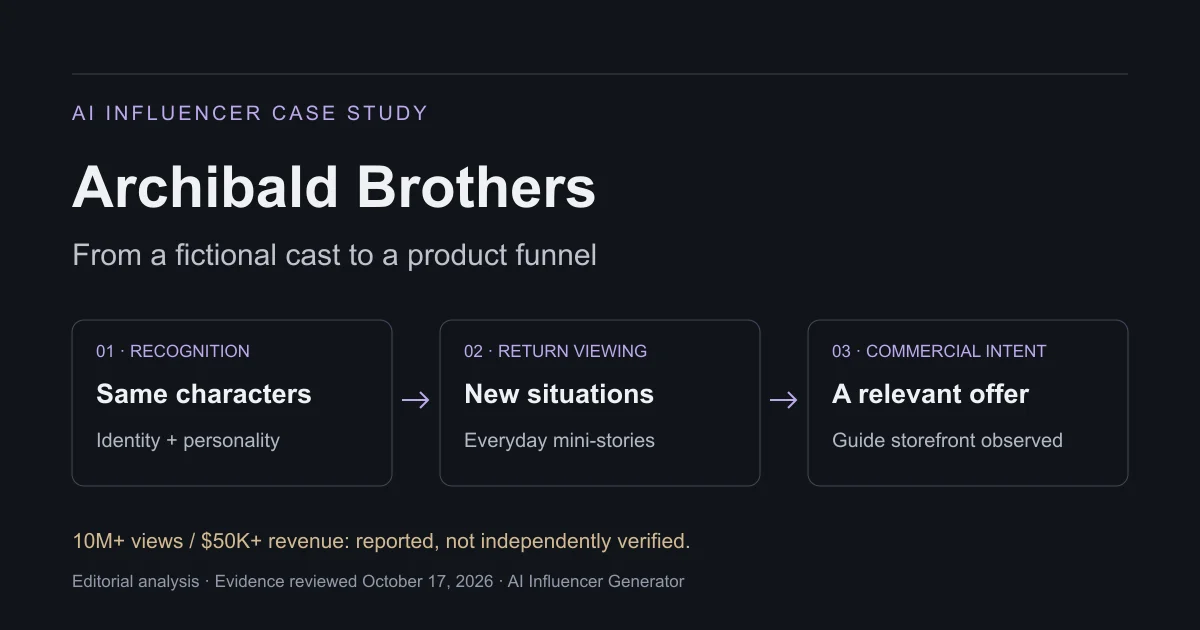
Archibald Brothers: what is verified, reported and unknown?
The October 15, 2026 X post by ALEXYZ (@Alexvx_nft), published at 18:33 UTC, describes a fictional couple going on a cake-shop date. It reports 6K+ followers across 36 posts, says Alter Studio claims 10M views, and describes more than $50K as “reportedly” generated. We reviewed the post, attached media and linked storefront on October 17.
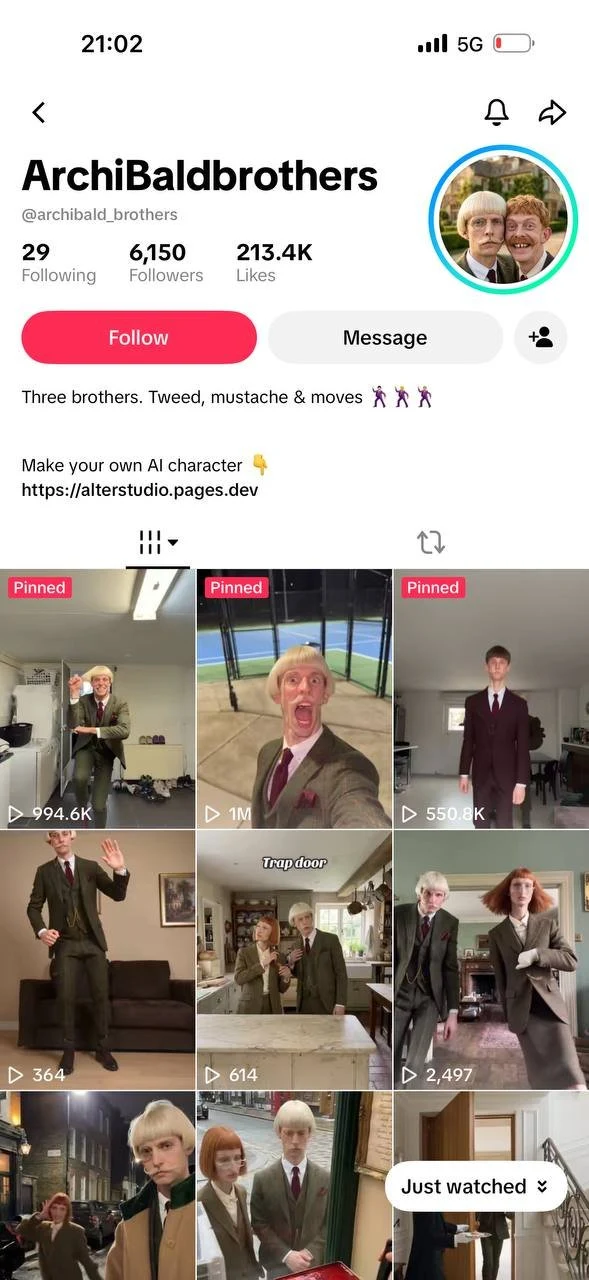
The account is a recurring cast, not a confirmed couple-only project. The screenshot reads “ArchiBaldbrothers,” handle @archibald_brothers, and “Three brothers. Tweed, mustache & moves.” The X author frames the attached episode as a couple's date. That does not establish every character's relationship, gender or role in a canonical story. We use AI influencer couple for the two-person story format, while preserving the account's own description.
| Claim | What we observed | Evidence limit |
|---|---|---|
| 6,150 followers | Visible in attached TikTok profile screenshot | Capture date unknown; direct TikTok check did not yield a usable live profile |
| 213.4K likes | Visible account-level Likes counter | Not the cake-shop clip’s likes and not a sales count |
| 36 posts | Reported by the X author | Complete dated post inventory not independently established |
| 10M+ views | X author attributes this to Alter Studio | Linked page displayed 2M when checked; scope and dates not reconciled |
| $50K+ income | Reported by the X author, without transaction evidence | Period, currency basis, attribution, gross/net and profit unknown |
| Alter Studio offer | Bio names alterstudio.pages.dev; live page sells guides | A public offer and checkout links do not prove completed sales |
The X post's wording associates the fiction with 213K likes. The attached evidence places 213.4K at profile level. Likewise, a product page, audience total and income claim cannot be combined into a verified conversion rate without aligned dates and sales records.
The live Alter Studio landing page displayed 2M total TikTok views, approximately 3,000 followers, and “first earnings from the affiliate program of the tool we use.” It did not disclose an amount in the reviewed page. These could reflect different periods or scopes; they do not corroborate 10M or $50K. The bio-to-domain connection supports the advertised funnel, but does not independently establish who legally owns the TikTok account. There is no evidence that our product made its videos.
Watch the complete cake-shop video
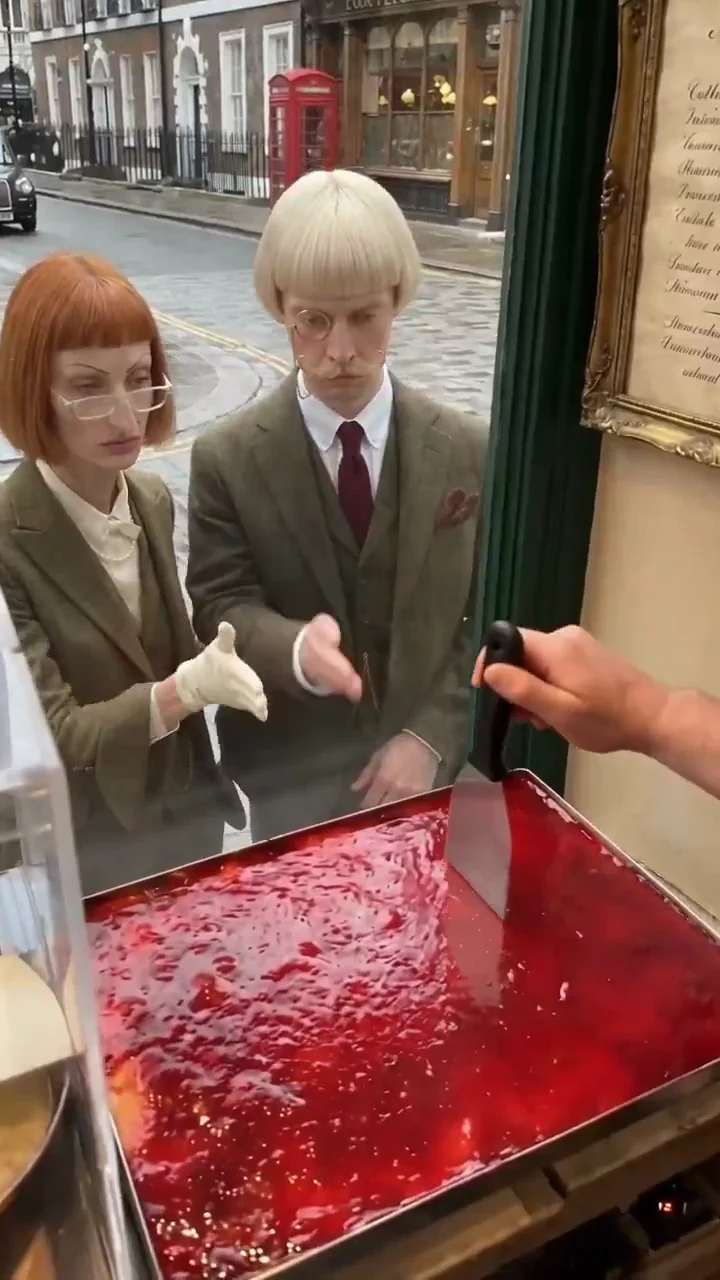
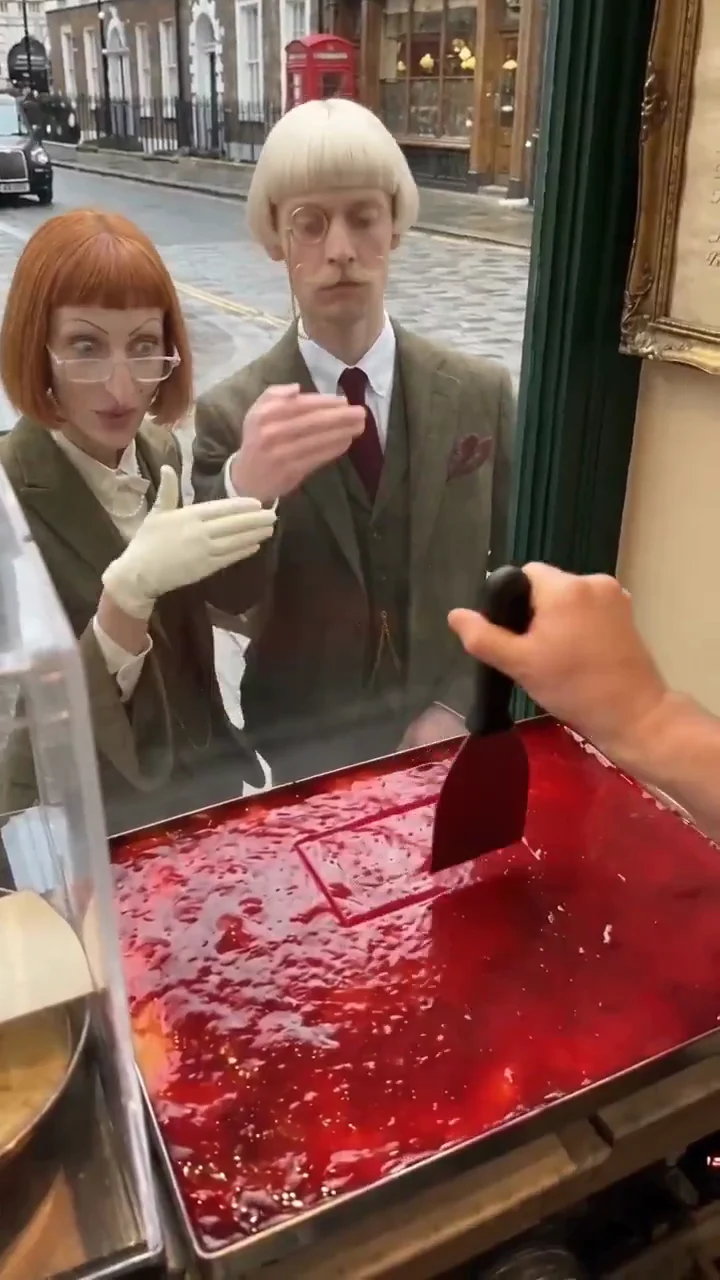
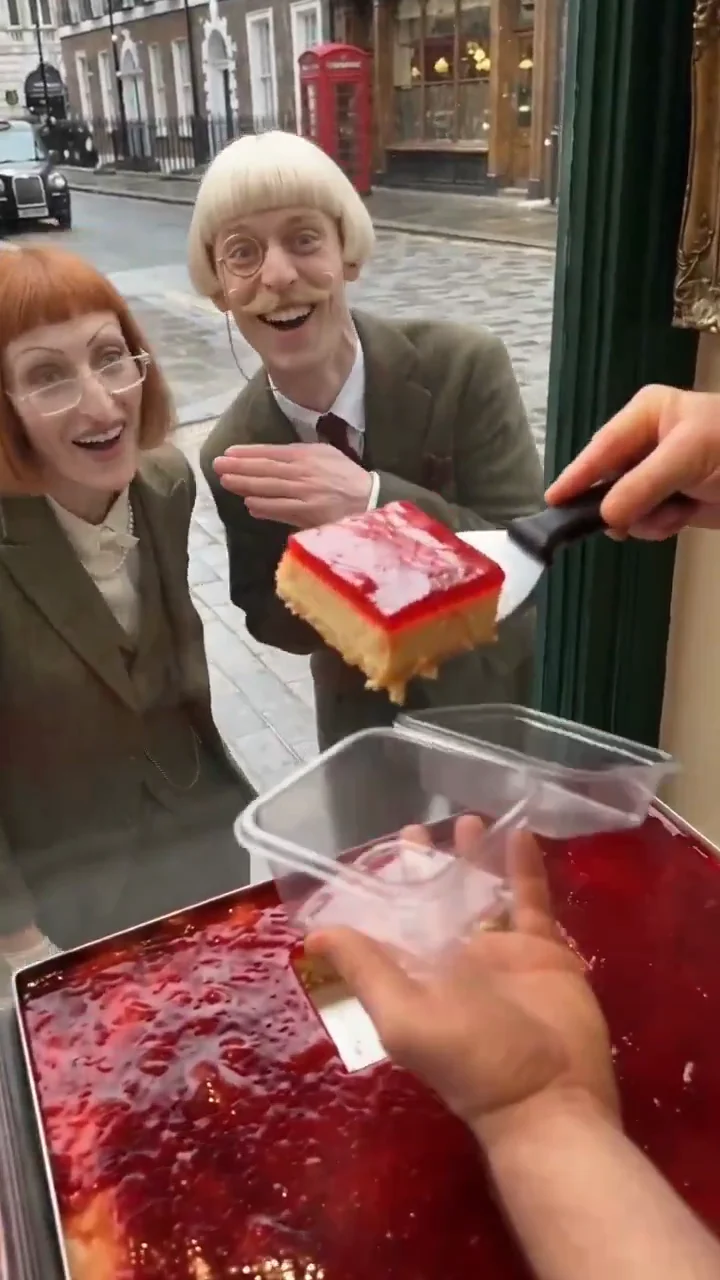
The 20-second attachment makes the format easier to understand than a growth claim. Two stylized adults in coordinated tweed wait at a shop window while a foreground server cuts a glossy red-topped cake. Their restrained anticipation escalates into delighted reactions as a slice is lifted.
Visual description of the video
From the shopkeeper's side of a counter, a rectangular red-topped cake fills the foreground. Outside the open window stand two tweed-clad figures: one with a red bob, rectangular glasses and a light glove; the other with a pale bowl cut, round eyewear and a burgundy tie. They gesture toward the cake, watch a portion being cut, and brighten as the server lifts the slice toward a clear container. This describes visible action, not a verbatim transcript of the audio.
Why would people watch a completely fictional life?
The situation is ordinary; the people make it distinctive. Buying cake needs almost no explanation. Viewers can read the desire, impatience and reward without learning a complicated fictional universe. The retro cast supplies the surprise: formal tweed, unusual hair, coordinated styling and exaggerated seriousness around a small pleasure.
A returning face lets an episode begin with the situation. The creator does not need to reintroduce the entire premise whenever the location changes.
Shared attention, a glance and different reaction timing give viewers something beyond a moving portrait. They can anticipate who will react first or take the moment more seriously.
A cake portion, a missed train or a disputed shopping choice can deliver a complete miniature story. Familiar situations make unusual characters easier to enter.
Viewers can enjoy styling, comedy and an invented world while knowing it is fabricated. Disclosure need not erase the entertainment value; uncertainty about whether it is real should not be the only hook.
These are editorial explanations of the visible format, not measured reasons from audience interviews. We have no retention curve, viewer survey or controlled comparison proving why this account grew. TikTok says its recommendations consider interactions and viewing behavior; that supports testing completion and response, not claiming that an algorithm automatically rewards AI couples.
The commercial advantage of a series is a repeatable expectation. “The impeccably dressed pair confronts another everyday inconvenience” can survive a change of trend or location. A novelty clip may earn a view; a familiar behavioral pattern can give someone a reason to follow. Compare the duo dynamics in our Harold Puddington case study and the portable visual premise in Magnus Brick.
Keep the people recognizable.
Let the situation create the next surprise.
The content system: fixed cast, changing situations
A usable AI character IP needs more than two matching faces. It needs a small set of rules that make a new scene feel like another episode. Preserve what viewers recognize—silhouette, personality, relationship and style—while changing the local problem.
| Layer | Keep stable | Vary by episode |
|---|---|---|
| Identity | Face, adult age, complexion, hair anchors and signature accessories | Angle, expression and light |
| Style world | A coherent wardrobe palette and degree of formality | Weather-appropriate outfits and locations |
| Relationship | Who plans, who improvises, and what they care about together | Who wins the small disagreement |
| Story format | A desire, complication and visible reaction | Cake shop, station, market, home or seasonal event |
| Audience promise | Short fictional life stories, clearly disclosed as AI | A new situation, running joke or viewer-selected choice |
Trends become settings for the cast rather than substitutes for it. A popular dance can reveal that the meticulous planner has no rhythm; a food trend can expose the impulsive partner's terrible ordering decisions. The trend brings a recognizable context, while the character's response supplies the series' own point of view. Using licensed or otherwise permitted references remains part of production.
Continuity also happens in writing. Record what occurred, which running joke was introduced and what the characters now know. A recurring cake obsession can lead to a disastrous attempt to bake at home; a disagreement at a station can return as a rule in the next travel episode. Give each installment a satisfying small payoff before inviting the next one.
The business model: the offer is visible; the income is not
The most concrete commercial evidence is the profile's “Make your own AI character” invitation and linked Alter Studio page. It moves a viewer from enjoying the character to wanting the method. The storefront presents a €7.99 Quick Guide, €19.99 Complete Course and €49.99 PRO package, each one-time, with Stripe checkout links. PRO advertises a written TikTok profile review and a personalized launch plan. These are observed offers on October 17, not verified purchases or independently reviewed deliverables.
- WatchA fictional cast earns attention.
- VisitThe profile invites viewers to make a character.
- EvaluateThe landing page explains guides and prices.
- Purchase?Checkout links exist; completed sales are unknown.
| Route | Evidence in this case | What a creator would need |
|---|---|---|
| Digital products | Live guide/course/PRO offers with public prices | An accurate curriculum, delivery, support and purchase records |
| Affiliate referrals | Alter Studio self-reports first tool-affiliate earnings; amount undisclosed | An approved program, useful recommendations and clear affiliate disclosure |
| Brand advertising / UGC | No campaign contract or paid brand placement verified | A relevant audience or creative service, approved brief and advertising disclosure |
| Character licensing | Suggested by the X author; no license agreement verified | Clear ownership/permissions and terms for character, media, voice and usage |
The logic is broader than TikTok view payouts. A character can function as entertainment, a demonstration of a method, or an entry point to a separate business. A sale of a course is not necessarily income from the fictional couple itself, and affiliate commissions are not the same as licensing royalties. Attribution matters when evaluating any viral AI influencer case study.
For planning, use relevant visits × paid conversion × average order value for gross product receipts. A purely hypothetical 1,000 qualified visits × 2% purchase rate × €19.99 equals €399.80 gross, before fees, refunds, tax, production and support. None of those inputs describes this account. A follower total or view count cannot fill in the missing purchase rate.
The $50K claim cannot be reconstructed from the evidence. We do not know its period, whether it is gross or net, which products it covers, or whether other businesses are included. For the accounting distinctions and practical routes, read how AI influencers make money.
How to create an original AI influencer couple or recurring cast
The following workflow uses real AI Influencer Generator destinations. It is an adaptation of the content pattern, not a reconstruction of the source creator's undocumented tool stack. The editorial duo below is original and adult; neither person copies the Archibald faces.
1. Give each character a recognizable identity and a role
Start in Create an AI Influencer and save each character separately. Specify an adult age, facial structure, hair, complexion, signature accessory and baseline wardrobe. Then write the relationship: partners, friends, siblings or colleagues. Choose it deliberately rather than inferring it from appearance.
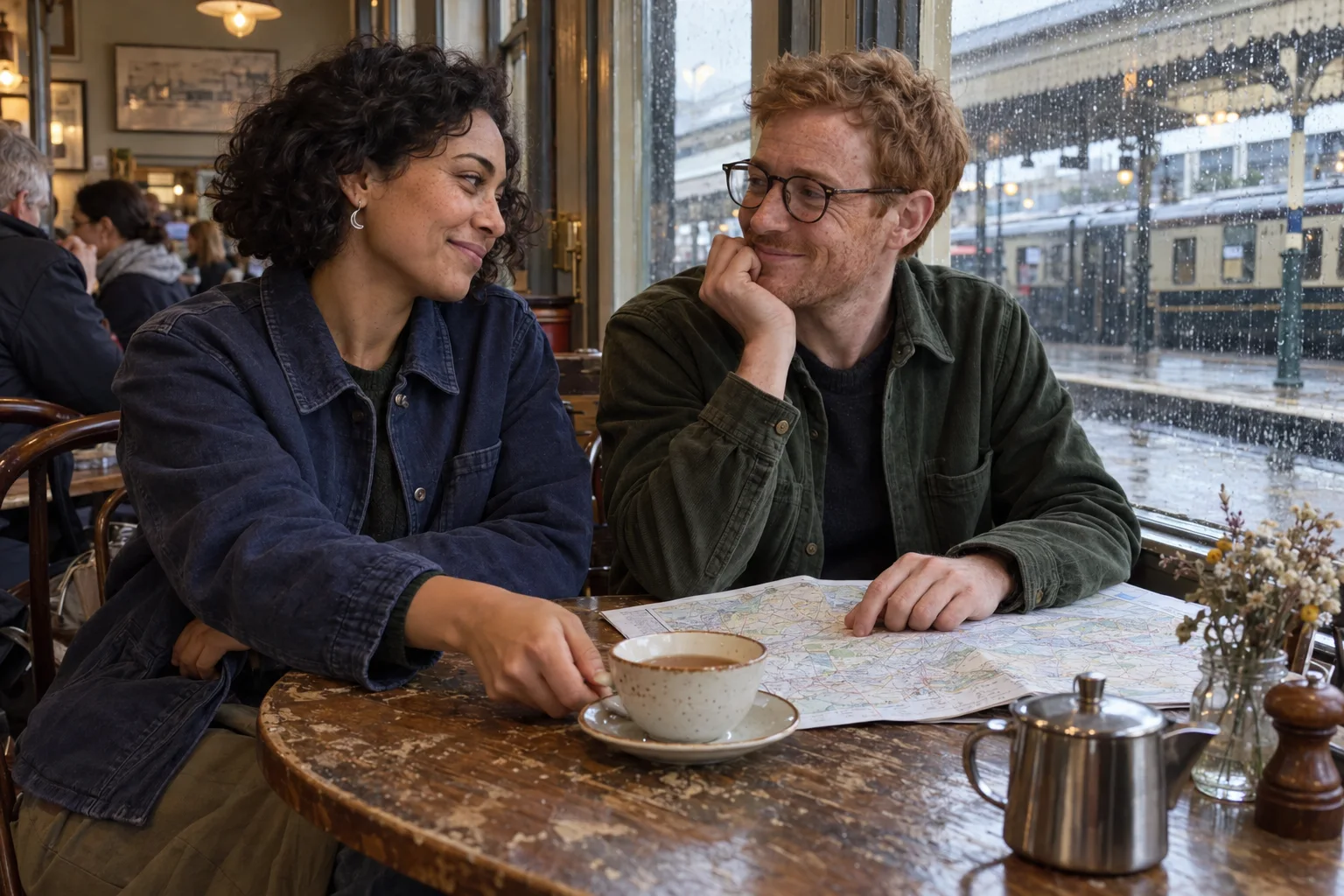
Our tutorial pair is Inez Vale, 34, a meticulous route planner with short dark curls, crescent earrings and indigo workwear, and Theo Moss, 37, a freckled copper-haired improviser with round dark glasses and a green overshirt. Their shared premise: a weekend outing always becomes a small negotiation. The contrast is behavioral as well as visual. For a fuller persona brief, use our AI influencer persona guide.
Create your first original character
2. Build Character Sheets before changing the scene
In My Influencers, keep approved character references together and use Character Sheet views where available. Use the Consistent Character workflow when making new images. A sheet is an identity specification: front, three-quarter and profile views; face shape; hair silhouette; adult age; accessories; wardrobe materials and palette. Expression and pose examples help define what can change without turning the character into someone else.
Write a compact identity lock: “Keep Inez's face shape, warm brown complexion, short curls, adult age and silver crescent earrings. Keep Theo's narrow freckled face, copper hair and round dark glasses. Do not exchange their facial features or accessories.” This is a proposed instruction, not a guaranteed model control. A sheet cannot substitute for reviewing the output.

| Character | Continuity anchors | Reject before animation |
|---|---|---|
| Inez | Short dark curls, warm brown complexion, crescent earrings, indigo style world | Changed face/age, straight long hair, or Theo’s glasses appearing on her |
| Theo | Narrow freckled face, copper hair, round dark glasses, green style world | New jaw shape, missing eyewear, or Inez’s complexion and features replacing his |
| The pair | Two distinct adults and a readable shared activity | Merged faces, duplicated people, implausible hands or drifting relationship roles |
Plan consistent character images
3. Compose a clean two-person scene with Group Photo
Use AI Group Photo Generator, then open the two-person workspace. The current interface has two adult face inputs. Select one saved character or authorized portrait for Face 1 and another for Face 2; use an optional location reference when appropriate. A full multi-panel sheet is useful as a guide, but use a clean single-person portrait in each face slot.
Inez is on the left in an indigo chore jacket, sliding a cup on its saucer across a worn railway café table. Theo is on the right in a green overshirt, looking up from a folded map. Both adult faces remain visible, their bodies do not overlap, and the window light falls from the same direction. Keep each person's approved identity.
Build the shot around one shared activity. Check seating height, eyelines, light direction, separate hands and object contact. Start with a low-contact scene before trying an embrace or an exchange across overlapping arms. This tool does not currently establish an arbitrary three- or four-character cast in a single operation; plan smaller scenes for a larger fictional world.
Compose a two-character reference
4. Animate one clear beat, then review both faces
Use AI Image to Video and the Animate Photo workspace to test the approved scene with a simple action: “Inez glances at Theo; Theo looks up and smiles; the camera remains still.” Start short. Two-person animation is a test to inspect, not a promise of separate control over each actor. You can also start a video project in Create Video.
- Lock identitiesSave each adult character and its approved references.
- Compose a stillTwo separate face inputs; one simple shared situation.
- Test motionShort action, stable camera, visible faces.
- Review and editCheck frame transitions, then add context and disclosure.
For a dance trend or defined body action, explore AI Motion Transfer and Motion & Dance. The current workflow is grounded in a single visible performer and character reference; independent two-person motion mapping is unverified. If a paired result drifts, create separate single-performer or reaction shots and edit them together. Our dance video tutorial shows the motion-reference approach.
Review the beginning, middle and end, including the frames where heads turn or a hand crosses a face. Reject swapped identities, changing glasses, distorted fingers, sliding feet, a morphing cake or a prop that jumps between hands. An acceptable first frame is not evidence of an acceptable video. Keep failed experiments out of the published series.
Test your first short interaction
5. Turn the winning situation into a content calendar
Use the AI Influencer Strategy Generator for an editable audience, content pillars, formats and posting rhythm. The saved character workflow also offers content strategy and a 30-day calendar. Give it a concrete series premise and production limits; review the plan rather than treating generated ideas as proven audience demand.
| Episode | Story beat | What to learn |
|---|---|---|
| The café map | Inez plans the route; Theo notices a tempting detour | Can a new viewer understand the relationship quickly? |
| The flower choice | One wants a precise color; the other chooses the largest bunch | Which reaction earns comments or replays? |
| The missed train | Their detour has a small consequence | Do returning viewers recognize the earlier setup? |
| The audience decision | Two clear destinations for the next outing | Do responses contain useful story preferences? |
Track completion, repeat viewing where available, relevant comments, follows, profile visits and outbound clicks separately. Track purchases separately again. Use tagged links and the destination's real order records to evaluate a funnel; do not relabel views as customers. Repeat the character behavior that works, while varying the setting and stakes. See our TikTok publishing guide for the posting workflow.
Build a recurring-story content plan
6. Match one honest offer to the audience
An entertainment audience may want more episodes; a creator audience may want a workflow, template or service. Test which intent you actually attract. A relevant brand brief or product can fit the fictional world without pretending the character is a real customer with real product results.
Use Monetize to explore the available creator workflow and AI Influencer Media Kit Generator to prepare an accurate pitch. New accounts should use portfolio examples and real capabilities, not fabricated reach or brand partnerships. These tools do not automatically sell memberships, secure advertisers or grant IP rights.
Prepare an honest character portfolio
What this case cannot tell us about production or rights
The source video has a foreground cake and server's hands, two background faces, coordinated expressions and a moving slice. A reference-led image-to-video workflow, video editing or compositing could plausibly contribute to that result. The published file does not reveal which model was used, whether the underlying shop footage was filmed, or whether faces were animated separately. Its storefront's broad AI claims do not resolve those technical questions.
For your own series, use original adult identities and authorized locations, references, music and voices. Follow TikTok's AI-content disclosure rules and disclose commercial relationships when relevant. A fictional character should not be presented as a real person giving a real testimonial. Do not imply a shop, brand or actor endorsed the project merely because it appears in a scene.
“Original character” also does not automatically mean every generated asset is copyright-protected or commercially cleared. The U.S. Copyright Office's human-authorship guidance distinguishes human creative contributions from purely AI-generated material. Licensing requires a clear account of rights in the character design, script, edit, source material and audio; applicable law and contracts can differ.
The lesson: a repeatable character is an asset, not an earnings receipt
The Archibald case supports a visible content-to-product funnel: a distinctive recurring cast, short everyday scenes, a profile invitation and a guide storefront. It does not verify $50K+ revenue or reconcile the reported 10M+ views with the linked page's 2M claim. That distinction makes the practical lesson stronger: build a format you can repeat and an offer you can deliver, then measure the results.
An AI virtual couple can become recognizable when identity, behavior and relationship survive each new location. A scene is an installment; a Character Sheet is part of the continuity system; a product is a separate commercial promise. Treat all three seriously and a fictional world has a foundation for a lasting creator business.
Start your own original AI character series
Frequently asked questions
What is the Archibald Brothers AI influencer account?
The supplied TikTok screenshot shows @archibald_brothers, display name ArchiBaldbrothers, with a bio reading ‘Three brothers. Tweed, mustache & moves.’ The source X author describes a cake-shop clip as a fictional couple’s date. That episode description does not establish the relationships of the entire recurring cast.
Did Archibald Brothers make $50K from 10M views?
That has not been independently verified. The October 15, 2026 X post reports over $50K and attributes 10M views to Alter Studio. On October 17, the linked Alter Studio page instead displayed 2M views and about 3,000 followers, and mentioned first affiliate earnings without an amount. No matched analytics, sales ledger or payout statement was available.
Does 213.4K likes mean the cake-shop video received that many likes?
No. The supplied screenshot places 213.4K in the TikTok profile’s account-level Likes counter. It does not show that number as the cake-shop video’s likes. Its capture date is unknown; the same screenshot shows 6,150 followers.
How do I create an original AI virtual couple?
Define two adult fictional people with distinct identity anchors and a shared story premise. Create and save each character, prepare Character Sheets, compose a two-person reference image, then test a short interaction. Review both identities and physical contact before building a recurring series.
How do Character Sheets improve AI character consistency?
A Character Sheet records views, facial structure, hair, age, accessories and baseline styling. Reuse approved clean portraits and the same identity rules across scenes. Sheets reduce ambiguity but do not guarantee perfect consistency, especially when faces turn, overlap or move.
Can AI Group Photo Generator create an entire cast at once?
The current workspace supports two adult face inputs, not an arbitrary multi-person cast in one operation. Use one clean portrait per face slot and check that identities remain distinct. Larger casts need separately planned scenes or another verified workflow.
Can Motion Transfer independently animate both people?
Independent two-person motion mapping has not been verified in the current workflow. Start with a simple two-person image-to-video test. Use single-performer Motion Transfer for separate shots when needed, then edit the sequence together.
How can an AI character account become a business?
A recurring fictional cast can lead viewers to a relevant product, disclosed affiliate offer, brand brief or licensed character project. Each route needs a real offer, rights and delivery. Views and followers alone do not verify sales, revenue or profit.
Sources and research method
Reviewed October 17, 2026. We read the source X post in Chrome, inspected the full attached profile image and video frames, retained the complete source video, and checked the bio-linked Alter Studio landing page. Direct TikTok access did not yield a usable live profile. No private account analytics, sales ledger, affiliate payout, brand contract or licensing agreement was available. Historical screenshot capture time is unknown.
- ALEXYZ, October 15, 2026 at 18:33 UTC: original post and two media attachments
- TikTok profile named in the source image: @archibald_brothers
- Alter Studio: public offers, self-reported 2M views / ~3,000 followers and affiliate-earnings statement, checked October 17
- TikTok Support: how recommendations work
- TikTok Support: AI-generated content
- U.S. Copyright Office, January 29, 2025: human authorship and AI outputs
Growth mechanisms, the tutorial workflow and business opportunities are analysis, not a verified production history or customer outcome. Inez and Theo are original fictional-adult editorial illustrations generated for this article, not Studio outputs. Third-party media is attributed and used for focused commentary; we do not claim ownership or verified reuse permissions. No paid product generation, purchase or message to the case account was submitted.
Plan Content
Measure Engagement
Build Your Profile
Price Your Work
Write Post Copy
Brand Partnerships