
AI influencers make money when the people operating them sell something valuable: audience access, brand-ready content, qualifying referrals, exclusive membership, digital products, education, merchandise or licensed character rights. Brands pay for campaigns and deliverables; customers pay for products or access; eligible platforms share revenue under specific programs. The operator receives the money and pays production, platform, marketing and support costs. A convincing character can help attract attention, but views and followers are not sales. Start by choosing one buyer, one offer and one permitted platform, then test whether revenue exceeds the full cost of delivering it.
| Revenue stream | What the buyer purchases | Starting requirement |
|---|---|---|
| Brand partnerships | Content plus access to your audience | Relevant audience and a credible pitch |
| AI UGC services | Licensed creative deliverables | Portfolio, client brief and production skill |
| Affiliate marketing | A qualifying attributed transaction | Program approval and buyer-intent traffic |
| Fan subscriptions | Recurring access or exclusive content | Allowed content, verified operator, retention |
| Digital products | A useful downloadable product | Original value, rights and delivery |
| Courses / communities | Instruction, support and member access | Real expertise and ongoing fulfillment |
| Merch / print on demand | Physical goods based on your character IP | Licensed designs and unit economics |
| Native payouts / licensing | Eligible content or defined usage rights | Program approval or a licensing contract |

Attention is the start.
An offer earns revenue.
Choose the buyer and deliverable before choosing a platform.
How Do AI Influencers Actually Make Money?
The creator, agency or brand behind the character receives payment. The AI persona is the public-facing identity; the operator signs contracts, verifies an account, handles delivery and reports income.
- AI influencer
- Content / audience
- Monetization offer
- Customer / brand
- Revenue
- Costs
- Profit
A high-view post may bring no buyers. A small specialist audience may convert, while a creator with no audience may sell production services. Track the full path: content → qualified inquiry or click → purchase → collected payment → retained margin.
Creator Advertising Market Growth
The expanding creator advertising market explains why brands buy content. It does not tell you what an individual AI influencer will earn, or what share goes to virtual rather than human creators.
8 Ways AI Influencers Make Money
The best model is the one you can fulfill credibly for a specific buyer. Start with one revenue stream; add another when delivery, rights and economics work.
1. Brand Sponsorships & Paid Partnerships
A sponsor buys content and distribution on the creator's account. The value depends on audience relevance, creative quality, reputation and permitted usage—not just follower count.
- Who pays
- Brand or agency.
- Requirements
- A suitable audience, genuine analytics, ad disclosure and a usage agreement.
- Platforms to evaluate
- Collabstr, Aspire, CreatorIQ and GRIN; the latter platforms also serve brand-side relationship management.
Example: a fashion brand commissions a disclosed outfit Reel. Quote creation, posting, revisions, exclusivity and paid-ad rights separately. This differs from UGC delivered only to the brand.
First move: build a media kit with persona positioning, audience geography, dated native analytics, sample work, deliverables and contact details. Pitch one relevant concept and its business objective. Do not invent metrics for a new account.
Why Brands Invest in Creator Marketing
0% Common axis: 0–50% 50%
The brand's goal changes your proposal: awareness calls for relevant distribution; a conversion campaign needs accurate product information and a measurable offer. Neither makes fabricated testimonials acceptable.
2. AI UGC Content Creation for Brands
Here, you sell production and a content license. The brand runs the assets on its own channels or ads, so a large personal following is not the core product.
- Who pays
- Brand, seller or agency.
- Requirements
- Strong samples, authorized product references, accurate claims, revisions and commercial usage terms.
- Platforms to evaluate
- Direct client work, Collabstr or an agency relationship; confirm AI acceptance before taking an order.
Example package: five product-interaction images and three short videos for a skincare brand. This is a proposed scope, not a completed order or a suggested market price.
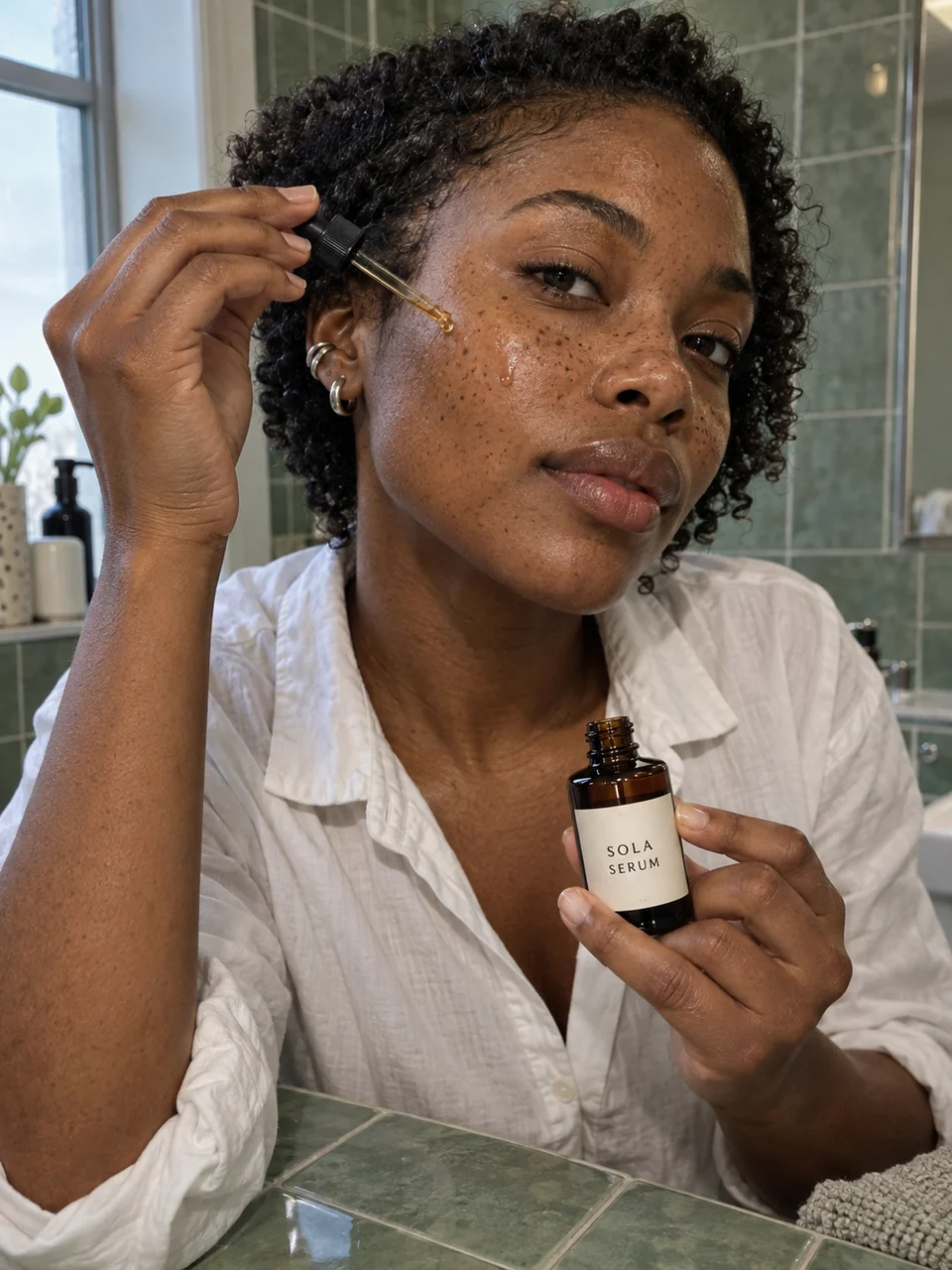
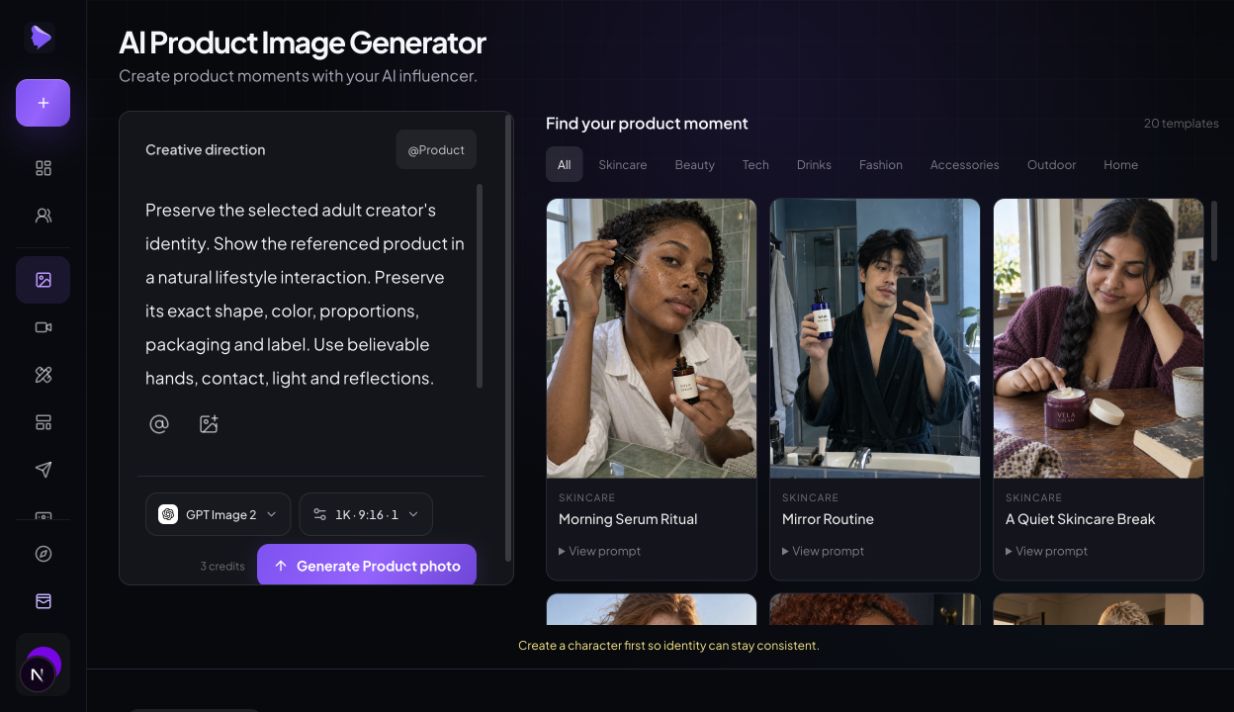
Build it: save the brand's permitted imagery and verified facts in Product Library, choose a character, then use the AI Product Image Generator. Develop UGC-style clips through Create Video or Talking Video. Approve packaging and claims before expanding the batch.
3. Affiliate Marketing
The operator earns a commission when a tracked referral meets a merchant's conditions. A click alone usually does not qualify: attribution, product exclusions, returns and validation affect payment.
- Who pays
- Merchant or advertiser, often through an affiliate network.
- Requirements
- Approved promotional channels, program acceptance, tracking links and clear affiliate disclosure.
- Platforms to evaluate
- Amazon Associates, impact.com, CJ Affiliate, Awin, PartnerStack and eligible Shopify Collabs partnerships.
Hypothetical calculation: 1,000 qualified clicks × 2% purchasing × $50 eligible order value × 5% commission = $50 gross commission, before reversals and costs. Every input is illustrative, not a platform benchmark or a universal commission rate.
Apply deliberately: impact.com distinguishes marketplace approval from individual brand relationships. The U.S. Amazon review process requires three qualifying sales within 180 days; personal purchases do not count. Shopify Collabs currently pauses general creator signups, while merchant invitations and applications can remain available. Build an accepted channel and a useful product explanation before promoting a link.
4. Fan Subscriptions & Exclusive Content
Fans pay for a recurring content promise, access or paid extras. Retention requires ongoing delivery and support; subscriptions are not passive simply because the character is synthetic.
- Who pays
- Subscribers and fans purchasing access or extras.
- Requirements
- Permitted content, a verified real operator, a sustainable cadence and payout eligibility.
- Platforms to evaluate
- Fanvue; Patreon where content classification permits it; Fanfix only after application and AI-policy confirmation.
Fanvue: its AI policy accepts AI-generated media within stated limits and requires clear disclosure. Its standard earnings policy allocates 80% to creators and 20% to the platform, with exceptions and adjustments. See our Fanvue monetization guide and policy and fees explainer.
Example and launch: offer an explicitly fictional creator's editorial photo series and behind-the-scenes production notes. Define exactly what renews each month. Patreon's adult hyperrealistic rules do not permit treating a fully fictional photorealistic model as a consenting real person. Fanfix's reviewed FAQ requires adult applicants and active social profiles; it did not establish blanket AI acceptance.
5. Selling Digital Products
Customers buy a useful file or content license: a template, ebook, planning system, licensed image collection or character-content pack. The product must solve a problem beyond displaying attractive generated images.
- Who pays
- Customers purchasing the operator's product.
- Requirements
- Original value, sufficient rights, a clear license, checkout, delivery and refund support.
- Platforms to evaluate
- Gumroad, Whop, Payhip, Sellfy and Ko-fi.
Example: sell a persona-planning workbook with editable briefs and production checklists. Show sample pages, the file formats and what buyers may reuse. Avoid promising exclusive ownership of rights you cannot grant.
Launch a small product: create the files, test delivery, then connect the offer to relevant content. At a hypothetical $20 direct Gumroad sale, the published 10% + $0.50 fee leaves $17.50 before other applicable expenses and adjustments. Fifty sales would leave $875 at that stage, not $875 profit.
6. Courses & Paid Communities
A course sells instruction; a community sells continuing access, activities and support. An AI character may present the material, but a responsible real operator must supply the expertise and fulfill the promise.
- Who pays
- Students or members.
- Requirements
- A useful curriculum, accurate qualifications, support capacity and permitted payment setup.
- Platforms to evaluate
- Skool, Teachable, Thinkific, Kajabi and Whop.
Example: a real designer teaches a workflow through a disclosed virtual presenter. The character must not claim a degree, professional license or career history it never had.
Validate first: publish one useful lesson and a clear syllabus. Run a small paid cohort or member pilot, measure completion and support time, and revise the offer before expanding.
7. Merchandise & Print on Demand
Character IP can support clothing, posters and accessories. A storefront takes orders; a print-on-demand supplier manufactures and fulfills them. They are different services with different costs.
- Who pays
- Fans or shoppers buying physical goods.
- Requirements
- Licensable designs, sample-quality review, fulfillment, returns and a positive per-order margin.
- Platforms to evaluate
- Shopify, Fourthwall and Beacons for creator commerce; Printful, Printify and Gelato for fulfillment; Redbubble as a marketplace.
Example: test a poster using an original character design. A hypothetical $25 sale minus $12 manufacturing, $5 seller-funded shipping and $2 fees leaves $6 before marketing, returns, labor and tax.
Start with one item: order a sample and check the print, rights and shipping experience. Compare total landed cost; a storefront subscription does not include physical production.
8. Social Media Monetization & Character Licensing
Eligible platforms share advertising or fan-funding revenue; licensing clients pay for defined character usage. Neither follows automatically from posting AI content.
- Who pays
- Platforms/advertisers, fans or a business licensing the character.
- Requirements
- For native programs: eligible country, account standing, thresholds and content review. For licenses: rights you control and a written scope.
- Platforms to evaluate
- YouTube, TikTok, Instagram, Facebook and X; direct brand or agency licensing.
Eligibility example: YouTube's full ad-revenue tier lists 1,000 subscribers plus 4,000 valid public watch hours in 12 months or 10 million valid public Shorts views in 90 days, followed by review. Earlier fan-funding access has different rules. Mass-produced repetitive content is not eligible; AI labeling is not monetization approval.
Licensing example: a brand licenses approved character assets for a defined campaign. Specify channels, territory, term, edits, exclusivity and renewal. Do not grant ownership of underlying technology or third-party marks. Check the account's current Earn or monetization area before building a native-payout plan.
Best Platforms to Monetize an AI Influencer
Choose by offer, permitted content and payment eligibility. This table compares representative options, not a universal ranking. A brand marketplace, affiliate network and digital storefront do different jobs. Their fees use different bases and exclude different charges.
| Platform | Monetization model | Best for | AI content policy | Fees | Eligibility | Official website |
|---|---|---|---|---|---|---|
 Fanvue Fanvue | Subscriptions, PPV, tips | Disclosed fictional adult creators | Fully AI-generated content allowed within its rules; clear disclosure required. Policy. | Standard 20% platform share; adjustments and other charges can apply. Source. | Real operator verification; adult appearance; rights and payout checks. | Visit Fanvue |
 Patreon Patreon | Memberships, purchases | Community, art and educational creators | General-audience AI permitted. Adult hyperrealistic people must be real, with documented consent. Policy. | Standard 10% for new pages, plus processing, taxes and other applicable fees. Source. | Content classification, verification and supported payouts. | Visit Patreon |
 Fansly Fansly | Subscriptions, paid media | Eligible non-photorealistic virtual creators only | Photorealistic/lifelike AI people prohibited; a label does not make them eligible. Policy. | Not evaluated for the excluded photorealistic use case. Source. | Real legal identity and standard verification; other content rules apply. | Visit Fansly |
 Gumroad Gumroad | Digital product sales | Templates, guides and licensed packs | Product and rights rules apply; no blanket AI-persona approval established here. | 10% + $0.50 direct/profile sales; 30% Discover sales. Source. | Supported payout country; permitted products; seller verification. | Visit Gumroad |
 Payhip Payhip | Downloads, courses, memberships | Small catalogs and direct sales | Check prohibited-product and processor rules for the actual assets. | Free plan: 5% transaction fee, plus payment-processor fees. Source. | Supported payment account and lawful, deliverable products. | Visit Payhip |
 Shopify Shopify | Owned online store | Merch and a broader creator brand | Merchant, IP, product and payment-provider rules apply. | Subscription plus payment fees; rates vary by region, plan and provider. Source. | Merchant/payment verification, tax and fulfillment setup. | Visit Shopify |
 Fourthwall Fourthwall | Merch, downloads, memberships | Creator shops without held inventory | Only sell designs and likenesses you may license; product rules apply. | Catalog base costs; digital/memberships 5%; processing extra. Plan exceptions apply. Source. | Seller/payout onboarding; compliant designs and products. | Visit Fourthwall |
 Amazon Associates Amazon Associates | Affiliate commissions | Relevant product discovery content | Original content and program disclosures required; no automatic AI eligibility. Policy. | Category-specific commissions on qualifying purchases, not a universal rate. Source. | U.S. application reviewed after 3 qualifying sales within 180 days; other rules apply. | Visit Amazon Associates |
 Impact.com Impact.com | Brand affiliate programs | Product-aligned commerce content | Promotional content must satisfy the selected advertiser's rules. | Commission, attribution and reversal terms depend on the brand contract. Source. | Marketplace approval and individual brand relationships are separate. | Visit Impact.com |
 Collabstr Collabstr | Brand deals and UGC orders | A clear creative portfolio or audience offer | Disclose the synthetic creator and confirm client/platform acceptance before selling. | 15% creator payout fee; buyer hiring fees are separate. Source. | Creator onboarding, suitable profile and a client-approved brief. | Visit Collabstr |
 Skool Skool | Paid community and courses | Operator-led education and member support | No blanket AI-persona acceptance verified; no invented expertise. | Monthly Hobby $9 + 10%; Pro $99 + 2.9% transaction fee. Source. | Real operator, suitable payment setup and content delivery. | Visit Skool |
 YouTube YouTube | Ads and eligible fan funding | Original recurring video formats | Original/authentic content required; mass-produced repetitive content is ineligible. Policy. | Revenue share depends on the monetization module; not a single store fee. Source. | Available country, account standing, thresholds and YPP review. | Visit YouTube |
For store and community services, a suitable business model does not establish unconditional AI-content acceptance. Recheck current terms for the actual assets and offer. Fansly is included to explain an important restriction, not to recommend a prohibited photorealistic use.
Explore AI Influencer Monetization Platforms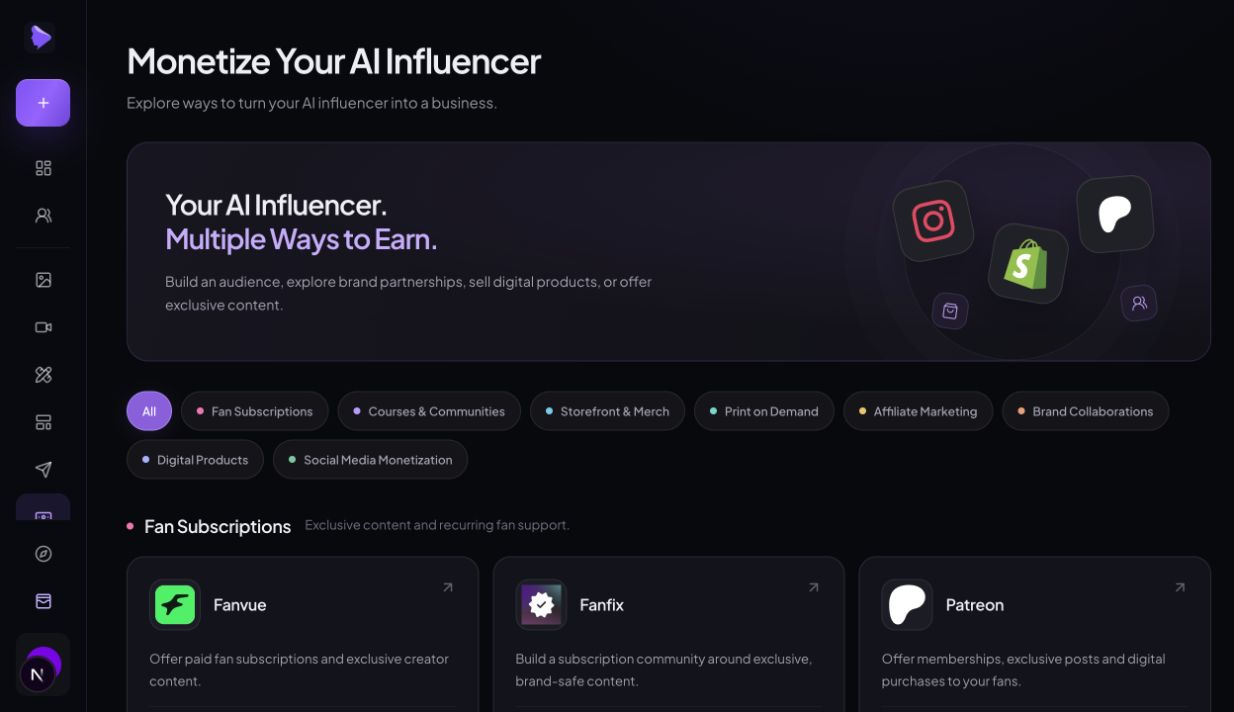
More platforms, grouped by business model
Shared names, links and brand marks from the existing Monetize catalog. These are resources to evaluate, not approvals or endorsements.
Fan Subscriptions

Courses & Communities




Storefront & Merch


Print on Demand




Affiliate Marketing




Brand Collaborations



Digital Products

Social Media Monetization


How Much Profit Can an AI Influencer Make?
Profit depends on collected revenue minus the full cost of acquisition and fulfillment. A platform payout is only one intermediate number. There is no defensible universal income forecast from the sources reviewed here.
For a concrete tool-cost reference, our Starter monthly plan currently lists $19/month for 300 credits. Model, resolution, duration, output count and retries determine usage. Budget for rejected outputs, editing, rights, labor, software, customer care and distribution; do not treat credits as finished client deliverables.
Gross revenue → fees → production → marketing → contribution
Gross = paying subscribers × monthly price
Contribution = gross × 80% − production − marketing
Break-even under these assumptions: 25 paying subscribers.
Illustrative monthly model. Fanvue's standard 20% platform share is fixed here. All prices, customer counts and operating costs are your assumptions. Refunded sales, chargebacks, taxes, processing/payout/FX charges, owner labor and other overhead are excluded. Promotional or negotiated rates can differ. This is contribution after selected costs, not take-home profit.
| Paying subscribers | Gross revenue | After 20% fee | Contribution after $200 selected costs |
|---|---|---|---|
| 25 | $250 | $200 | $0 |
| 100 | $1,000 | $800 | $600 |
| 250 | $2,500 | $2,000 | $1,800 |
At these assumptions, 25 paying subscribers cover the selected $200 operating costs. Full break-even will be higher when excluded costs apply. Track renewals, refunds, acquisition cost and support time—not just a strong launch month.
Real AI Influencer Monetization Examples
Public case evidence can establish a revenue model without proving net profit. The examples below separate attributed reporting from documented commercial activity.
Aitana López: agency-reported sponsorship and fan income
Persona: pink-haired fictional fitness/lifestyle creator. Channels: Instagram and Fanvue in the source reporting. Methods: advertisements, brand representation and paid fan content.
Euronews, updated December 27, 2024, attributes earnings of up to €10,000/month, usually about €3,000, and just over €1,000 per advert to her creators. These are historical agency statements, not audited accounts, current run rates or net profit. Production, labor and acquisition costs were not disclosed.
Beginner lesson: define a recognizable identity and a repeatable content operation. Do not use a headline maximum as your forecast.
Lil Miquela: documented brand collaboration, undisclosed economics
Persona: established virtual fashion/music character, originally CGI rather than simply a modern text-to-image account. Channel: social campaign content. Method: brand collaboration and creative character usage.
Prada's own FW 2018 page documents its collaboration with Lil Miquela across Milan billboards, posters and social GIFs. It establishes a commercial campaign, not a disclosed fee, royalty or profit figure.
Beginner lesson: the character must fit the creative brief. Do not multiply followers by a speculative rate card and call the result verified earnings. Public source links are provided; no unlicensed celebrity or case-study images are republished here.
How to Start Making Money with an AI Influencer
Choose one buyer and validate one paid offer before adding more channels. Use audience-first for distribution-led income; use service-first for a production business.
- Choose a Niche and Revenue Model. Write the buyer, problem, deliverable and payment event. “Skincare creative for small brands” is more testable than “make money from AI.”
- Create a Consistent AI Influencer. Use the creator workspace and persona tutorial. Retain approved references and inspect identity, hands, product contact and labels.
- Build a Content Library. Assemble a small coherent set. Use Product Library for authorized product context and Creator Kit for available character materials. Sign in for private saved products; do not invent a completed campaign.
- Grow an Audience or Prepare a Brand UGC Portfolio. Audience-first needs a useful recurring series and relevant reach. Service-first needs a sample brief, deliverables, revision boundaries and usage terms.
- Choose a Monetization Platform. Check AI rules, real-operator verification, fees and payout country in Monetize, then apply on the external platform. Directory access is not acceptance.
- Publish, Measure, and Improve. Turn approved Content Strategy ideas into assets. Use Publish for supported connected-channel workflows; account authorization and platform limits apply. Track transactions, collected revenue and delivery costs.
30-Day AI Influencer Monetization Plan
| Week | Audience-first | Service-first | Deliverables / measures |
|---|---|---|---|
| 1 · Define | Select niche, persona and one recurring series. | Choose a buyer segment and one scoped UGC offer. | Persona brief, rights checklist, cost sheet; approved sample assets. |
| 2 · Produce | Publish a small, coherent content batch. | Create a sample portfolio and tailored proposals. | Content library; relevant reach or qualified replies; production/revision time. |
| 3 · Test an offer | Launch one permitted affiliate, product or membership offer. | Negotiate one small paid pilot with clear usage terms. | Working checkout/tracking or a signed scope; conversion and actual delivery cost. |
| 4 · Review | Examine paid conversions, refunds and renewal signals. | Review acceptance, revisions and repeat demand. | Collected revenue − fees − costs; decide whether to improve, repeat or stop. |
The month is a validation window, not an income deadline. Do not buy followers or fabricate testimonials to make the offer look proven. If nobody buys, revisit buyer fit and the deliverable before increasing production volume.
Is AI Influencer Monetization Legal?
A fictional character can support a lawful business, but the content, claims, rights and operator must comply with applicable rules. There is no universal platform approval or jurisdiction-independent legal clearance.
The FTC's Consumer Reviews and Testimonials Rule Q&A says it has no blanket ban on AI avatars or virtual influencers. Fake or false underlying testimonials can violate the rule, and avatar advertising may still be deceptive under the FTC Act. Do not script “this cleared my acne” for a character that never used a product.
- Separate disclosures: explain the AI identity and follow destination labeling rules. Separately disclose material brand or affiliate relationships; one does not replace the other.
- Clear rights: verify likeness, voice, source images, music, trademarks and campaign licenses. License only what you may grant.
- Verify the real operator: use genuine identity, age, tax and payout details. A fictional ID cannot satisfy KYC.
- Respect exclusions: Fansly's photorealistic-AI prohibition remains even with an AI label. Patreon's adult-content restrictions and Fanvue's disclosure/appearance rules require separate checks.
- Recheck before launch: policies, eligible countries, program thresholds and processor conditions change. Do not use a directory listing to bypass them.
Frequently Asked Questions
Revenue requires a permitted offer, a real buyer and a verified operator. These answers distinguish the opportunity from the conditions needed to earn.
Can AI influencers really make money?
Yes. Operators can sell sponsored content, UGC production, affiliate referrals, subscriptions, products, education, merchandise and eligible platform or licensing rights. Payment depends on an actual transaction or approved program, not on the AI character existing.
How much do AI influencers earn?
There is no reliable universal average established by the sources reviewed here. Euronews reported Aitana's creators claiming about €3,000 in an average month and up to €10,000; these are historical agency claims, not audited profit or a beginner forecast.
Can you monetize an AI influencer with no followers?
You can sell a defined UGC production service without selling audience reach. You still need credible samples, product permissions, client acquisition, quality control and a usage agreement. No followers does not mean no work or guaranteed buyers.
Which platforms allow AI influencers?
Fanvue expressly permits AI content subject to its rules. Patreon permits general-audience AI depictions, with stricter adult-content limits. Fansly prohibits photorealistic AI people. Other platforms require checking the specific product, program and operator eligibility; a listing is not approval.
Can AI influencers make money on Instagram?
An operator can use Instagram for disclosed brand partnerships, permitted affiliate traffic and sales to an external store or membership. Native monetization features have separate account, country and policy requirements. An AI account is not automatically eligible.
Does Fanvue allow AI-generated models?
Yes, within its AI and acceptable-use rules. The content must be clearly disclosed, depict adults and respect rights. The real operator must pass the applicable onboarding and verification checks. Acceptance does not guarantee subscribers or income.
Can AI influencers earn affiliate commissions?
Their operators can earn commissions after joining an eligible program and generating attributed, qualifying transactions. Network enrollment does not guarantee brand approval; returns, excluded purchases and attribution rules can reduce the final payable amount.
How much does it cost to run an AI influencer?
Costs include tools, generation credits, rejected outputs, editing, labor, distribution, storefront or platform fees and customer support. AI Influencer Generator's Starter monthly plan is $19 for 300 credits at the check date; your live generation settings determine usage. A tool subscription is not the total business cost.
Are AI influencers profitable?
Some operations may be, but profitability cannot be inferred from followers or reported revenue. Deduct platform charges, production, acquisition, refunds, labor, taxes and other expenses. This guide's calculator shows illustrative contribution after selected costs, not proven take-home profit.
Do AI influencers need to disclose they are AI?
Follow the destination platform's AI-label rules and applicable law, and describe the fictional identity clearly. Separately disclose commercial relationships. The FTC does not ban virtual influencers outright, but fake testimonials and deceptive endorsements can violate its rules.
Start with a recognizable character and one useful offer. Create your AI influencer, build reviewable content, then use Monetize to evaluate the channels that fit your business.
Sources & Methodology
Checked October 15, 2026. Public research, platform policy, reported cases and our product demonstration are separate evidence types. No client order, new generation, earnings experiment or external-platform enrollment was performed for this guide.
- IAB / Advertiser Perceptions 2025 report: market estimates, forecasts and top-three goal selections; n=453 advertiser survey, with market estimation methodology distinct from a survey percentage.
- Virtual influencer marketing: A meta-analytic review (2026): 210 independent experiments, 643 effect sizes; research synthesis, not creator-income data.
- Fanvue, Patreon and the official fee/policy links in the platform table: baseline rules, subject to their stated exceptions.
- Euronews supplies attributed historical earnings claims; Prada supplies campaign evidence without financial results.
- FTC guidance: advertising and testimonial boundaries; not individualized legal advice.
- Editorial structure informed by Ahrefs' affiliate tutorial and income analysis, and Semrush's influencer marketing guide and SEO editorial library.
All commercial calculations are labeled assumptions. Product screenshots show actual local input/catalog screens, not completed client work. Existing fictional media illustrates formats; real public case images were not copied. Source links allow readers to check policies at decision time.
Plan Content
Measure Engagement
Build Your Profile
Price Your Work
Write Post Copy
Brand Partnerships