
Who is Renji Kuru, the AI fitness influencer?
Renji Kuru is a recurring fictional fitness persona on Instagram @renjikuru. The visual anchors are long, shaggy dark-red hair, unusually broad shoulders, extreme muscularity and an anime-inspired appearance. Distressed gym clothing appears in the identity described by Findra; the airport clip itself shows a fitted dark T-shirt and contrasting light trousers. The identity survives a change of outfit.
The profile credits Made with @higgsfield.ai.
Original post hosted by Instagram. The airport sequence is fictional entertainment, not a real athlete's physique.
Why does an exaggerated character work in an ordinary scene?
The creative structure is stable identity + familiar rule + visible mismatch. The airport supplies a place people recognize; Renji supplies an outsized silhouette; the normal procedure makes the contrast legible.
1. The silhouette does the introduction
The hair color and shoulder-to-waist proportions are readable before a viewer studies facial detail. That makes the character easier to recognize across different scenes. Long red hair alone would be a weak identity system; paired with body scale, face and styling, it becomes a stronger visual signature.
A recurring character should not need a name card every time. For your own persona, lock a small number of visible anchors that survive clothing and lighting changes. Treat face shape and body proportions as identity; treat outfit and location as scene choices.
2. Ordinary people and luggage become measuring sticks
In the airport sequence, Renji shares the frame with normally proportioned security staff and an everyday rolling suitcase. Those objects give the body scale a reference. A giant figure against an empty background could simply read as fantasy; beside a familiar suitcase, the mismatch becomes specific.
The setting also comes with a familiar script: arrive, wait and follow the procedure. An extraordinary body has to navigate the same ordinary rules. The comedy can remain patient and understated; it does not need a fight, a shouted line or a complicated backstory.
3. The humor comes from a social problem, not a flex
A bodybuilding pose asks viewers to admire a physique. An airport encounter asks what happens when that physique meets everyday expectations. This changes the content from a static character reveal into a situation with a question.
That question travels well into other settings: how does an enormous hand handle a tiny espresso cup? What does a small shopping basket look like against that arm? These are proposed original scenarios, not claims about other Renji posts.
4. A short opening can present the contradiction immediately
For a new clip, put the unusual body and the ordinary task in the opening composition. Let the viewer see the mismatch before explaining it. A long establishing shot of an airport or café spends time before the actual idea arrives.
Then add one modest action and one reaction. A shoe enters a tray; the character glances at it. A small cup rises; the character pauses.
5. Recognition can connect episodes while situations supply novelty
The fixed character carries continuity, so the next scene can begin with a new ordinary problem. This gives viewers a concrete way to describe or suggest another episode.
Visual clarity also reduces reliance on dialogue. Vary the framing and joke so each episode gives viewers a fresh situation.
- Recognizable identity
- Ordinary task
- Visible scale mismatch
- Small action and reaction
For related structures, compare the recurring training premise in our Baki case study and the visual contradiction in the Derek Mercer breakdown.
Create your own character before copying the setting
Borrow the contrast, then design a different person. Our teaching character is Luca Vale: short black curls, a moustache, dark olive skin, a copper ear hoop and an oversized muscular silhouette. His restrained reactions make small errands the story. He does not copy Renji's red hair, face, outfit or identity.
An original fictional adult named Luca Vale, age 38: dark olive skin, broad square face, thick dark eyebrows, very short black curls, neat short dark moustache, small copper hoop in his left ear. Comically oversized muscular shoulders, upper arms and torso; stable human hands, joints and facial proportions. Quietly patient personality. He does ordinary errands without flexing. Natural skin texture, coherent light and real-looking objects. Do not imitate Renji Kuru, a real athlete or an existing fictional character.
The following three images were created with a separate image-generation tool for this article. They are original teaching illustrations, not Renji Kuru, customer work or verified outputs from AI Influencer Generator. The prompts below are starting points for the site's supported workflows; models and settings can produce different results.
Step 1: approve one master reference
Open Create Photos and generate a distinct adult reference. Use a clear view of the face, hair and body silhouette; do not hide the hands or identity behind a dramatic pose. If the model normalizes the exaggeration, refine the original design rather than adding conflicting anatomy instructions.
Create one original fictional adult character reference. An original fictional adult named Luca Vale, age 38: dark olive skin, broad square face, thick dark eyebrows, very short black curls, neat short dark moustache, small copper hoop in his left ear. Comically oversized muscular shoulders, upper arms and torso; stable human hands, joints and facial proportions. Quietly patient personality. He does ordinary errands without flexing. Natural skin texture, coherent light and real-looking objects. Do not imitate Renji Kuru, a real athlete or an existing fictional character. Three-quarter view, head to knees, both empty hands visible, relaxed standing posture beside a plain gray brick wall in open shade. Fitted slate-blue cotton T-shirt and black travel trousers. Keep the face, hairline, ear accessory and broad body silhouette readable. One person and one continuous frame, no collage, text, logos or watermark.
Reject a reference with an unstable face, merged fingers or a body shape that cannot survive a normal pose. Then open Character from Image, upload the approved image you are authorized to use and save the character. The guided character creator is another entry point if you prefer to start from appearance choices.
Step 2: create three stills with the same saved character
To build a recurring photo series with AI Influencer Generator, open Create Photos and select that same saved character for each scene. Reuse the same approved master every time; do not make the supermarket face the only reference for the café, because successive reinterpretations can accumulate drift.
Keep face shape, apparent adult age, hair, skin tone, ear accessory and shoulder-to-head proportions stable. Let clothing respond to the scene. Compare all three outputs together, including their full-size faces and hands, before moving on. For more repair techniques, use our character consistency guide.
Step 3: animate each approved scene separately
Open Create Video in Advanced Mode and use the matching video prompt. Choose a model that supports Start / End Frames, select that reference mode and attach the approved scene as the start frame. An end frame is optional. Select a supported duration and frame format, review the credit quote, then generate. A landscape teaching image needs reframing or a new vertical generation before a 9:16 Reel; check that the crop preserves the head, hands and comic prop.
Build each clip around an activity with a clear cause and outcome; let body, gaze and hands coordinate at normal speed. Image-to-video makes the approved scene the starting point; a text-only video request is more likely to reinterpret the identity. If a model changes the cup, basket, shoe or face, simplify the action and regenerate. Our photo-to-Reel guide explains the broader preparation and review flow.
Create your own original AI character ↗
Three everyday scenes, with copyable image and video prompts
Generate these as three separate episodes using one saved identity. Copy a prompt, select your character and adapt the names and styling to your own design. The illustrations demonstrate the intended composition; no generated video result is claimed here.
1. Airport: a giant arm, an ordinary tray
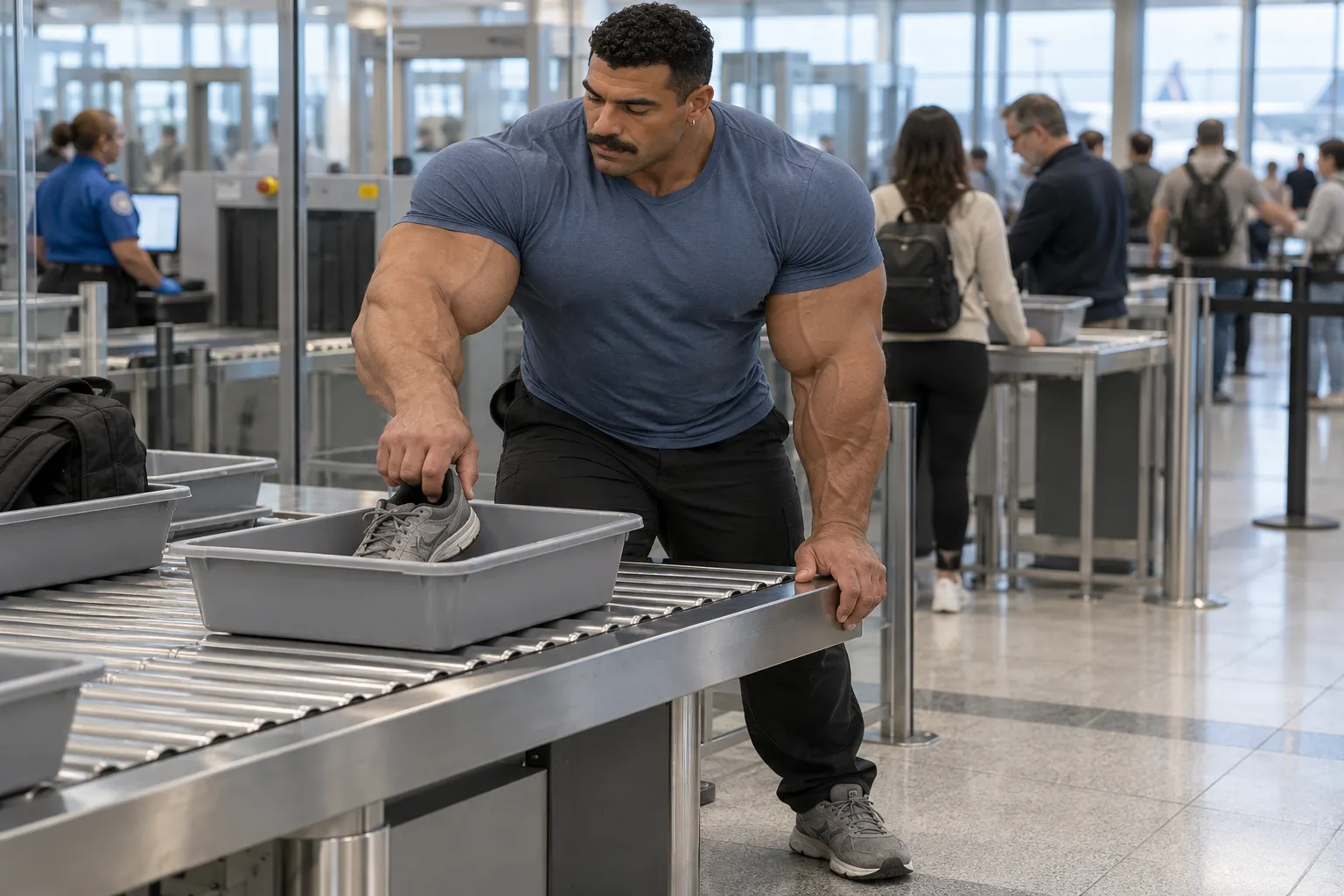
The joke: The character is enormous. The procedure stays completely normal.
Opening composition: Show the broad shoulders and small tray together before the shoe moves.
Image prompt
Use my approved Luca Vale identity reference. An original fictional adult named Luca Vale, age 38: dark olive skin, broad square face, thick dark eyebrows, very short black curls, neat short dark moustache, small copper hoop in his left ear. Comically oversized muscular shoulders, upper arms and torso; stable human hands, joints and facial proportions. Quietly patient personality. He does ordinary errands without flexing. Natural skin texture, coherent light and real-looking objects. Do not imitate Renji Kuru, a real athlete or an existing fictional character. Fitted slate-blue short-sleeve T-shirt, black travel trousers, gray sneakers. At an ordinary airport security conveyor, he leans forward and places one worn gray sneaker into a gray screening tray with his right hand; his left hand rests on the conveyor edge. Three-quarter medium-wide shot with the entire head, both hands, tray and broad shoulders visible. Stainless-steel rollers, glass partitions, cool overhead light and soft daylight. Coherent fingers, shoe grip and tray contact. No logos, text overlays, flexing or new face.
Open this image prompt in Create Photos ↗
Video prompt
Continue from the approved airport still at normal real-time speed. Luca places the sneaker in the tray, releases it and uses the free hand to slide the tray along the conveyor, shifting his stance as it moves. The contrast comes from the large arm doing an ordinary task, not from slow motion or a posed reaction. Keep his adult face, short curls, moustache, copper hoop, slate-blue shirt and exaggerated body scale consistent. Fixed three-quarter camera; fingers, tray and feet maintain correct contact and support. End after the tray moves onward. No cuts, extra shoes or new people.
2. Supermarket: the basket becomes the punchline
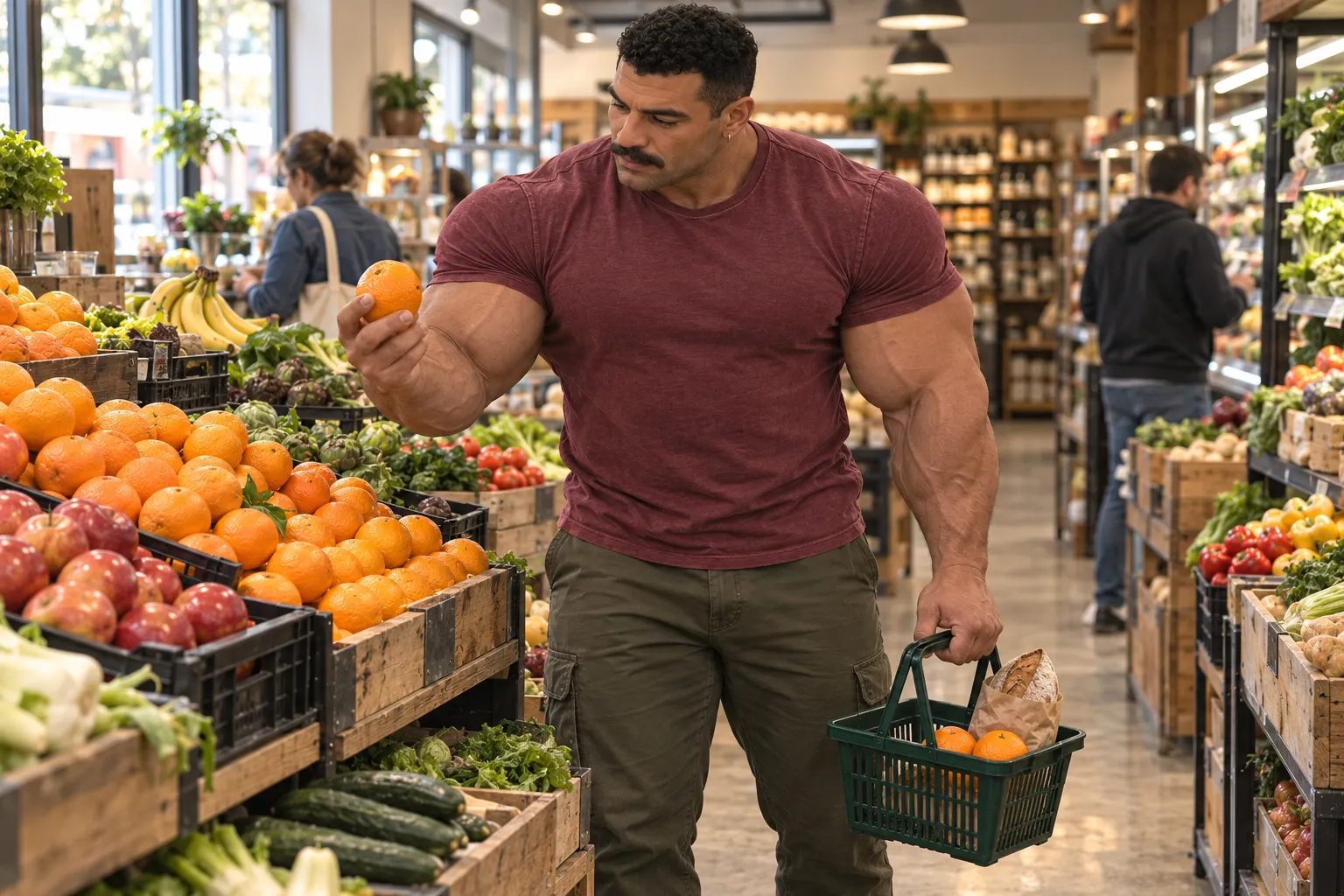
The joke: He can lift a great deal. He still needs to choose one orange.
Opening composition: Start with the small basket beside the large forearm, with the orange in view.
Image prompt
Use my approved Luca Vale identity reference. An original fictional adult named Luca Vale, age 38: dark olive skin, broad square face, thick dark eyebrows, very short black curls, neat short dark moustache, small copper hoop in his left ear. Comically oversized muscular shoulders, upper arms and torso; stable human hands, joints and facial proportions. Quietly patient personality. He does ordinary errands without flexing. Natural skin texture, coherent light and real-looking objects. Do not imitate Renji Kuru, a real athlete or an existing fictional character. Washed burgundy cotton T-shirt and olive cargo trousers. In a small supermarket produce aisle, he examines one orange in his right hand and holds a small dark-green shopping basket by its folding handle in his left. A paper bread bag and two oranges sit inside the basket. Three-quarter medium-wide view with the entire head, both hands, orange and basket in frame. Scuffed produce crates, usable vegetables, overhead shop light with warm window light. Quiet concentration rather than a pose. Coherent grip and scale; no floating fruit, logos, text overlays or new identity.
Open this image prompt in Create Photos ↗
Video prompt
Continue from the approved supermarket still at normal real-time speed. Luca turns the orange to inspect it, places it into the basket and resumes walking along the produce aisle. His gaze follows the fruit as his hand changes grip and releases it; the basket responds to its weight. Preserve adult identity, short curls, moustache, copper hoop, burgundy shirt, exaggerated proportions and basket construction. A friend records from a three-quarter view in the existing shop light. End as shopping continues; no automatic nod, extra fruit or scene cut.
3. Café: all that strength, one tiny espresso
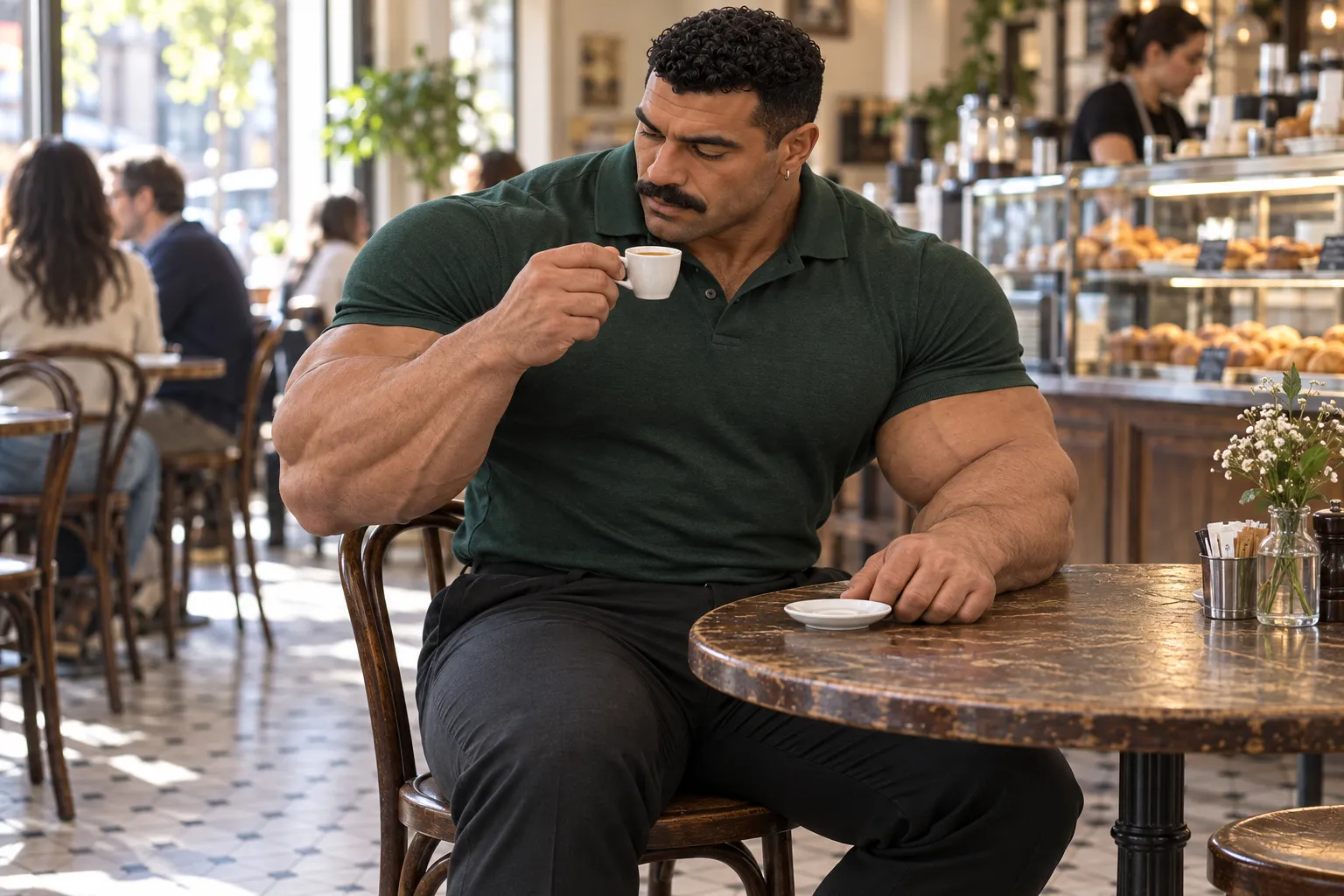
The joke: A delicate task makes excessive strength irrelevant.
Opening composition: Put the tiny cup and massive hand in the first composition, not after a long café establishing shot.
Image prompt
Use my approved Luca Vale identity reference. An original fictional adult named Luca Vale, age 38: dark olive skin, broad square face, thick dark eyebrows, very short black curls, neat short dark moustache, small copper hoop in his left ear. Comically oversized muscular shoulders, upper arms and torso; stable human hands, joints and facial proportions. Quietly patient personality. He does ordinary errands without flexing. Natural skin texture, coherent light and real-looking objects. Do not imitate Renji Kuru, a real athlete or an existing fictional character. Forest-green short-sleeve knit polo and dark trousers. Seated slightly sideways at a worn café table on an ordinary bentwood chair, he delicately lifts a tiny white espresso cup by its actual handle with his right hand; his left hand rests beside a saucer. Keep the cup upright below his face, both arms and the complete head visible in a medium-wide three-quarter view. Morning window light, scratched tabletop, tiled floor and a softly blurred pastry counter. The furniture stays intact. Coherent fingers, cup handle and shadows. No logos, text, product endorsement or identity change.
Open this image prompt in Create Photos ↗
Video prompt
Continue from the approved café still in real time. Luca lifts the small cup by its handle, takes an ordinary sip and returns it to the saucer, releasing the handle once the cup is supported. His other hand and torso adjust naturally for balance. The scale contrast supplies the humor without an artificial pause. Preserve his adult face, short curls, moustache, copper hoop, green polo, exaggerated proportions and cup shape. Fixed three-quarter phone camera, existing café light, no spilling or scene cut.
Review consistency, then test the premise
A repeatable production method needs rejection criteria. Review the actual output, not just the saved character name or prompt.
- Identity: compare jaw, hairline, moustache, skin tone, earring and body proportions with the master.
- Physical contact: inspect every finger around the shoe, basket handle and cup; check weight, occlusion, reflections and shadows.
- Opening clarity: the body and normal-sized object should be readable together, including on a phone.
- Motion: watch the beginning, middle and end for face drift, hand changes, expanding muscles or new props.
- Story: each location needs a different everyday problem, not the same flex with a different background.
Publish an approved episode with a clear fictional-AI disclosure and appropriate rights for character, imagery, audio and locations. An AI fitness persona should not be presented as evidence of an achievable physique, a training transformation or a product result. See our AI disclosure guidance and commercial-use information.
For your own test, record the posting time and compare the same time window after each upload. Use the platform's actual reach, watch-time or retention, shares, saves and follows when available. Change one creative variable at a time, such as the opening composition. A three-post test can generate useful questions; it cannot establish a universal rule from a tiny sample.
Explore more examples in Absurd AI Characters / AI Meme Influencers.
Renji Kuru and AI fitness influencer FAQ
Who is Renji Kuru?
Renji Kuru is the recurring AI fitness character on Instagram @renjikuru, recognizable through dark-red shaggy hair, exaggerated muscles and an anime-inspired appearance. The account bio says Made with @higgsfield.ai. He is a fictional persona, not evidence of a real person's training results.
Why can exaggerated AI characters work in everyday scenes?
A familiar location provides scale and a recognizable social rule; an unusual character creates an immediate mismatch. Keeping the identity stable while changing the ordinary problem can connect episodes.
How can I keep an original AI fitness influencer consistent?
Save an approved original adult character, use the same identity reference for every scene, repeat a short list of facial and body anchors, and approve each still before animation. Compare face shape, hair, skin tone, accessories and proportions across outputs. A saved reference reduces ambiguity but does not guarantee perfect identity preservation.
Can I make airport, supermarket and café videos in AI Influencer Generator?
The site supports original character creation, character-referenced images in Create Photos and image-to-video in Create Video. Approve each scene separately, then use its still as the start frame with a compatible model in Advanced Mode. Use authorized inputs, review the generation quote and inspect every output. The three illustrations in this article were made with an image-generation tool for teaching; they are not a benchmark of the site's models.
Start an original character series ↗
Plan Content
Measure Engagement
Build Your Profile
Price Your Work
Write Post Copy
Brand Partnerships