
What is Mr. Stretchy AI?
Mr. Stretchy is a fictional cartoon persona whose TikTok account presents AI-assisted domestic comedy. The official bio describes “little stories from a magical AI world” and “cozy characters • AI art.” The reviewed videos also display TikTok’s “Contains AI-generated media” label. That is direct evidence for the account’s AI presentation; an unusual face alone would not establish how a video was made.
The male character is identifiable by a tall swept-up hair shape, oversized ears, a long rounded nose, expressive brows and exaggerated proportions. His recurring partner often wears a patterned headscarf, a muted pink top and a long skirt. Their rooms use plants, floral details, soft light and lived-in domestic props. The result combines a cozy world with disruptive behavior: a kitchen feels ordinary until a character’s solution becomes ridiculous.
The cleaning video’s caption explicitly calls the other character “my wife.” We use couple and husband and wife for that fictional relationship. We do not have verified personal identities for the operators, an official name for the wife, a production budget or evidence that the on-screen relationship describes the creators’ real lives.
Three original videos: a small sample, not a growth history
We opened the supplied cleaning short and two works from the profile’s Popular view. The selection lets us compare a recurring cast across more than one scene. It does not establish that these are the account’s all-time highest-viewed posts, that the same people watched each one or that their likes became follows.
| Original work | Visible likes | What we can inspect |
|---|---|---|
| My wife cleans the mess. I just cover it up. | ≈ 99.5K | about 40 seconds; The supplied representative short contrasts cleaning a kitchen mess with covering it up. The native TikTok heart control displayed 99.5K during the review; counters can change. |
| Kitchen couple comedy · October 10 display | ≈ 316.8K | about 10 seconds; Selected from the profile’s Popular view. A kitchen, cooking, the recurring couple and an exaggerated physical reaction make the domestic disagreement visible. |
| Sofa and household expectations · October 15 display | ≈ 283.4K | about 16 seconds; Selected from Popular. The husband rests on a sofa as his partner approaches; the same characters and warm domestic setting carry the episode. |
Two posts show month-and-day labels in the interface, and the cleaning post showed a relative age. We retain those source links without inventing exact publication timestamps. The table’s observation date is the review date, not a claim that every episode was published that day.
A cleaning disagreement that explains itself
The selected short’s caption provides the premise in one sentence: “My wife cleans the mess. I just cover it up.” Its kitchen action contrasts actual cleaning with concealment. The floor, cleaning equipment and mat give the abstract disagreement a visible form. The exaggerated body and feet turn a familiar shortcut into physical comedy.
This is a useful script lesson. “One partner wants a clean room; the other wants the mess to stop being visible” gives both characters a goal. Those goals generate different actions, so the joke can be read without a paragraph of backstory. A reaction or reveal then makes the difference legible. Simply placing two consistent faces beside a mop would preserve the cast but omit the comic mechanism.

The supplied representative short contrasts cleaning a kitchen mess with covering it up. The native TikTok heart control displayed 99.5K during the review; counters can change. Runtime: about 40 seconds. Watch the original TikTok ↗
Open official TikTok player
TikTok controls playback and availability. Consent, sign-in or regional restrictions may apply; the original-post link stays available above.
The same relationship travels from kitchen to sofa
The other kitchen short places the couple beside cooking equipment and uses an exaggerated physical reaction. The sofa short opens with the husband resting under a blanket as his partner approaches; later frames return to the partner’s visible reaction. Across these works, a new situation arrives while the cast and domestic world remain recognizable.
That supports a claim about a recurring sitcom format. It does not establish a numbered, causally continuous season. A recurring relationship is enough for a viewer to anticipate friction; a serialized plot would additionally require one episode’s events to change what happens next. Creators can use both, but should not confuse a repeated character with a verified ongoing story arc.
Selected from the profile’s Popular view. A kitchen, cooking, the recurring couple and an exaggerated physical reaction make the domestic disagreement visible. Runtime: about 10 seconds. Watch the original TikTok ↗
Open official TikTok player
TikTok controls playback and availability. Consent, sign-in or regional restrictions may apply; the original-post link stays available above.
Selected from Popular. The husband rests on a sofa as his partner approaches; the same characters and warm domestic setting carry the episode. Runtime: about 16 seconds. Watch the original TikTok ↗
Open official TikTok player
TikTok controls playback and availability. Consent, sign-in or regional restrictions may apply; the original-post link stays available above.
Why the couple is recognizable before the joke lands
AI character consistency works at four levels: identity, behavior, world and story state. A face reference mainly helps the first. A sitcom needs all four to prevent each post from feeling like a new account.
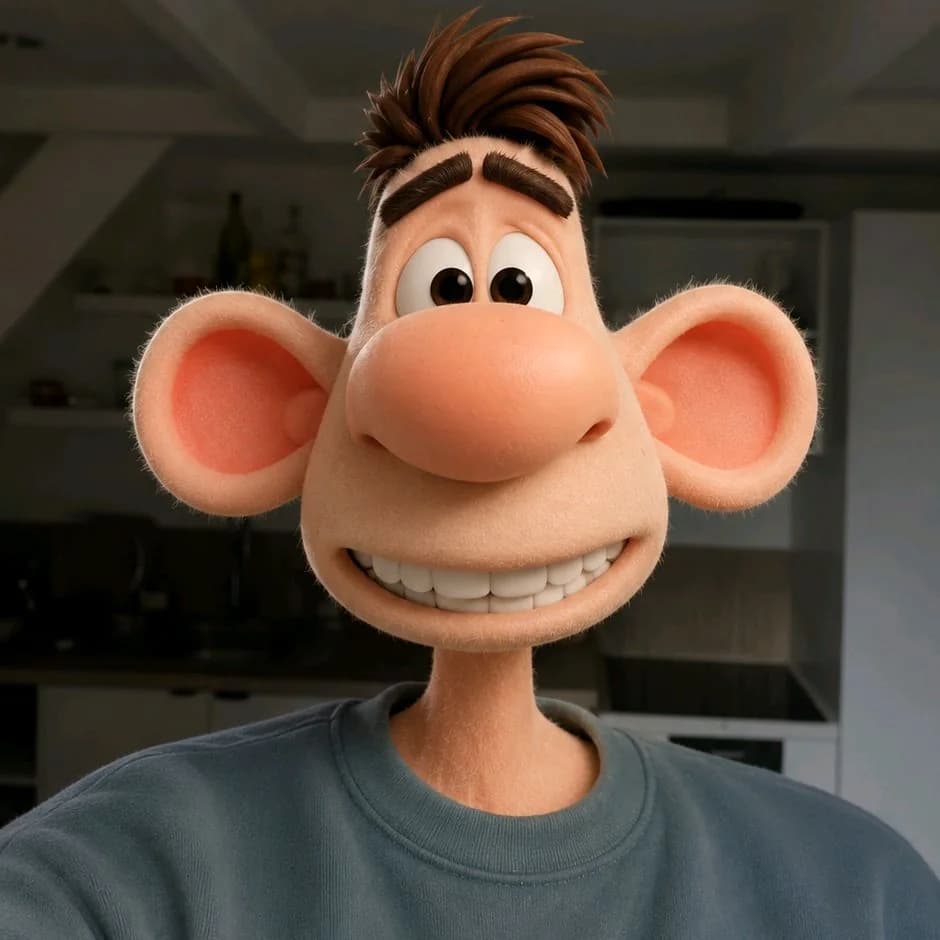
Large ears, a rounded nose, raised hair and broad brows identify him even when the room or action changes. Source: official profile portrait.
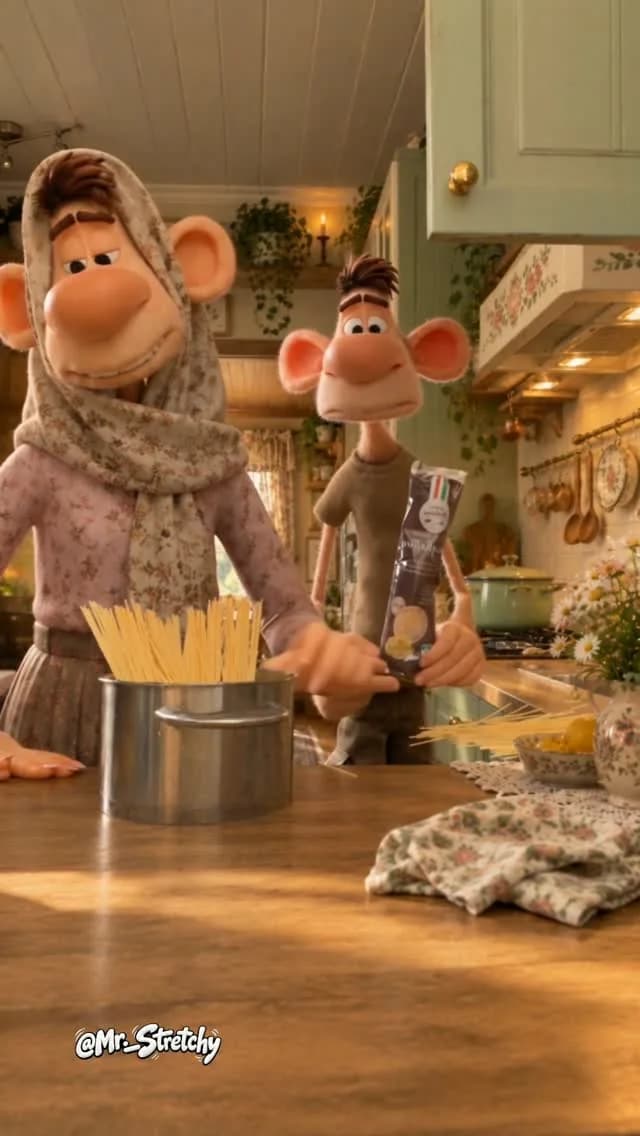
The headscarf and clothing distinguish her from the husband behind her. Source: original Instagram video preview, from the account linked by the TikTok bio. Its creator watermark is retained. This is a separate work, not a frame from the cleaning short.
| Layer | What should persist | What may change |
|---|---|---|
| Identity | Each face, silhouette, proportions, apparent adult age and distinguishing features. | Expression, camera distance and a purposeful costume change. |
| Behavior | A recognizable way of noticing and responding to a problem. | Which partner is right, who causes trouble and who resolves it. |
| World | The home’s layout, scale, recurring props and visual style. | Time of day, the room and the current household task. |
| Story state | What has already happened and what the characters know. | A new consequence or callback that the episode actually earns. |
Exaggeration also has a job. Large brows, ears, hands or a distinctive posture can make a reaction readable in a small vertical frame. Deliberate stylization should still obey the scene’s own rules: a cup must stay in the correct hand, a floor must not slide under a character and a new shot should not change which partner owns a face. Cartoon style is not a reason to accept accidental identity swaps.
The relationship does not need permanent gender stereotypes. A strong original series lets each partner be competent in some episodes, foolish in others and affectionate without abandoning the conflict. Copy the structural idea of contrasting goals, not the source account’s exact characters or an assumption that one spouse should always do the chores.
How AI couple comedy can support audience growth
A recurring cast can reduce the explanation needed for the next joke. A returning viewer already knows the faces and may recognize the relationship. That leaves more of a short video for a new problem and a payoff. This is a plausible creative advantage, not a measured retention result for Mr. Stretchy.
1. Familiar stakes make the opening easy to enter
Cleaning, cooking and resting on the sofa are ordinary situations. The viewer can understand the task before learning the fictional world. Make the first shot show a discrepancy: an implausible shortcut, a suspiciously tidy surface or someone ignoring a visible problem. A title that says “Episode 12” supplies less information than the problem itself.
2. The reversal rewards the setup
A useful reversal changes the meaning of something already on screen. A clean-looking floor can hide a shortcut; a helpful-looking gesture can create another task. Keep the cause visible enough that viewers can connect it to the reaction. Random deformation can be surprising without being a joke, because it has no relationship to the characters’ choices.
3. A series supplies more reasons to return
One successful household premise can become a format with different stakes: the same shortcut appears at breakfast, during packing or before visitors arrive. Preserve the relationship while changing the problem. Reposting an almost identical gag with a different prop risks fatigue, even if every render keeps the same face.
Use small callbacks when they add a second reward for returning viewers. A previously misplaced object can reappear in the next episode, but the new video should still deliver a complete joke for someone encountering the account for the first time. Strict cliffhangers are optional; an earned ending is more useful than a promise to reveal everything later.
4. Comments can help identify what viewers actually noticed
Visible replies on the reviewed posts refer to the exaggerated feet, recognize the couple and compare the behavior with everyday life. Those examples show that some viewers engage with both the visual design and the relationship. They are not a representative survey or proof that an interaction tactic increased distribution.
Ask a question connected to the choice in the scene: “Would you fix it now or hide it until the guests leave?” A reply episode can show the alternate choice. Avoid unrelated engagement requests that do not improve the next story. A response can supply a useful premise even when it never becomes a measurable source of follower growth.
Write an original couple before generating a single episode
Start with a relationship bible, not two isolated appearance prompts. Define what each partner wants, how they misunderstand the other and why they remain a believable team. Give each a visual identity that is yours to use. The examples below use Nora and Eli, two original fictional adults; they do not reproduce Mr. Stretchy’s designs.
Create a relationship bible for two original fictional adult sitcom characters, Nora and Eli. Nora is an improviser who values playful solutions; Eli is a careful planner who dislikes surprises. Both are capable, affectionate and sometimes wrong. Use a distinct handmade cartoon style without copying an existing franchise or Mr. Stretchy's faces. Lock each character's face, ears, hair, silhouette, apparent adult age, voice and signature accessory. Define their shared home, three recurring disagreements, what each secretly appreciates about the other, and one boundary: conflict targets a choice, never a protected trait or humiliation. Write five standalone episode premises and one small callback that can recur without requiring viewers to watch earlier episodes.
A one-page bible should include identity anchors, a shared home, a voice for each partner, three sources of everyday friction and the limits of the comedy. Add a continuity row after each completed episode: clothing, prop positions, what changed and what can return as a callback. This is lighter than a large lore document and more useful than repeatedly correcting the same preventable identity drift.
| Beat | Job | Nora and Eli lunch-label example |
|---|---|---|
| Opening · roughly 0–2s | Show the discrepancy before explaining the characters. | A tiny lunch container receives an absurdly large blank label. |
| Setup · roughly 2–5s | Make the partners’ different goals visible. | Nora wants the lunch impossible to miss; Eli wants it easy to carry. |
| Escalation · roughly 5–9s | Let one choice create a concrete complication. | The oversized label covers the container’s handle. |
| Reversal · roughly 9–12s | Resolve the discrepancy in a surprising but readable way. | Eli carries the large label while the container stays behind. |
| Reaction · roughly 12–15s | Give the audience time to understand the consequence. | Both look at the abandoned lunch, then at each other. |
This example still needs a physical staging test: the label and handle must remain coherent, and the final separation may be easier to create as two shots. The durations are an editorial starting point. The source sample itself ranges from roughly 10 to 40 seconds, so it does not justify a universal ideal length.
Write three opening variations for one finished premise: start on the suspicious prop, start on the partner’s reaction or start on the attempted shortcut. Test which version communicates the problem fastest. Do not spend generation credits on multiple endings until the script has a single understandable cause and consequence.
Create consistent AI sitcom characters in AI Influencer Generator
The workflow below is a reconstruction for your own original series. We did not verify that Mr. Stretchy uses this site, a particular model or these prompts. One reviewed post displays a CapCut editing credit; that credit does not establish the image or video generator.
- 1 · CharactersSeparate approved references and a relationship bible.
- 2 · Shared sceneOne model-supported reference for each identity and a clear screen position.
- 3 · Short shotsAnimate approved stills, then inspect identities and object contact.
- 4 · EpisodeEdit the setup, reversal and reaction; publish and review your own results.
Suggested workflow diagram. It is not the source creator’s disclosed production pipeline.
Step 1: Make two distinct characters and save their references
Open the character workspace and create each original adult identity separately. Specify the visible features that distinguish them: face shape, hairstyle, apparent age, body silhouette and an accessory that reads clearly at phone size. For a cartoon or creature design, use the appropriate character type and a model that supports that style; a photographic adult-portrait template is not a promise of unusual-anatomy support.
Use Consistent Character as the reference-preserving part of the process. Keep a small approved set for each identity, then compare every variation with its own reference. One image can establish appearance; a wider view may help check proportions. Several reference images can describe one character, so input-image count should not be treated as a guaranteed cast count.
Create your original sitcom couple ↗
Step 2: Establish the shared home with multi-reference image generation
Open Image Generation, select a model that accepts the references you need and assign a clear role to each image. Current supported image adapters include multi-reference routes such as Nano Banana 2.1 and GPT Image 2.5; the actual input limits and controls depend on the selected workflow. State which character stands on the left, which stands on the right and which optional reference describes only the room.
People Together is a convenient dedicated still-image route for two fictional adults. Its two-person form is not a platform-wide limit. For a strongly stylized cartoon cast or a larger ensemble, use a suitable general reference-guided model and inspect the anatomy carefully. Do not assume a person-specific form will preserve elastic limbs or an unusual cartoon face.
Use reference 1 only for Nora and reference 2 only for Eli, both original fictional adults. Keep each identity, hairstyle, proportions and clothing separate. Establish a modest lived-in apartment kitchen in a distinctive handmade cartoon style. Nora, on the left in a mustard cardigan, labels a small lunch container. Eli, on the right in a teal overshirt, looks at the oversized label she has chosen. Each has one clear action; hands and container stay physically coherent. Shared soft morning light, scuffed wood counter, restrained background detail, both faces readable. Do not blend the faces, add characters, copy Mr. Stretchy's design, invent a logo or render captions. This is our episode's establishing still, not a claimed result from the source account.
Approve a calm establishing image before attempting the punchline. Check that both faces are distinct, the room is stable, hands have one purpose and the prop is usable. The two-character image guide explains identity separation and repair. Save the approved scene and record the references and settings you actually used; a prompt by itself is not enough to reproduce a visual.
Build your reference-guided couple scene ↗
Step 3: Animate one readable action at a time
Use AI Influencer Video or the Video Generation workspace with a compatible image-to-video model. Start from the approved scene. If the video model offers additional references, follow its own controls; image-model input limits do not automatically apply to video.
Animate the approved Nora-and-Eli scene as one short continuous shot. Preserve both adult characters' identities, positions, proportions, outfits and the kitchen layout. Nora sets the labeled container down and glances at Eli; Eli looks from the large label to Nora, then gives one small amused eyebrow lift. Hands remain separate, the container stays on the counter, no extra fingers or new props. Keep the camera nearly still and leave a clean reaction beat at the end. No cuts, face swaps, elastic body deformation or simultaneous dialogue. Make any later visual punchline as a separate approved shot and assemble it in an editor.
Reference preservation and complicated physical interaction are separate problems. A body-stretch gag, wrestling contact or an object changing hands is harder to control than a glance and a reaction. You can create a comic reveal through a cut, a sound cue or a changed prop position instead of requiring the model to perform the source character’s deformation. Review the quoted credit cost and duration before submitting a paid generation.
For dialogue, make separate speaking and reaction shots when the selected tool cannot independently direct both speakers. Do not assume one portrait lip-sync control guarantees two-speaker timing, or that a video generation automatically edits a complete short. Use an editor for the assembly, captions, sound and final pacing. Watch once without audio to test the action and once with audio to test timing and lip movement.
Animate an approved sitcom scene ↗
Step 4: Plan the next episodes and publish deliberately
Finish a small batch before committing to a schedule. The site’s Publish workspace supplies scheduling for eligible connected accounts and supported media. An active subscription and an eligible platform connection are required. Confirm the current account options, timezone, caption and final media in the interface before scheduling. A queued item is not evidence that a platform has successfully published it.
| Episode | Keep | Change and learn |
|---|---|---|
| 1 · The lunch label | The original couple and kitchen. | Test whether the opening prop communicates the problem. |
| 2 · Packing light | Their different goals and visual identities. | Move to the hallway; let the other partner cause the complication. |
| 3 · Five-minute tidy | The same home and readable actions. | Use an original task and payoff; avoid recreating the source cleaning short. |
| 4 · Viewer’s alternate choice | The relationship and an earned ending. | Use a relevant comment as a premise, with permission if quoting or identifying someone. |
| 5 · A small callback | A previously established prop or habit. | Reward returning viewers while completing a standalone joke. |
Use the 30-day content planning guide to fit a pilot around your production capacity. More posting is not automatically better when repairs, continuity errors or rushed endings make the series harder to follow.
Measure a series without inventing a growth story
The available Mr. Stretchy evidence is a set of dated public counters, not an attribution study. A profile with 4.1M accumulated likes has received engagement across its posts. That does not identify unique fans, returning viewers, revenue or the post that persuaded each follower to subscribe. The 413.7K follower display cannot establish a 7-day or 30-day growth rate without comparable earlier observations.
| Question | Useful measure | Interpretation limit |
|---|---|---|
| Did the opening make sense? | Available early-view retention or skip data, compared with similar-length posts. | Topic, distribution and audience mix may also change. |
| Did the joke pay off? | Average watch time, completion and rewatch indicators where the platform provides them. | A loop, a shorter runtime or confusion can alter these values. |
| Do viewers recognize the show? | Relevant comments, returning-viewer indicators and interest in the next episode. | Comments alone do not measure the whole audience. |
| Does attention reach the profile? | Profile visits and available follows attributable to a post, retaining original scope labels. | Account totals do not identify a specific acquisition source. |
| Can the process sustain a series? | Approved shots per attempt, repair time and continuity failures per episode. | An efficient workflow is not proof of audience demand. |
For a small test, compare several episodes with similar lengths, posting windows and topics. Change one opening or story decision at a time when practical. Record the denominator behind every rate and keep a dated copy of the original analytics. Label observations as observations; do not convert an improvement after a format change into proof that the format caused it.
For a different relationship engine, read our Abu Nutty vs Casper crossover analysis: rivalry connects separate character accounts, while Mr. Stretchy’s couple provides a recurring relationship inside one account. Granny Spills offers another comparison in recognizable character comedy. Neither case supplies a guaranteed forecast for a new creator.
Mr. Stretchy AI: frequently asked questions
What is Mr. Stretchy AI?
Mr. Stretchy is the recurring cartoon persona on TikTok @mr_.stretchy. The profile describes a magical AI world and AI art, and the reviewed posts show TikTok’s AI-generated-media label. This case examines its fictional couple comedy; it does not identify a verified full production pipeline.
How many followers does Mr. Stretchy have?
During our October 26, 2026 Chrome review, the TikTok profile displayed 413.7K followers and 4.1M profile likes. The selected cleaning-comedy video displayed 99.5K likes. These are rounded public snapshots and can change; profile likes are different from likes on one video.
Which AI tool makes Mr. Stretchy’s videos?
The reviewed material does not establish the complete generator, prompts, reference assets or editing workflow. One post displays a CapCut editing credit, which does not identify the image or video generator. The workflow in this guide is a suggested reconstruction with original characters, not a claim that Mr. Stretchy uses AI Influencer Generator.
How do I keep AI sitcom characters consistent?
Keep an approved reference for each character, a relationship bible and a small continuity sheet for the home, wardrobe, props and story facts. Reuse the appropriate identity references, state screen positions explicitly and inspect each still and animated shot. Consistent appearance alone does not preserve motivation or comic timing.
Can I create an original AI couple comedy on this site?
Yes. Prepare separate original adult characters, use a supported multi-reference image model to establish their shared scene, then animate approved images with a compatible AI Video workflow. Use simple actions and assemble separate speaking or reaction shots in an editor when needed. References guide generation but do not guarantee perfect identities or interactions.
Does People Together limit every scene to two characters?
People Together is a dedicated still-image workflow for two fictional adults. It is not a platform-wide reference limit. General image-generation models can accept multiple references subject to the selected model’s controls. For strongly stylized cartoon casts, use a model and workflow that support those references rather than assuming a person-specific template preserves unusual anatomy.
Does character consistency guarantee follower growth?
No. A recognizable cast can make a series easier to understand and remember, but the public snapshots do not prove what caused Mr. Stretchy’s audience size. Test openings, completed jokes and repeat viewing with your own authorized analytics; do not treat another account’s likes as an expected result.
Sources, rights and research limits
- Official Mr. Stretchy TikTok profile: identity, bio, avatar, 413.7K follower display and 4.1M account-like display, reviewed October 26, 2026.
- My wife cleans the mess. I just cover it up.: original caption or descriptive identification, visible cast, native like control and AI-generated-media label checked in Chrome.
- Kitchen couple comedy · October 10 display: original caption or descriptive identification, visible cast, native like control and AI-generated-media label checked in Chrome.
- Sofa and household expectations · October 15 display: original caption or descriptive identification, visible cast, native like control and AI-generated-media label checked in Chrome.
- Official Instagram couple preview: an attributed visual comparison from the account linked by TikTok. This image is separate from the three TikTok works; Instagram followers are not added to the TikTok count.
Official portrait and video preview belong to their respective rights holders and appear here for attributed editorial analysis. The comparison reuses source material; it is not a newly generated image or permission to copy the characters. Full videos remain on TikTok through its official player and source links. Browser screenshots used for research retain interface context; analytics supplied by extensions were not treated as platform data. No operator identity, earnings, paid partnership, private analytics or complete generation pipeline was verified. The prompts and workflow are our original recommendations, and this is an independent analysis rather than an affiliation or customer story.
Explore Mr. Stretchy’s dated sources in AI Influencer Trends ↗
Plan Content
Measure Engagement
Build Your Profile
Price Your Work
Write Post Copy
Brand Partnerships