
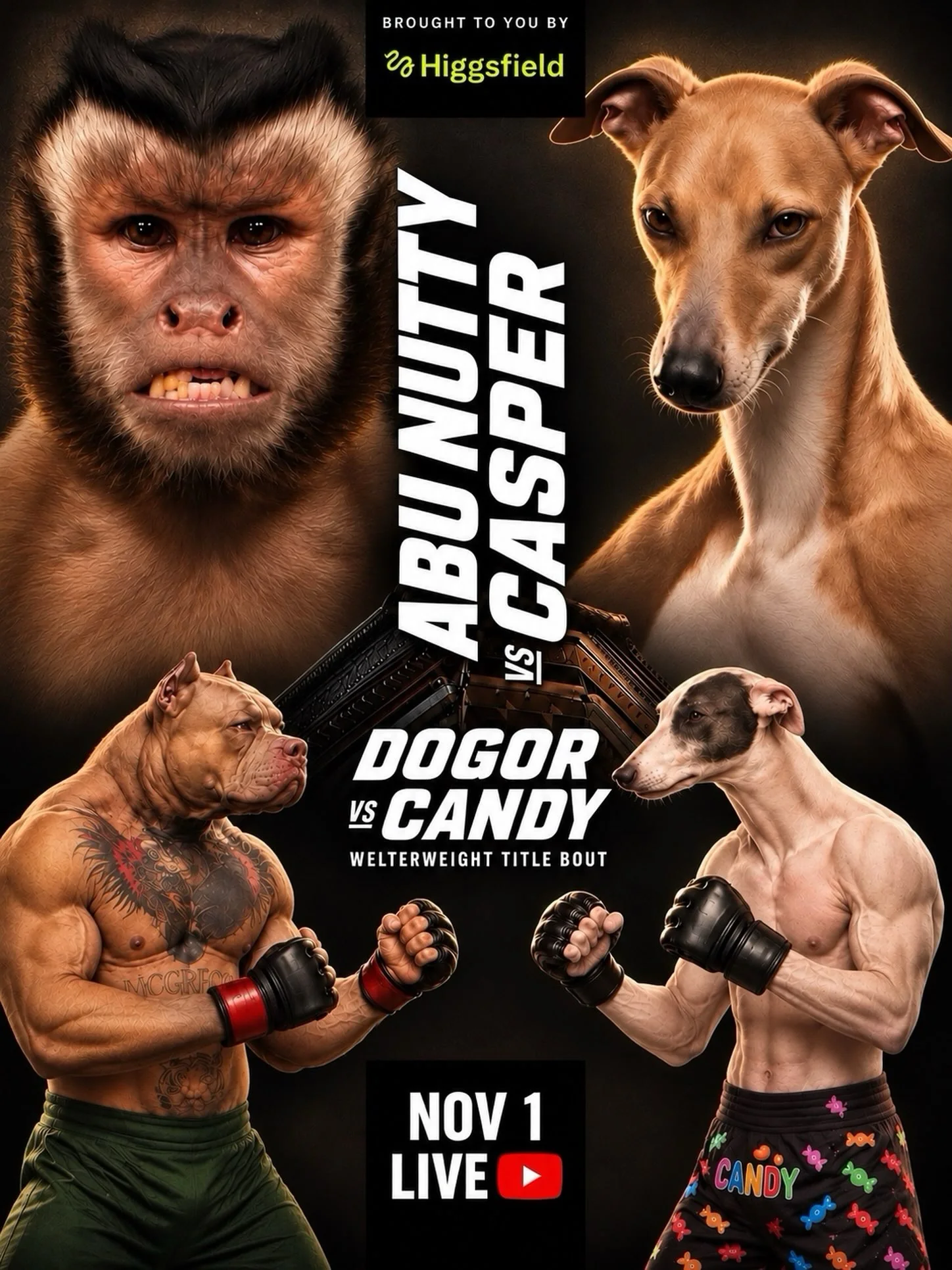
What is Abu Nutty vs Casper?
Abu Nutty vs Casper is an advertised confrontation between a monkey-fighter persona and an athletic Italian greyhound persona. Their operators use the familiar grammar of fight promotion: an announcement, training, visiting fighters, a wider card and a date. The characters can be absurd while the publishing structure remains easy to understand.
The Abu Nutty website labels the matchup its next fight and displays November 1. The collaborative fight-card post advertises a YouTube broadcast and a second bout, Dogor vs Candy. That second pairing connects the headline rivalry to an existing dog-fighter storyline. These are fictional-character promotions, not independent verification of real combat-sport records, sanctioning or a physical venue.
As of our October 26 research cutoff, November 1 is still ahead. There is no result to report. The caption advertises a 19:00 UTC start on November 1, alongside local time conversions; viewers should check the original account for changes. An advertised broadcast is also not evidence of an audience size or that a livestream has already happened.
The timeline: from a two-character challenge to a shared card
| Date | What the source shows | Why it matters |
|---|---|---|
| October 13 | A matchup announcement co-authored by @abunuttyofficial and @casper.iggy | The rivalry has two visible account owners, not only one character talking about another. |
| October 18 UTC | A locker-room episode led by @ia.vacalha, with Abu Nutty among five co-authors | A guest appearance places the character inside another cast’s fight-week story. |
| October 26 in Shanghai / October 25 UTC | A fight-card post with six accounts in Instagram’s Collaborators dialog | One shared publication connects the headline pairing and the wider cast. |
| November 1 · planned | The official site advertises Abu Nutty vs Casper; the card promotes YouTube live coverage | A future appointment creates a reason for countdowns. No outcome is available at the cutoff. |
Date note: Instagram’s machine-readable timestamp for the card is October 25 at 20:05:04 UTC, which is October 26 at 04:05:04 in Asia/Shanghai. The locker-room post is October 18 at 22:06:40 UTC. We keep that distinction rather than silently assigning every post the same timezone.
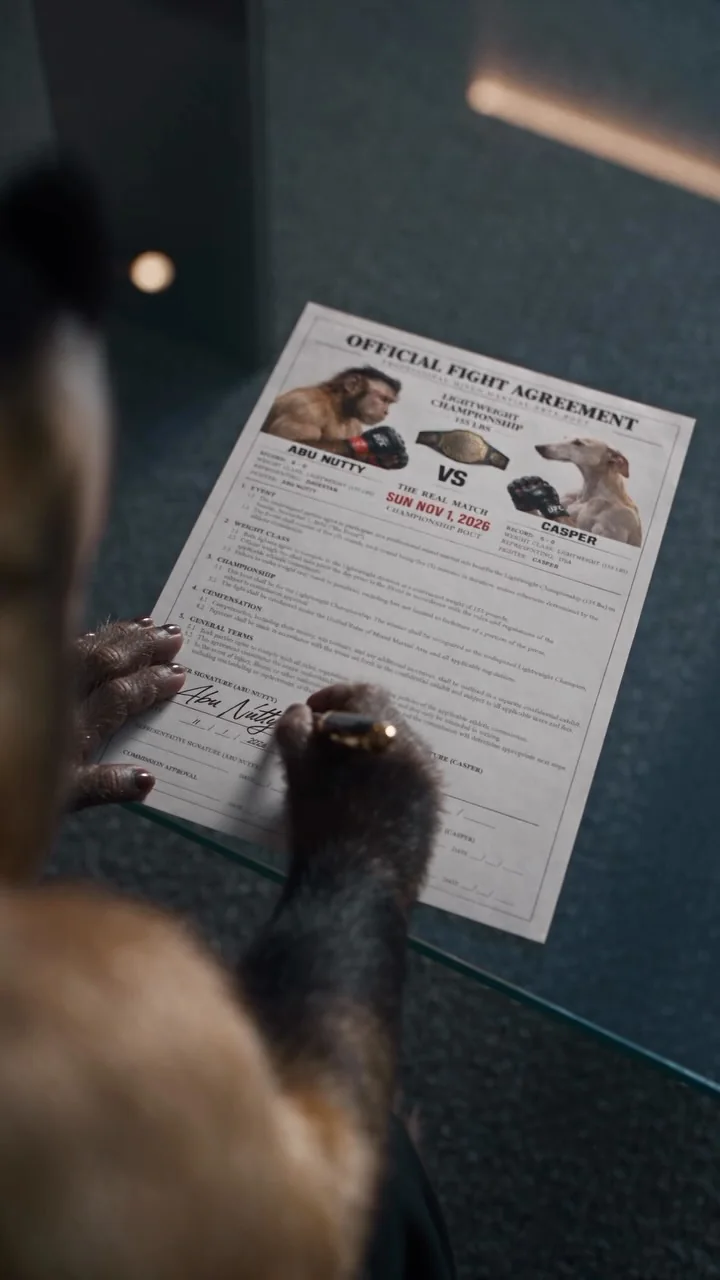
Original video preview. The agreement is a story prop, not evidence of a real signed contract.
Open official Instagram embed
Instagram controls playback and may require consent or sign-in. If the player is blank, use the original-post link above.
Who are the six collaborating accounts?
The six names below come from the fight-card post’s actual Collaborators dialog. A caption mention or an on-image credit alone does not establish co-authorship. The October 18 locker-room post lists five of these accounts: Cuca Beludo, Caramelinho, Abu Nutty, Malysh and Candy. Casper appears in the October 13 pairing and the later six-account card.
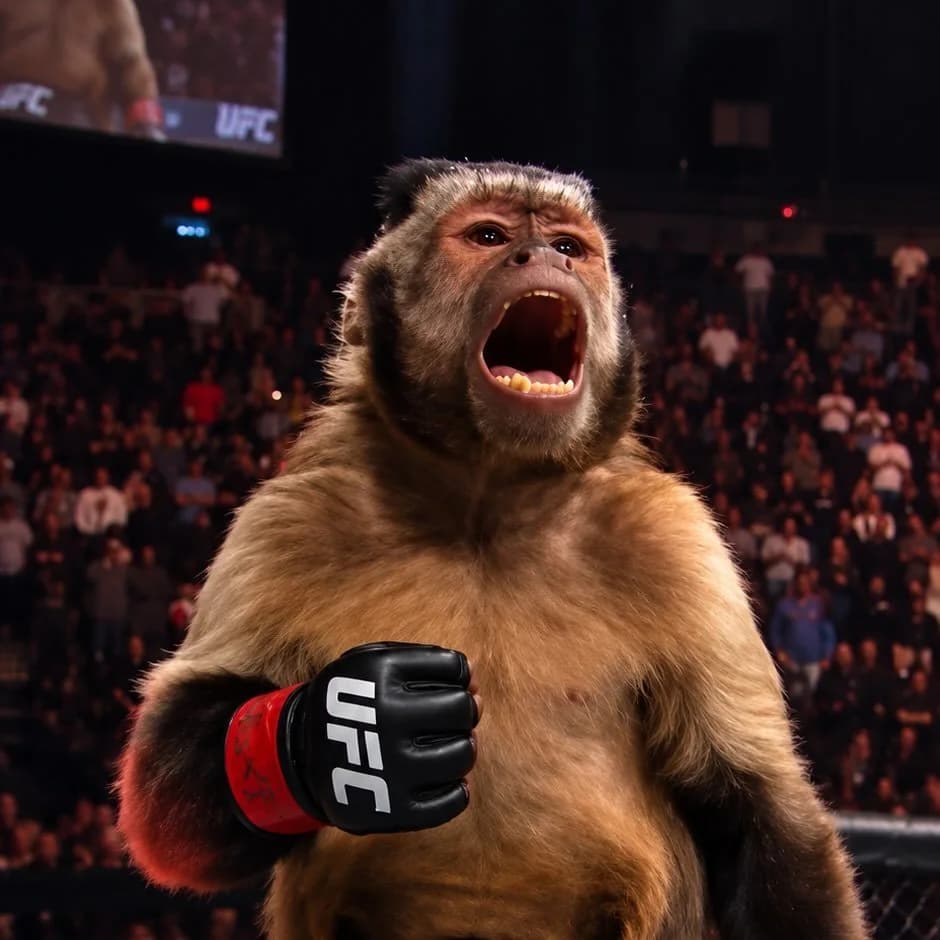
The monkey fighter and one half of the headline rivalry.
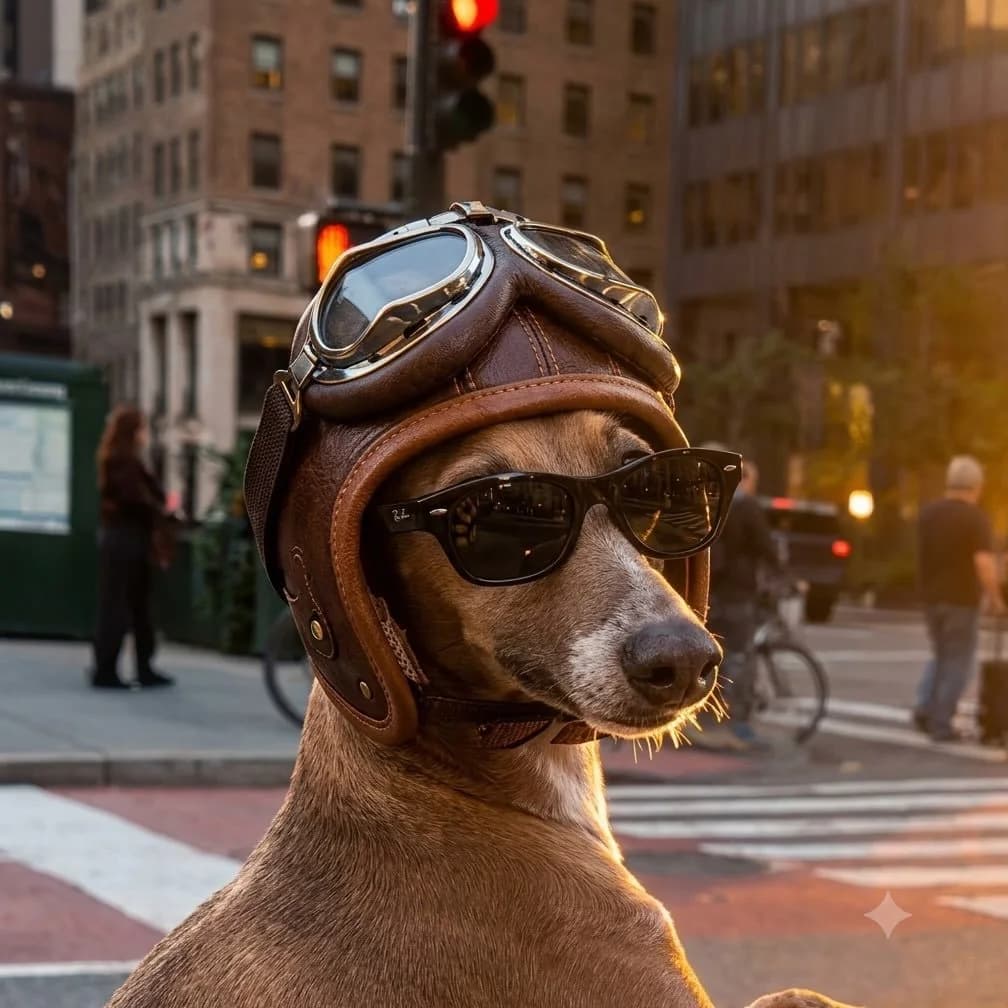
Abu Nutty’s advertised opponent; an athletic Italian greyhound persona.
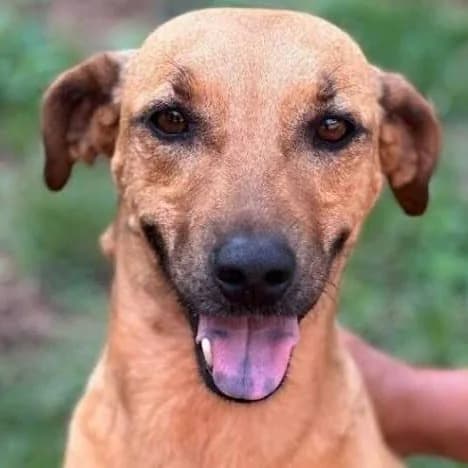
The boxing-dog character whose earlier fight-week growth Findra tracked.
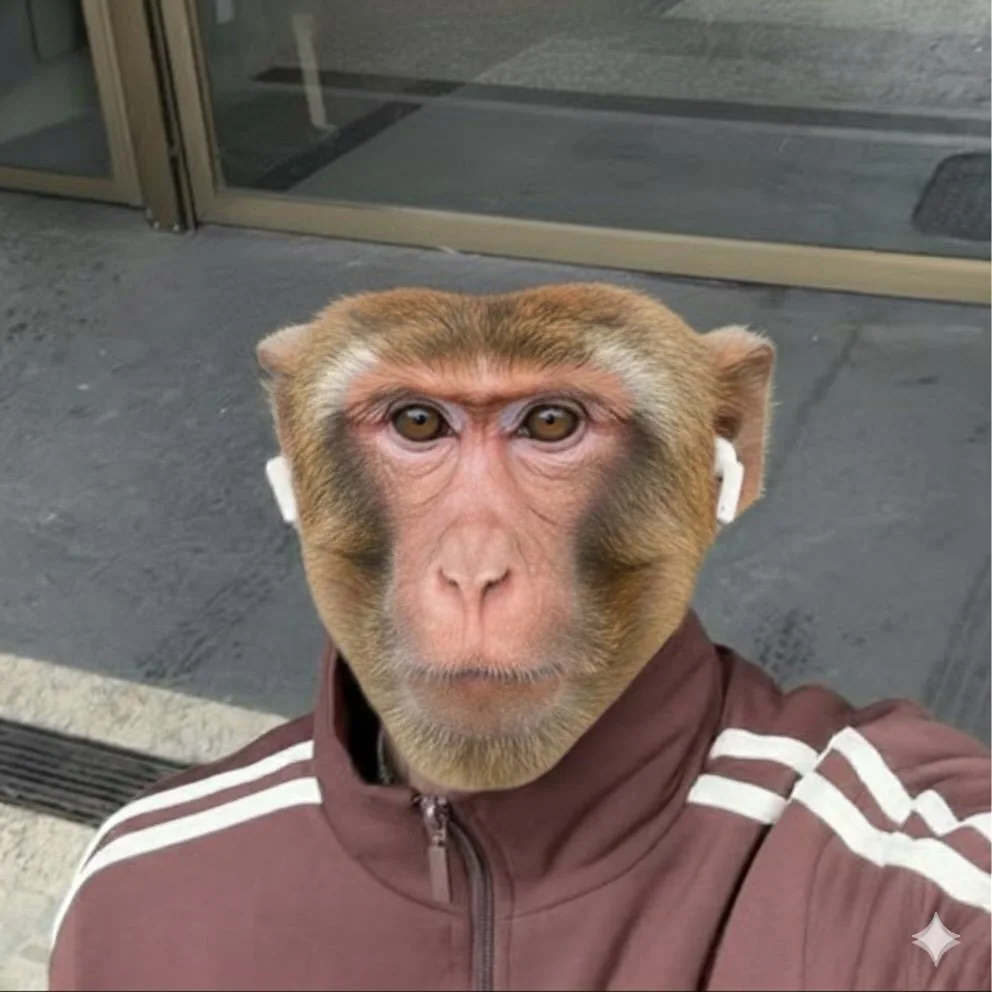
A recurring monkey persona; this account leads the October 18 locker-room collaboration.
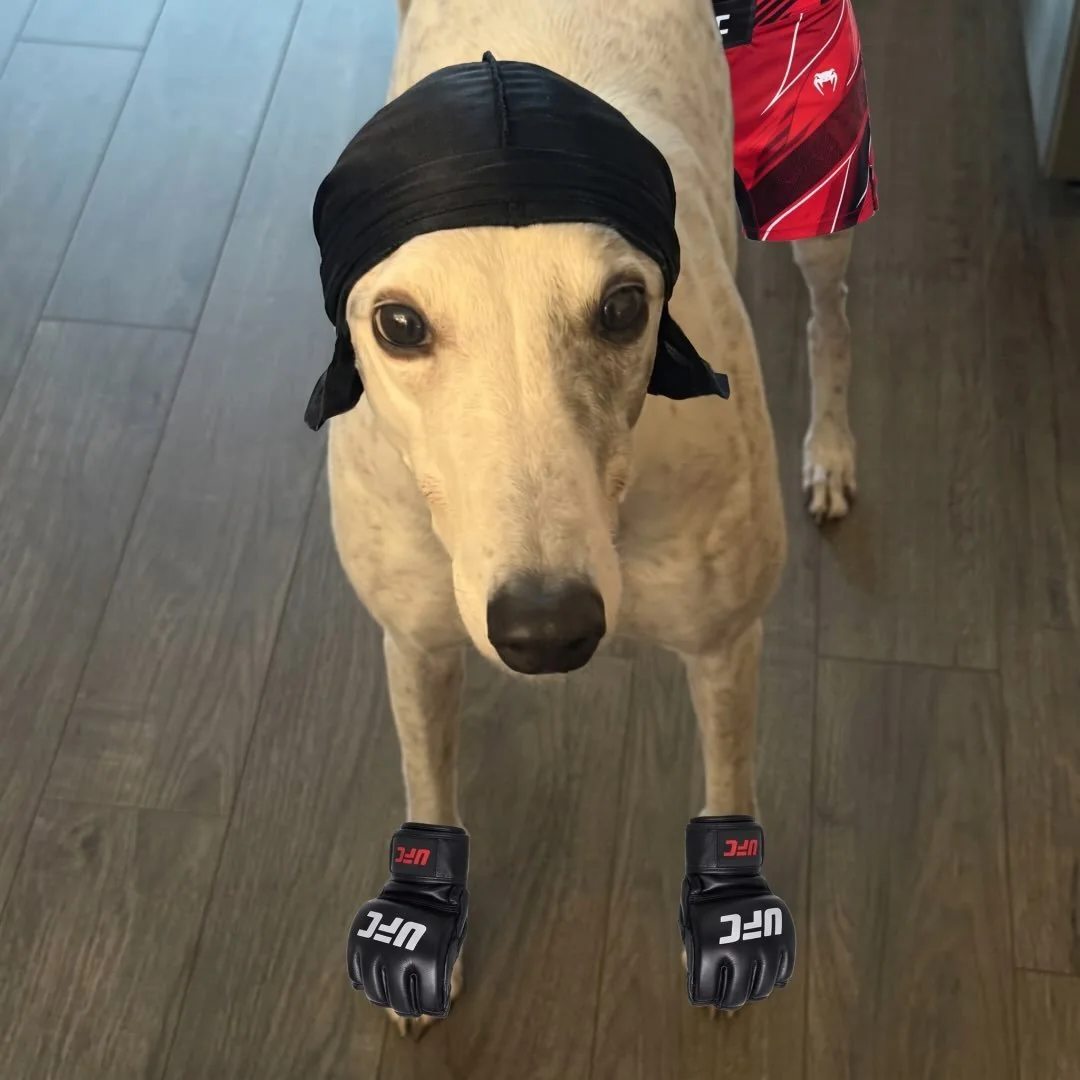
The greyhound on the second advertised matchup, Dogor vs Candy.
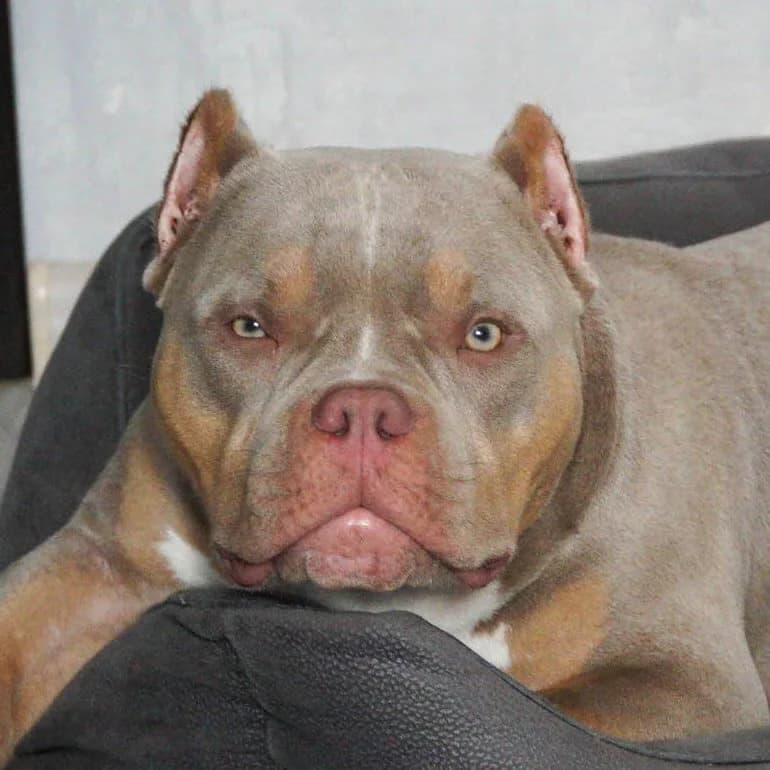
The bully-dog account tagged for the Dogor side of the second matchup.
Avatar sources are the participants’ own Instagram profiles, checked October 26. Their handles identify publishing accounts; the fictional cast and the human account operators are different things. The Malysh account appears in the poster’s Dogor pairing. We do not infer that every character, account or production role has a separate owner.
For the live research directory, use the AI influencer crossover cast in Trends. Each profile links back to this analysis and to original works. The directory’s new follower observations are rounded public displays, not exact audience exports.
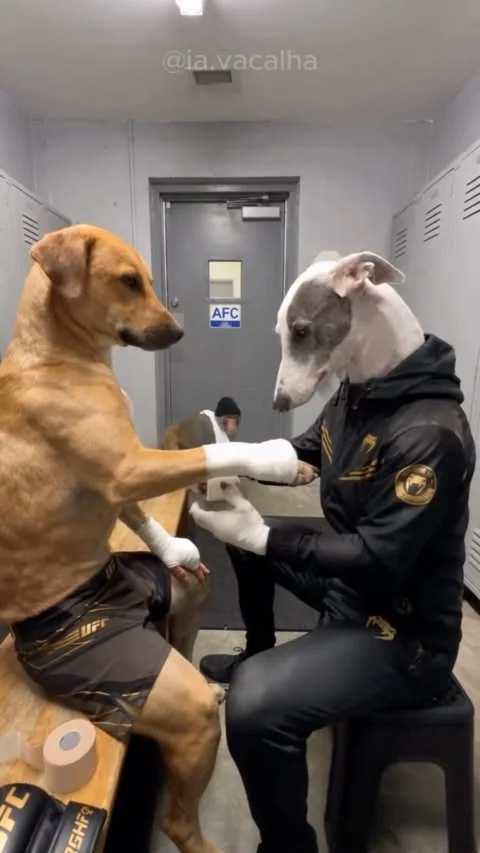
Original video preview from the locker-room crossover, retaining the creator watermark.
Open official Instagram embed
Instagram controls playback and may require consent or sign-in. If the player is blank, use the original-post link above.
How an AI influencer crossover can create opportunities for growth
The mechanism has three connected jobs: help someone discover a new character, make the relationship understandable, and give that person a reason to come back. Collaboration solves only part of that problem. A shared publication without an interesting scene can distribute an uninteresting scene.
1. Instagram Collab creates shared authorship
An accepted Collab lets a post appear on collaborators’ profile grids and be distributed to their audiences. Meta’s own Collabs announcement describes that accepted-co-author behavior. Its historical numerical invitation limit should not be used as a current universal limit; in this case we directly checked a six-account author list.
The practical difference from a mention is important. A mention points to an account. Co-authorship puts the partner’s identity on the publication itself. That gives viewers a visible route to another creator and a reason to understand the post as a joint episode. Acceptance and account eligibility still matter, and no feature guarantees delivery to every follower.
2. Cross-account exposure creates discovery, not six times the unique reach
A Casper follower can encounter Abu Nutty through a joint card; someone following the dog-fighter story can meet the headline pair through the same object. This is an opportunity for exposure across account boundaries. It is not valid to add all six follower counts and call the result the post’s reach: audiences overlap, inactive followers exist and feed delivery is selective.
Co-authors also share a post rather than creating six independent experiments. Treat its public engagement as engagement on one publication. Ask operators for authorized Insights if you need reach or non-follower exposure, and document which account and reporting scope each number describes.
3. Conflict makes the relationship legible
A rivalry supplies a question that a first-time viewer can answer immediately: who will win? Two unfamiliar faces become opposing positions. The October 13 replies contain audience members choosing teams; the card’s replies extend that behavior to Candy and the other matchup. Those comments demonstrate visible participation, not a representative audience survey.
Ordinary creators do not need a fight. A cook who values speed can challenge a cook who values presentation. A fictional minimalist can exchange packing lists with a collector. Give both characters a defensible preference and a weakness. A rivalry that humiliates the partner or depends on a false real-world accusation is a poor basis for a durable collaboration.
4. Serial episodes turn one question into several useful scenes
An announcement introduces the promise; training supplies effort; a guest visit expands the cast; a card makes the destination concrete. Each installment can stand on its own while changing the viewer’s understanding of the next one. This gives a returning viewer new information instead of another version of the same poster.
End an episode with a specific unresolved development, then deliver it. If a guest arrives carrying a mystery object, the next episode should explain the object. Repeating an empty cliffhanger teaches people that the series has no payoff. A continuing story needs continuity of identity, relationships and consequences as well as a consistent face.
5. A countdown turns passive interest into an appointment
A named date makes the promise easier to remember and gives the cast a shared production deadline. The event site and card provide that anchor here. For your own series, state the date, timezone and location of the finale clearly. A countdown is useful only when the next piece of content is ready and the time is accurate.
6. A shared character world gives every account a continuing role
A cameo works best when it changes a scene. A trainer can reveal a weakness, a rival can set a rule and a commentator can interpret a disputed moment. The locker-room crossover matters because it places several identities in a common situation. The shared world becomes a set of relationships viewers can recognize, not merely a larger image-generation prompt.
Open official Instagram embed
Instagram controls playback and may require consent or sign-in. If the player is blank, use the original-post link above.
What Caramelinho’s real growth data does—and does not—show
Findra reported a rise from 35,861 to 121,868 Instagram followers between October 11 and October 21, 2026. That is a calculated gain of 86,007, or approximately 239.8%; the ending count is about 3.40 times the starting count. These are Findra’s dated observations, not private account analytics collected by us.
- 35,861
- 41,352
- 51,141
- 75,616
- 89,953
- 107,684
- 115,270
- 121,868
Source: Findra, October 21 report. October 16–20 totals are calculated from its stated daily gains and October 15 count. October 12–14 are not interpolated. This visualization shows timing, not causal attribution.
Findra’s reported gains for October 16–19 sum to 66,332—about 77.1% of the ten-day increase. That period included training, preparation and fight-day episodes. The report also records a 13.5-million-view October 15 Reel and collaborative publications. The observations are compatible with several mechanisms acting together, including the viral video, continued output and exposure through other accounts.
| Observation | Supported conclusion | Unsupported leap |
|---|---|---|
| 35,861 → 121,868 in Findra’s dated counts | The reported account total increased by 86,007 over ten days. | Collab alone generated exactly 86,007 followers. |
| Faster reported gains during the episode sequence | The acceleration coincided with fight-week publishing. | Posting daily guarantees that growth, or one format caused it. |
| A Reel reported at 13.5M views | At least one reported breakout creates another plausible exposure source. | Those views are unique viewers, paid customers or attributable followers. |
| A later six-account fight-card collaboration | The cast continued to coordinate distribution around another advertised event. | The October 26 card caused growth measured through October 21. |
That last date mismatch is easy to miss. Caramelinho’s October 11–21 window is evidence from an earlier fight-week cycle. It cannot measure the effect of the later Abu Nutty vs Casper card. Use it to formulate a testable publishing hypothesis, rather than borrowing another account’s graph as a forecast for your own.
How to find a collaboration partner your audience can understand
Choose for a shared audience interest and a productive character contrast. Follower size is a secondary filter. A smaller food character may be a stronger partner for a café persona than a much larger unrelated fashion account.
Build a shortlist from accounts whose recurring scenes, language and audience questions overlap with yours. Read recent comments and watch complete episodes. Look for a role your character can actually fill: opponent, instructor, customer in a clearly fictional skit, host or reluctant teammate. Also check whether the operator posts reliably and can supply usable references with permission.
| Check | Useful question | Evidence to request |
|---|---|---|
| Audience fit | Would both audiences understand the challenge without a long introduction? | Recent original posts and relevant audience questions. |
| Character contrast | Can each character contribute a distinct preference or skill? | A one-sentence role for each participant. |
| Production fit | Can both operators deliver references, approvals and a finale on time? | A short test scene and an agreed review deadline. |
| Permissions and ownership | Who can use each likeness, voice, render and final edit? | Written approval for scope, reuse, credits and any compensation. |
| Measurement fit | Will both operators share the same dated metrics? | An agreed baseline, reporting window and Insights scope. |
A concise outreach message can be specific without pretending a deal exists: “I run an original café character. Your quick-lunch character would make a good partner for a three-episode lunch challenge. You bring the five-ingredient rule; we bring the presentation rule. Could we review one test scene, agree reuse rights and publish one accepted Collab for the finale?” Send it yourself after checking the account’s preferred contact method.
Plan a small series before generating the big crossover
Start with two core characters and one clear question; add the wider cast only when each extra role earns its place. That is an editorial starting point, not a technical limit on reference-image inputs. A host or referee can be useful, but six participants also mean more approvals, more identity checks and more opportunities for an incomplete episode.
Original fictional creator crossover: Mina Vale, an adult practical home cook in her thirties, believes a good lunch needs only five ingredients. Theo Moss, an adult meticulous café owner in his forties, believes presentation changes the meal. Their friendly rivalry is a timed lunch challenge, not a real dispute. Episode one: each states a rule. Episode two: they try the other person's method. Episode three: they meet at a shared counter. Finale: viewers choose which recipe they would make. Both characters get a credible strength, a funny limitation and a reason to return. No copied public characters, fake customer claims, violent threats or invented performance results.
| Day | Episode and viewer job | Publishing task |
|---|---|---|
| 1 | Meet the disagreement: five ingredients versus presentation. | Each operator introduces the challenge in their character’s voice. |
| 2 | See one attempt by each character; understand the stakes. | Publish distinct scenes, and link back to the premise. |
| 3 | Watch each try the other’s method. | Use a shared visual detail to connect the accounts. |
| 4 | Meet at the same counter; reveal the final rule. | Publish an agreed joint scene after both operators approve it. |
| 5 | Help choose the final constraint. | Ask a useful question; record answers without pretending the comments are a poll of everyone. |
| 6 | Remember when and where the payoff arrives. | State a timezone and finale location; confirm the Collab invitation plan. |
| 7 | See a complete ending, then decide whether to follow the next story. | Publish the accepted joint finale and collect the agreed metrics. |
Keep a small continuity sheet: each character’s appearance, voice, motivation, relationship to the other cast, current story facts and the next promised payoff. Separate plot conflict from the operators’ working relationship. Both participants should approve how their character is portrayed before anything is published.
Create the shared scene and interaction in AI Influencer Generator
Reproduce the collaboration workflow with original characters and authorized references. We are not claiming that these accounts used our product, or that their exact production pipeline is public. The following is a practical way to build your own stills, short performances and publishing plan.
1. Prepare stable identities with Consistent Character
Save an approved identity reference for each original character. In Consistent Character, reuse the appropriate reference across scene variations and compare the result against that character’s original. Keep hair, facial structure, proportions and signature details distinct. A reference guides the model; it does not guarantee perfect preservation.
Mina and Theo are original fictional adults. For an original nonhuman cast, use a general image model that supports your references and describe the original anatomy explicitly. Do not force an animal identity through a person-specific template or assume that an adult portrait workflow establishes animal-character support.
Start your original character cast ↗
2. Choose the right shared-image route
People Together is the convenient two-adult route. Open People Together and its Group Photo workspace, choose or upload the two adult references separately, then specify who stands where and what each person does. The optional location input describes a setting; it is not an extra face slot. The result of this dedicated workflow is one still image.
Use reference 1 for Mina, reference 2 for Theo and, if supplied, reference 3 for the location only. Preserve each character's own face, adult age, hair, body proportions and outfit. Mina stands on the viewer's left in her cobalt work shirt; Theo stands on the right in his olive apron. They face each other across a worn café counter before a friendly lunch challenge. Mina rests one hand beside her own empty plate; Theo rests his hands beside his own folded towel. Keep their hands separate and both faces unobstructed. Side-window daylight, real counter texture, believable scale and shared shadows. One calm continuous moment, no crowd, copied celebrity, text overlay or fabricated brand endorsement.
General image generation is the route for a larger reference-guided cast. Open Image Generation, select a model that accepts multiple reference images, and attach the approved references it supports. Our current image adapters pass reference-image lists to supported models such as Nano Banana 2.1 and GPT Image 2.5. Input limits and controls depend on the model and workflow; the dedicated two-face form is not the platform-wide limit.
Map every input to a job: one identity per character, then a separate environment reference if needed. State the required cast count, left-to-right positions, each character’s own clothing and one shared camera. Several reference images may describe just one identity, so image count and cast count are not interchangeable. More inputs also do not guarantee that every face will be preserved.
Use the attached reference images as separate identity anchors, not as interchangeable style examples. Reference 1 is Mina, reference 2 is Theo, reference 3 is our original adult host Jules; the final reference, if supplied, is the venue only. Exactly these three adults at one neighborhood café counter: Mina on the left in cobalt, Theo on the right in olive, Jules behind the counter in a rust overshirt. Preserve each person's own face, hair, age, proportions and signature accessory. Each has one natural task and separate hands. One shared camera, coherent daylight, realistic spacing and contact. No extra people, blended faces, duplicated characters or generated captions. This is an original fictional scene, not a photograph of a real collaboration.
Inspect every face or nonhuman identity, limb, outfit and prop contact at full size. Start with a calm face-off or conversation, not a complicated grapple. If one identity drifts, return to its approved reference and simplify the action. Our two-character image guide contains documented examples and a real repair; the same separation of identity and scene is useful when planning a larger cast.
Build a reference-guided crossover scene ↗
3. Turn an approved scene into a short interaction
Open AI Influencer Video or Video Generation. Choose an image-to-video model that accepts the approved scene as its starting image. Where a video model supports additional references, use the role and limit shown in that model’s controls; an image model’s reference capacity does not carry over automatically.
Animate the approved shared-scene image as one short continuous shot. Preserve every reference character's identity, outfit, position and proportions. Mina gives a small amused eyebrow lift; Theo glances toward her and briefly smiles. Their hands remain beside their own objects. Subtle handheld camera movement, stable counter and light. No cuts, face swaps, added cast, sudden contact, simultaneous dialogue or new objects. Keep the action restrained so the character relationship remains readable.
For dialogue, a reliable editorial fallback is a short establishing shot plus separate reaction and speaking shots, assembled in an editor. Review audio, lip movement and identity continuity for each shot. Do not assume a single portrait lip-sync control can independently direct several speakers, or that the platform automatically edits a finished multi-character episode. Check the selected duration and credit quote before submitting any generation.
4. Schedule the sequence, then handle Collab acceptance in Instagram
The site’s Publish workspace provides the Scheduler function: choose finished media from History or upload supported media, select eligible connected accounts, review captions, choose Schedule and confirm the local date, time and timezone. Publishing requires an active subscription and a supported connected account; Instagram is offered as Instagram Business in the reviewed interface.
Scheduling delivery and inviting co-authors are separate jobs. We did not find a verified Collab-invitation field in this workspace. For the jointly authored episode, coordinate the upload and accepted invitations in Instagram itself. Do not independently schedule the same finale to every account and describe those duplicates as one Collab. Use Scheduler for the supporting sequence and use native Instagram controls wherever shared authorship requires them.
After publication, check the actual author header and the post on the partner’s profile. A sent invitation, a tag and an accepted collaboration are three different states. Keep a working copy of the agreed caption and credits so an account or scheduling failure does not erase the production plan.
Plan your crossover episodes in Publish ↗
Measure the collaboration without inventing attribution
Define success before the first teaser: relevant discovery, meaningful viewing and a reason to follow the next episode. A large view count can coexist with weak profile conversion. A smaller crossover can still be useful if it introduces the right audience to a repeatable character.
| Metric | How to collect it | Interpretation limit |
|---|---|---|
| Follower change | Record each account’s count before the sequence, after the finale and seven days later. | Net change includes other posts, unfollows and external exposure. |
| Reach and non-follower exposure | Use authorized Insights for the shared post; record account, date window and metric definition. | Do not add overlapping audience counts or assume co-authors are independent reach reports. |
| Watch time / retention | Compare available video metrics with recent similar-length episodes. | A change in length, topic or distribution can change the comparison. |
| Profile visits and follows | Use the platform’s available post/profile Insights and retain the original scope labels. | A ratio is meaningful only when numerator and denominator describe a comparable scope. |
| Useful participation | Track saves, shares, questions about the next episode and replies relevant to the premise. | Comments do not establish unique people, sentiment for the whole audience or future sales. |
| Site visits and registrations | Use separate tagged landing-page links for each partner and measure actual visits and signups. | A tracked click is not proof of which Instagram exposure first created interest. |
A simple directional check is campaign-window net follower gain minus a comparable baseline-window gain. Label it baseline-adjusted change, not incremental followers caused by Collab. Other posts, seasonality and the novelty of the event remain confounders. If you can run repeated matched episodes with and without co-authorship, keep topic, length and timing as comparable as possible and still describe the design’s limits.
Review the process as well as the totals. Did both operators approve on time? Did every invitation get accepted? Did each installment deliver its promised development? How many generations needed repair? These observations can improve the next collaboration even when a small account cannot support a convincing causal experiment.
The repeatable asset is the relationship and the production process around it. Start with a manageable premise, protect each character’s identity and give the audience a completed story. Use a wider content plan to place the crossover between regular episodes rather than abandoning the rest of the account for one event.
AI influencer collaboration: frequently asked questions
What is Abu Nutty vs Casper?
It is an advertised matchup between the Abu Nutty monkey-fighter persona and Casper the Italian Greyhound, developed through AI-character content and collaborative Instagram posts. As of October 26, 2026, the official site advertises November 1 and the fight-card post promotes a YouTube broadcast. The event has not yet occurred at this article’s research cutoff.
Who won Abu Nutty vs Casper?
There is no verified result at our October 26, 2026 cutoff. November 1 is still in the future. Promotional records and fictional fight lore are not evidence of the outcome of that scheduled matchup.
Which six accounts collaborated on the fight-card post?
The Instagram Collaborators dialog lists @abunuttyofficial, @caramelinho.ia, @ia.vacalha, @casper.iggy, @candy.greyhound and @malysh_bully. We checked the actual co-author list rather than treating every caption tag as a collaborator.
Did an Instagram Collab cause Caramelinho’s follower growth?
That causal claim is not established. Findra reported 35,861 followers on October 11 and 121,868 on October 21, 2026, during a period of viral Reels, serial episodes and collaborative posts. We can calculate the change, but public counts do not identify which post, co-author or other exposure brought each follower.
Can I create a crossover with more than two AI characters?
Yes, use a general image-generation model that accepts multiple reference images, subject to its current input limits. Assign a reference and a distinct position to each character, then inspect the ensemble. People Together is a separate dedicated two-adult still-image workflow; its input limit is not the limit of general multi-reference image generation. More references do not guarantee more correctly preserved characters.
Can AI Influencer Generator automatically invite Instagram collaborators?
The reviewed Publish/Scheduler workflow supports content scheduling and delivery to eligible connected accounts. We did not find a verified Instagram Collab-invitation control. Arrange accepted co-authorship in Instagram itself, and avoid independently scheduling duplicate uploads when the plan calls for one shared post.
Is Higgsfield sponsoring the fight?
The official poster and caption display a Higgsfield promotional credit, and some participant bios describe a creative-partner relationship. Those are observable public credits. They do not disclose compensation, contract terms or a production budget, so this article does not claim a paid sponsorship agreement or sponsorship income.
Sources, statistics and update policy
- October 13 announcement: author pair, caption, visible audience participation and publication timestamp checked directly in Chrome.
- October 18 locker-room post: five named collaborators, caption and timestamp checked directly.
- Six-account fight-card post: all six names checked in the Collaborators dialog; source poster retained with its original credit. Published October 25 at 20:05:04 UTC / October 26 in Shanghai.
- Abu Nutty official site: next-fight announcement reviewed October 26. Promotional sporting language is treated as character lore.
- Findra, October 21, 2026: reported October 11–21 follower counts, daily gains and view snapshots. Calculations are ours; the underlying counts are third-party observations. Later profile counts are different snapshots.
- Meta’s official Collabs explanation, August 2023: accepted shared authorship and profile/audience distribution. Historical invitation limits are not presented as today’s universal limit.
- Participant profiles and another collaborative promo were checked for account identity and representative works. Casper’s training Reel provides another source for his athletic character premise.
This article is an independent editorial case analysis, not an affiliation, customer story or verified production-stack disclosure. Official embeds remain hosted by Instagram and may require consent or sign-in; every embed has an original-post link. No new AI imagery was generated to imitate screenshots. After November 1, update the event section only when the relevant original accounts provide verifiable evidence; do not automatically turn an advertised date into a completed event.
Follow the cast and event evidence in AI Influencer Trends ↗
Plan Content
Measure Engagement
Build Your Profile
Price Your Work
Write Post Copy
Brand Partnerships