
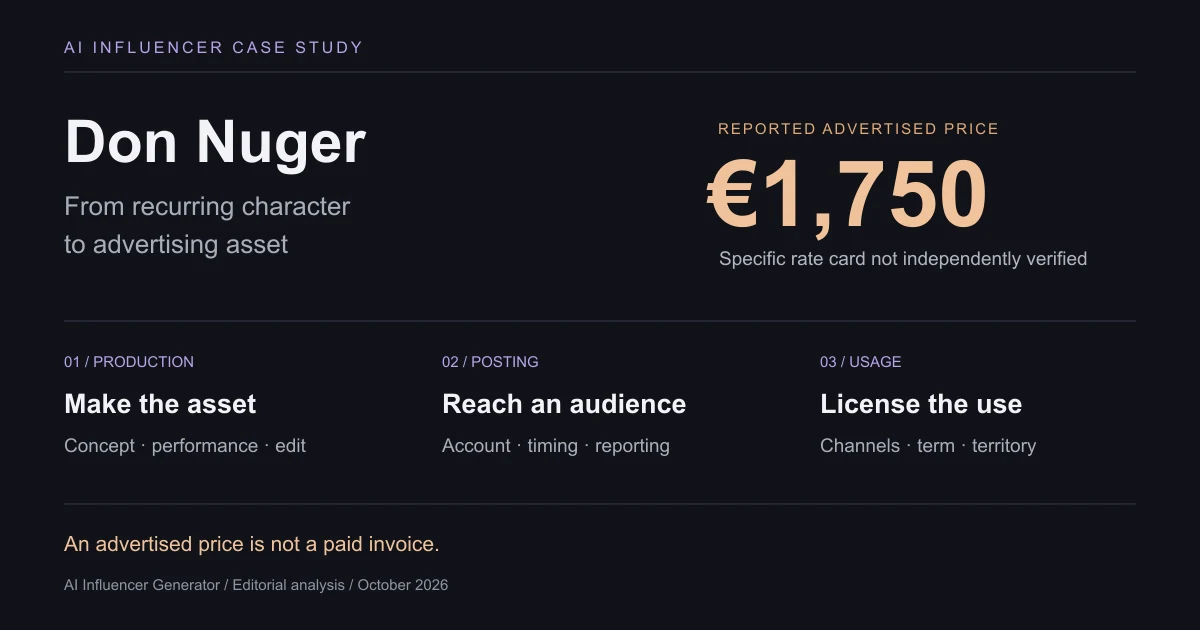
Don Nuger AI influencer: the evidence behind the numbers
In an X post published October 16, 2026 at 12:14 UTC, Synapze&Tech (@AI_Synapze) describes Don Nuger as a virtual character with 77.9K followers and a clip at 5.1 million views. The author says Internet People lists video production featuring him at €1,750, then explicitly adds that his actual earnings are not public. We reviewed the post, its attachments and the public Instagram profile on October 17.
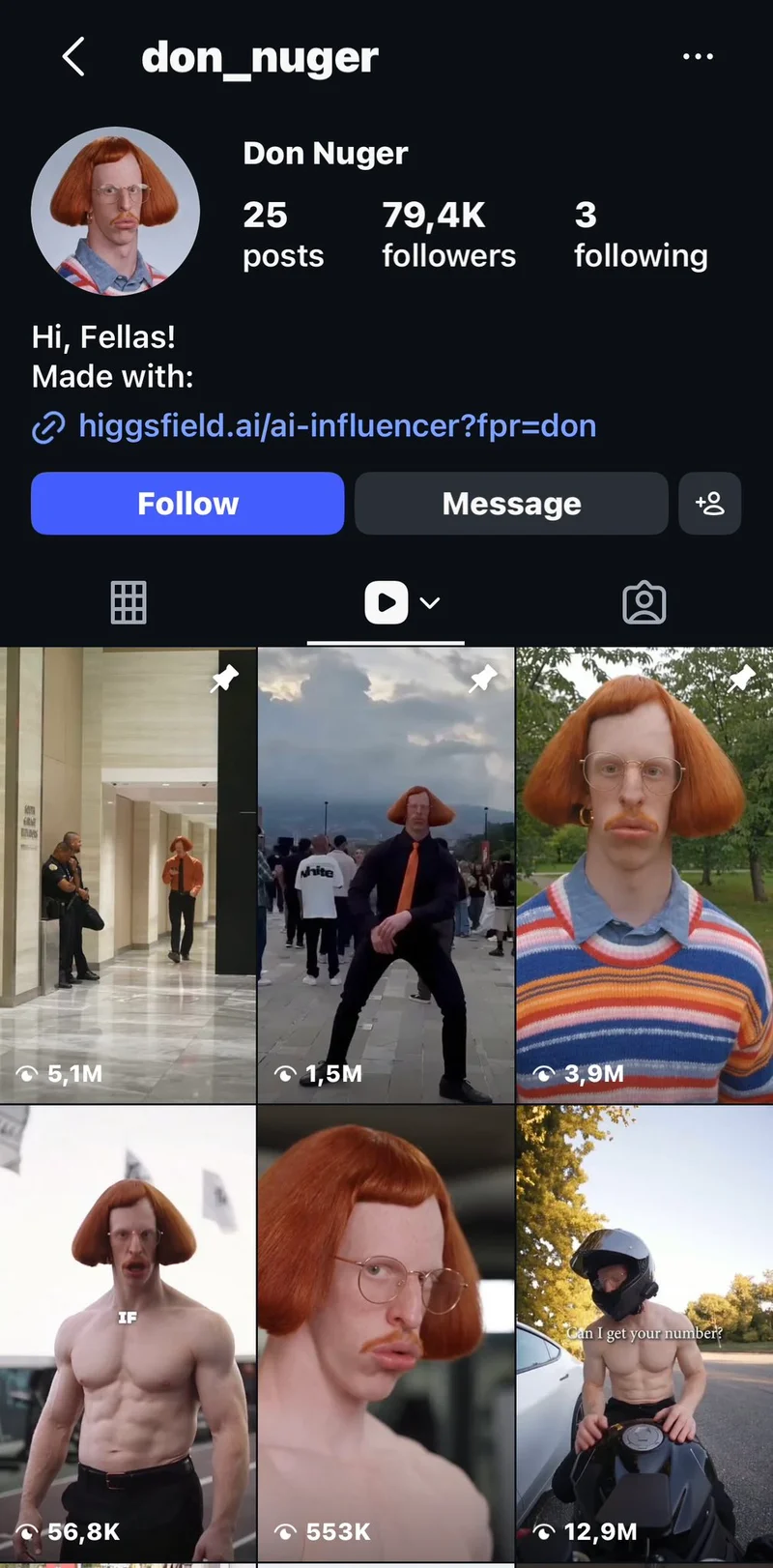
| Item | What is observable | What it establishes |
|---|---|---|
| Follower count | X text: 77.9K. Attached screenshot: 79.4K. Live public profile check: 80.5K on October 17. | Different observations; no known screenshot capture time or verified growth interval. |
| Posts | The source screenshot displays 25 posts. | A profile counter at capture time, not a complete audited publishing history. |
| 5.1M views | One pinned video tile displays 5.1M; another visible tile displays 12.9M. | A rounded video-view counter. 5.1M is not the largest counter visible in this screenshot, nor a unique-viewer count. |
| €1,750 offer | The X author attributes a video-production listing to Internet People. | A secondary-source report of an advertised price. We could not locate the specific official listing to independently verify its amount, date or scope. |
| Actual income | No invoice, payout, signed booking or accounting period supplied. | Unverified. Neither view counters nor a price establish revenue, profit or demand. |
| Tool link | The bio shows higgsfield.ai/ai-influencer?fpr=don. | A public referral-style destination, not proof of commissions or the exact production stack. |
The distinction matters for anyone researching how to make money with AI influencers. “Someone offers a service at €1,750” and “someone received €1,750 for a completed campaign” are different claims. Here, even the exact original rate-card wording remains independently unconfirmed. We analyze the commercial logic of the reported offer without treating it as a completed sale.
Our public Instagram check displayed 80.5K followers. That is a later, rounded profile reading, not a replacement for the attached evidence. We did not obtain private reach, retention, audience geography, sales attribution or sponsor records. The source does not establish who owns every component of the character or footage.
Why this character is easy to recognize—and keep watching
The red bowl-shaped bob is a silhouette before it is a face. Round glasses, a narrow mustache and unusually emphatic reactions add cues that survive small thumbnails and quick cuts. In the attached reference sheet, striped knitwear over a denim collar creates another repeatable visual pattern. These details let a viewer identify the recurring performer without reading a handle.
The stronger creative idea is the relationship between that appearance and ordinary settings. A marble hallway, public square or roadside scene is familiar. An oddly styled character performing with complete confidence makes the familiar setting unpredictable. Viewers can understand the visual situation before they know any backstory.
| Creative choice | Viewer-facing function | Commercial implication |
|---|---|---|
| Distinctive hair and glasses | Make the same character identifiable across clips. | A brand can join an existing visual world instead of commissioning an unrelated face. |
| Serious commitment to absurd behavior | Creates tension between the character's confidence and the situation. | A product can motivate the joke without becoming the only reason to watch. |
| Everyday locations | Make the premise legible quickly. | Wardrobe, drinks and practical objects can have plausible roles in the story. |
| A stable persona with changing situations | Gives returning viewers both familiarity and variation. | Supports connected episodes and a recognizable campaign rather than isolated assets. |
These mechanisms are plausible explanations of the creative, not measured causes of the account's reach. We have no controlled comparison separating character design from performance, editing, sound, posting time or distribution. The lesson is to test whether people recognize and enjoy your own character, rather than assume an unusual haircut produces a particular view count.
A recognizable face wins a glance.
A recognizable way of behaving gives the next episode a premise.
A long-running virtual IP needs behavioral rules as well as an appearance. What does the character obsess over? What do they misunderstand? How do they react to embarrassment? A wardrobe-only imitation misses the system that makes a character usable in multiple scenes. For another take on recurring personality, see our Magnus Brick case study.
The attached video: one performance, several consistency tests
The approximately 13.78-second attachment shows the red-haired character approaching two uniformed people in a large hallway, pausing nearby and moving through an exaggerated stepping performance. The orange shirt, dark tie and trousers differ from the sheet's striped sweater. The face, glasses and distinctive hair carry recognition while the wardrobe changes.
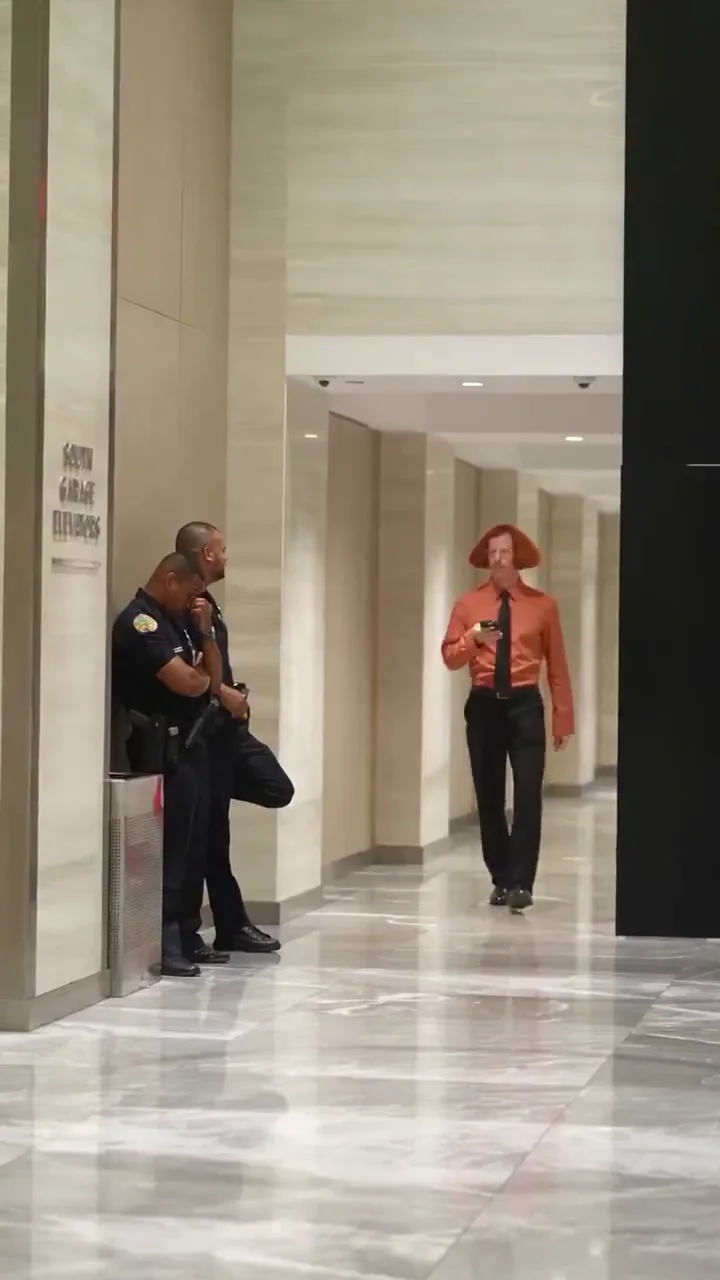
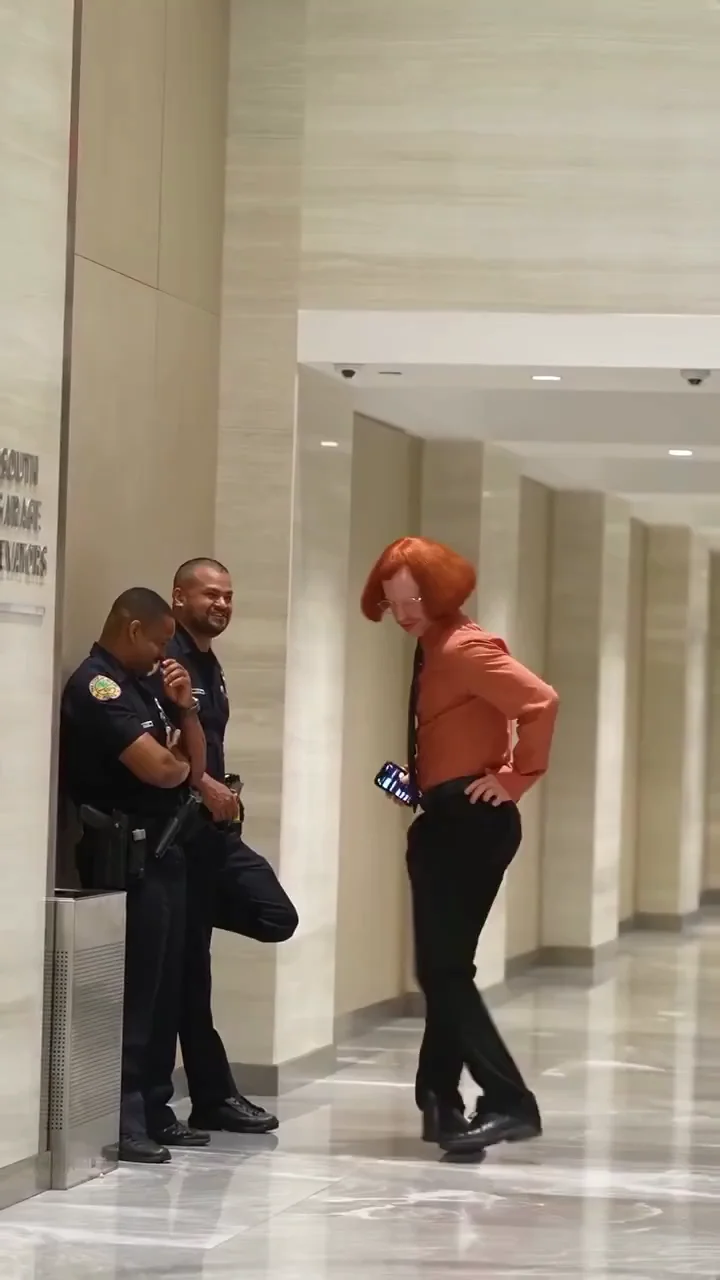
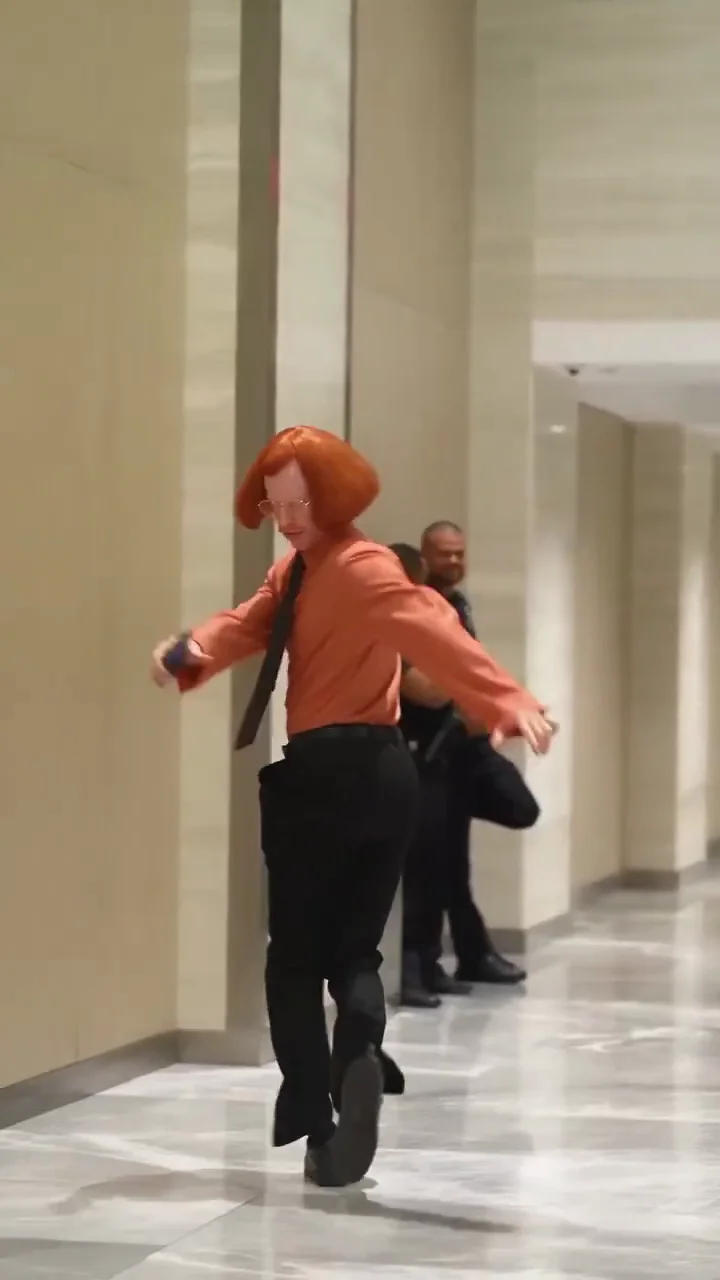
The surrounding people give the performance a social context: viewers can look between the lead character and the apparent reactions. That structure makes the scene readable without a long explanation. It also raises a production challenge. If a workflow changes one performer in existing footage, it must preserve the surrounding bodies, contact, occlusion and camera motion convincingly. A static face match alone cannot do that.
The attachment visually resembles the hallway tile labeled 5.1M in the screenshot, but we have not matched a private analytics record to this file. Its retained audio is not transcribed here; the analysis describes visible action. The file alone does not reveal whether movement was generated, transferred from a performance, locally replaced or assembled with several tools.
What the Character Sheet actually locks
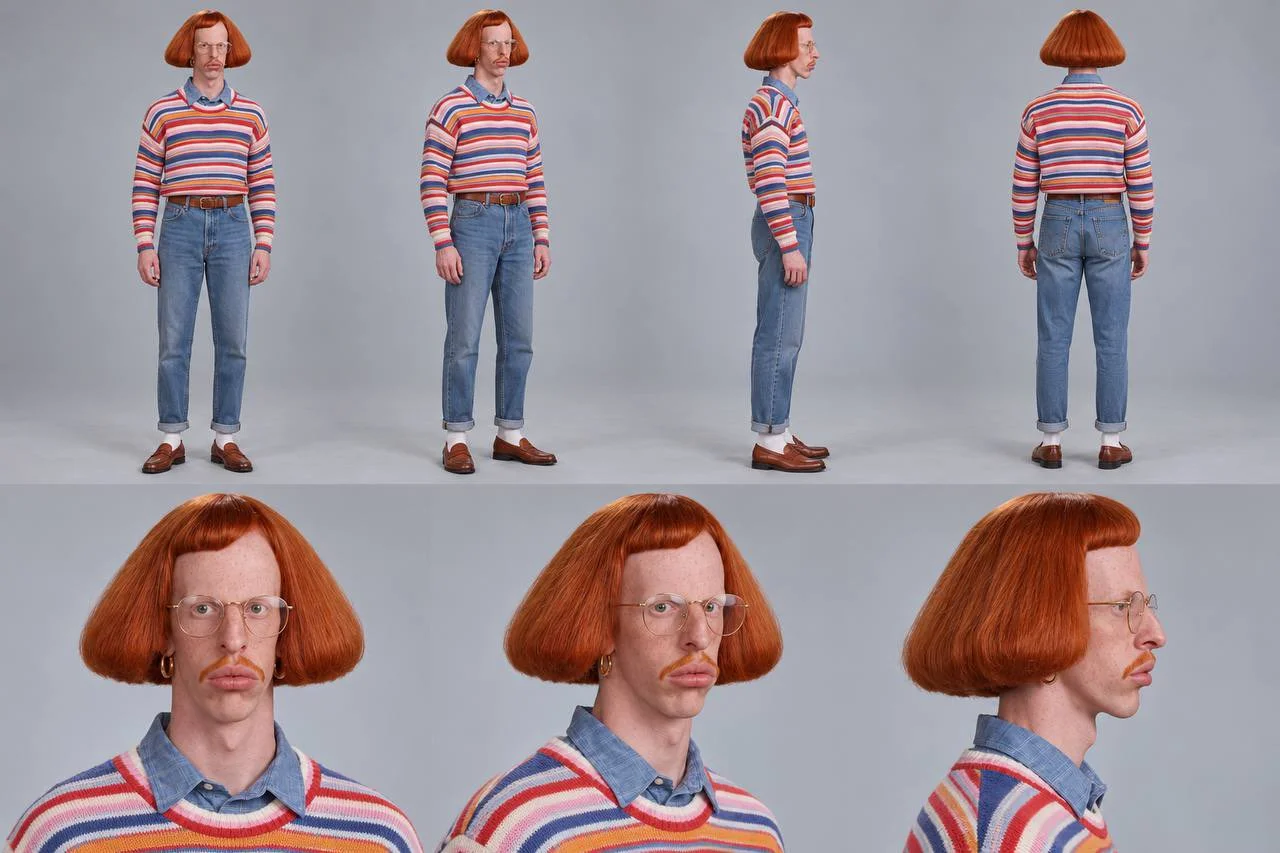
The top row shows front, three-quarter, profile and back views. The lower row shows three closer facial angles. Together they describe the hair's width and rear shape, glasses placement, nose and jaw profile, mustache, body proportions and baseline outfit. The knit stripes, blue denim, brown belt and shoes also provide a coherent palette and material reference.
This is an appearance specification, not a complete animation system. It contains no visible eight-expression grid, six-pose library, written “DO NOT CHANGE” rules or motion settings. Its inclusion in the post does not prove it was the account operator's actual generation input. For an original character, add your own identity rules and separate them from scene instructions.
| Lock across episodes | Allow with direction | Inspect in the video |
|---|---|---|
| Face structure, adult age and complexion | Expression, gaze and camera distance | Profile turns, teeth, eye alignment and emotional transitions |
| Hair silhouette, hairline and signature accessories | Wind or natural movement | Hair edges, glasses and ears during fast motion |
| Body proportions and recognizable mannerisms | Action, location and approved wardrobe changes | Hands, foot contact, scale, occlusions and background stability |
| Approved product geometry, colors and label | Lighting and physically plausible placement | Grip, reflections, label legibility and continuity through motion |
Character Sheets reduce ambiguity by supplying several views of the same identity. They do not guarantee perfect consistency. A model may still blend features, reinterpret an accessory or change a product when the head turns. Use the sheet to judge results, choose an appropriate single scene reference for animation, and reject drifting frames before they become campaign assets.
A feasible production workflow—and what remains unknown
The X author proposes ChatGPT for original reference design, Claude for personality and short scenes, and Higgsfield Genjutsu for authorized footage transformation. The post explicitly calls this a suggested workflow, not Don Nuger's confirmed process. We retain that distinction.
Higgsfield's official Genjutsu page describes two approaches: Motion Transfer preserves movement, camera and timing while rebuilding the scene from references; Object Swap targets selected elements while retaining the surrounding shot. Its official guide describes uploading an existing video and character, object or scene references. Those documented capabilities make a reference-led workflow feasible; they do not prove this attachment used it.
- Design identityOriginal adult character, clear silhouette and stable face.
- Stage the sceneOne shot, one action, clear physical relationships.
- Guide performanceAnimate a reference image or use an authorized motion clip.
- Review the resultCheck identity, anatomy, background and edit timing.
Choose the technique to fit the shot. Image-to-video is useful for a controlled reaction or small movement. Motion transfer is useful when comic timing and body rhythm are already present in a performance you can use. A character-replacement workflow can preserve more of an existing scene's structure, but also inherits its footage and likeness obligations. Giving credit to a viral performer does not by itself establish permission for a commercial derivative.
Keep clips short enough to inspect carefully. Compare the opening, strongest expression, largest turn and final pose with the identity reference. Then watch at normal speed for flicker and timing. A convincing poster frame cannot rescue a video whose glasses slide or product changes shape during the joke.
What a reported €1,750 brand-video offer is really selling
A brand does not necessarily buy followers when it buys a video. It may buy a creative concept, character performance, usable files and permission to distribute them. The reported €1,750 figure has no independently confirmed scope here: runtime, revision rounds, delivery formats, VAT, posting, paid-media rights and exclusivity are unknown. Do not present those items as included.
Concept, script, character preparation, scene generation, editing and agreed deliverables. This buys the asset-making work.
A post on the creator's account, timing, caption and reporting. This buys access to a distribution channel, subject to actual delivery.
Where, how and for how long the brand can run or adapt the asset. Paid advertising, territory and exclusivity need defined terms.
Separating these services prevents a common pricing error: assuming that one production fee includes unlimited advertising forever. It also lets a small account sell a useful creative asset without claiming a large audience. Conversely, a large audience may have little buying intent for an unrelated product.
| Model | What the brand could buy | What must be agreed |
|---|---|---|
| One sponsored episode | A product with a role in one character scene | Creative approval, deliverables, posting, disclosure and usage |
| Connected campaign | Several episodes with a recurring product premise | Episode count, production schedule, continuity, revisions and approval deadlines |
| Brand-owned advertising asset | A character video for the brand's channels | Paid-media term, territory, formats, adaptation and renewal |
| Character or content licensing | Defined reuse of a character or finished material | Ownership chain, allowed contexts, exclusivity and limits on derivative work |
| Affiliate referral | An attributable invitation to buy a relevant tool or product | Program eligibility, tracking, qualifying purchases and commission records |
The source bio supplies a concrete referral-style link; it does not reveal clicks, conversion, commission or payouts. The sponsored episodes and licensing routes above are business options, not confirmed account revenue streams. Our AI influencer monetization guide explains the wider set of models and evidence requirements.
The economic test is simple: campaign contribution = collected fee − production labor − generation and editing costs − licenses and other delivery costs, before applicable tax and overhead. If a hypothetical job collected €1,750 and its direct delivery costs were €650, the remaining €1,100 would still not be take-home profit. These are illustrative inputs, not Don Nuger's costs. Multiplying €1,750 by a guessed number of monthly bookings invents a business result.
Nor should you divide this proposed fee by 5.1M and call the result a campaign CPM. The view counter is historical organic attention; no evidence connects it to a paid sponsor's delivery. A defensible proposal specifies what you will supply, then measures what the completed campaign actually achieved.
Make the product part of the episode
The source author's strongest commercial suggestion is to give brands a role in an existing format. A clothing label supplies a character's over-serious “uniform” for an ordinary errand. A drink becomes the object of an elaborate morning ritual. An AI tool sponsors a transparent making-of episode using real screen recordings. In each case the product belongs to the premise.
The alternative—a disconnected face holding an object beside a logo—offers little reason to watch. Product fit should be visible in the action, without inventing personal experience. A fictional creator can demonstrate a garment, introduce verified product facts or perform a scripted joke. It cannot supply evidence that a real customer tasted the drink, lost weight or personally used a service for months.
- Define the roleAudience, product fact and character-specific joke.
- Approve a frameIdentity, garment or object, setting and contact.
- Produce the episodeShort performance, clear product beat and ad disclosure.
- Deliver and measureAgreed files, license, tracked destination and actual results.
How to build an original AI influencer brand series in our Studio
Use the production pattern, while giving your character a distinct identity and point of view. The example below is Milo Voss, an original fictional adult whose comic flaw is treating small laundry decisions like major investigations. His blue chore jacket, mustard neckerchief and silver-streaked curls create a different visual language from Don Nuger.
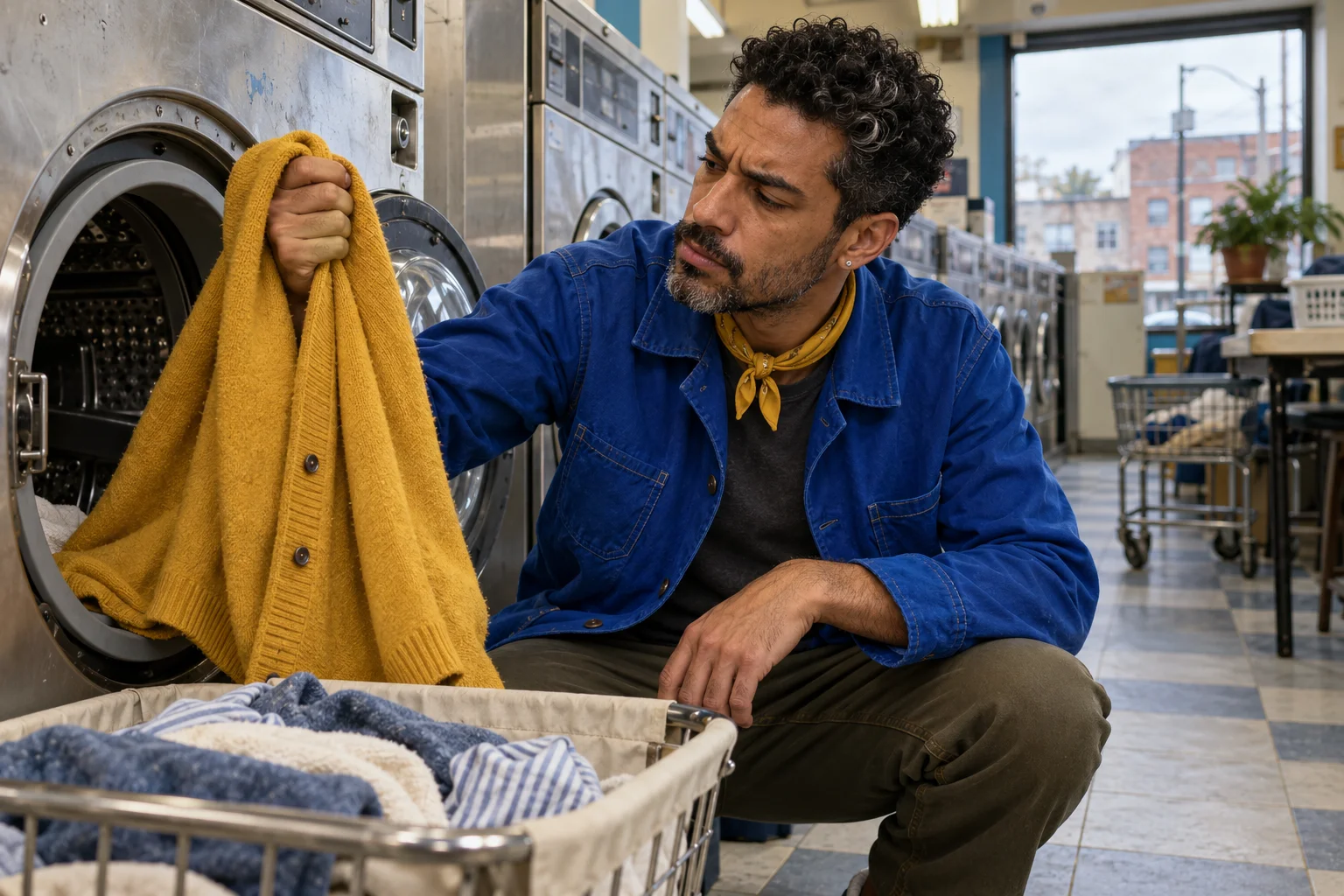
1. Create a person with a premise
Open Create influencer and define an original adult's face, hair, baseline wardrobe and memorable styling. Give the character one recurring motivation and one comic contradiction. For Milo: he wants perfectly ordinary clothes, but treats every care label as a mystery. That premise can support several scenes without copying someone else's face, name or mannerisms.
Write a compact brief: “A fictional 39-year-old neighborhood laundry obsessive; medium-brown complexion, short dark curls with a silver temple streak, short salt-and-pepper beard, blue cotton chore jacket and mustard neckerchief. His reactions are restrained until a tiny laundry problem becomes a personal investigation.” Refine the description until it makes creative choices rather than listing generic attractiveness.
Save the character before creating multiple campaign scenes. For personality and voice, use our AI influencer persona guide to connect appearance with behavior, vocabulary and audience interests.
Create your original AI influencer
2. Build a Character Sheet and test continuity
In My Influencers, open your saved character and create its Character Identity Reference. The current identity pack covers front, 45-degree, profile and full-body references; supported photo pickers label the identity reference as a Character Sheet. Review it before using it, and retry if it changes the face.
Use Consistent Character Photo to place the saved identity in another scene. Add a clear lock instruction: preserve face shape, complexion, adult age, curls and silver streak, beard and left-ear stud; change only the location and requested action. The written instruction supports the visual reference; it does not guarantee a perfect output.
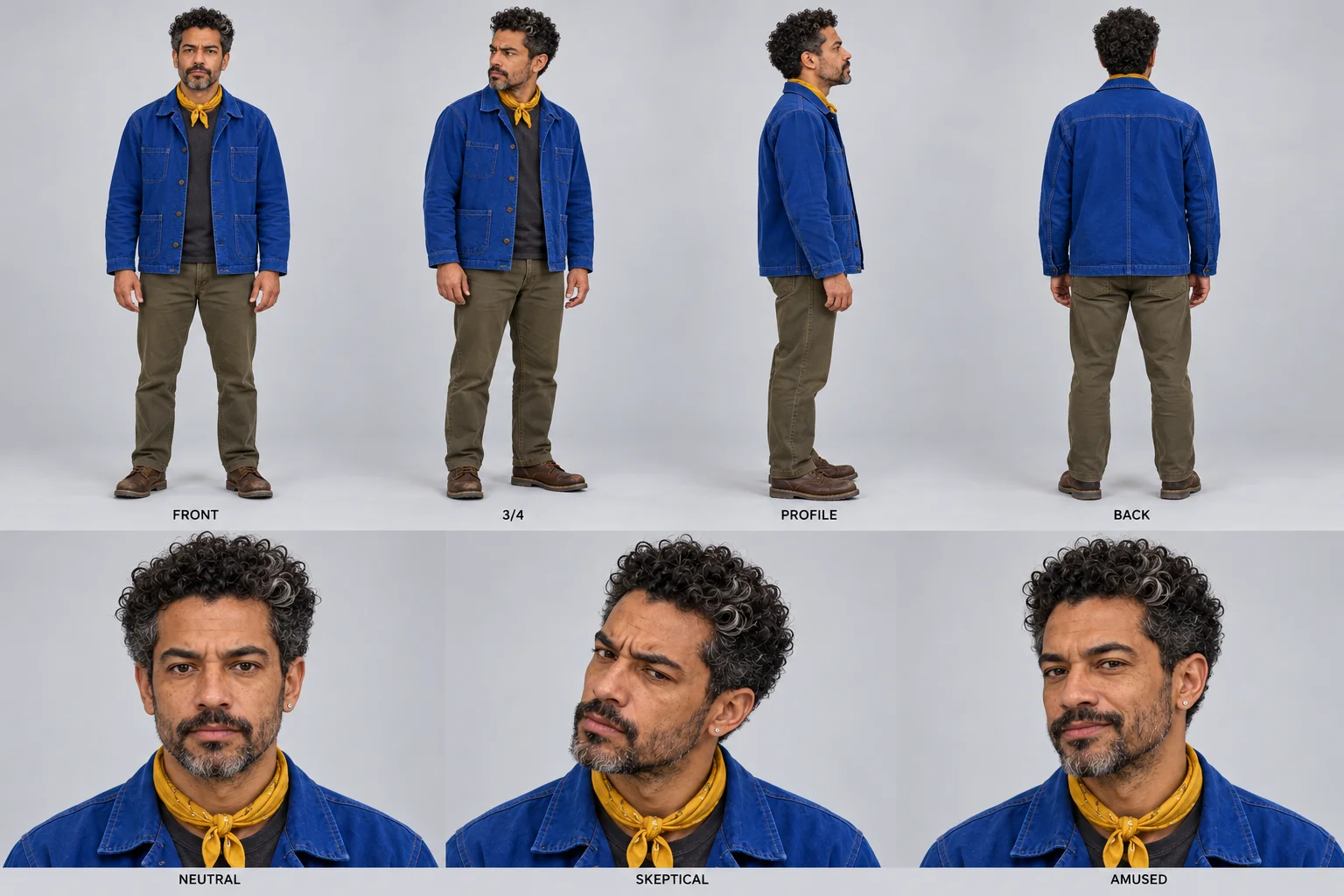
Test one neutral portrait, one profile and one scene with a changed expression before building a batch. Preserve identity while varying the joke. Keep the blue jacket as a baseline cue; an approved sponsor garment can change deliberately within the same style world. Unplanned changes in the jaw, eyes or apparent age are defects, not creative variation.
Make a consistent character scene
3. Write and animate one short comedy beat
Start with a simple sequence: a visible problem, a deliberate reaction and a payoff. For an illustrative 12–15-second Milo episode: he notices one yellow cardigan; inspects it with excessive seriousness; then reveals an entire basket sorted around that single color. The timing is a script target, not a promise that one model call returns that exact runtime.
For a small expression or gesture, animate a clean scene image in Image to Video or use Create Video. Describe one action, camera behavior and the details to preserve. Generate manageable shots and assemble the final episode in your editor when needed.
For a precisely timed walk or comic dance, open Motion & Dance. Add your character image and an owned or properly licensed performance reference. Match full-body framing when the action needs feet and hands. Review profile turns, body proportions and clothing through motion; do not assume a reference clip automatically clears its performer, music or commercial rights.
Give your character a performance
4. Add an approved product before animating the ad
Open AI Product Image Generator with the saved creator and a clear product image. The current workflow requires a product reference. Use an item you own or have permission to advertise, and specify its role: Milo inspecting the actual garment's care label, rather than holding a random package beside his face.
Generate and approve a still first. Compare garment color, seams and silhouette—or a packaged product's shape and label—with the supplied reference. Check the hand's grip, contact, light and scale. If the generator cannot preserve a critical detail, use a truthful separate product shot or revise the scene. Do not release a malformed package simply because the character looks good.
Bring the approved scene into Create Video. For scripted messaging, open Talking Video with an appropriate character portrait and your script or authorized speech. Structure the message as a hook, verified product facts and a clear next step. Combine that speaking shot with approved product footage in your editor when a separate demonstration is needed. This is a UGC-style advertising workflow, not evidence of a real user testimonial. Review the final speech, product details and captions.
Our example contains no real sponsor or branded package. A garment partner could later supply an authorized item and approved factual brief; that would be a new production task. Adding a logo to the editorial concept would not turn it into a completed collaboration.
Build your first product scene
Create a scripted advertising video
5. Turn three episodes into a portfolio and a clear offer
Use the AI Influencer Strategy Generator to organize audience, content pillars, formats and a sustainable rhythm. Build a connected sequence: a laundry misunderstanding, a wardrobe ritual and a practical resolution. Maintain the same personality while changing the situation. The strategy tool supports planning; it does not guarantee distribution or automatically secure sponsors.
Present the resulting work with the Media Kit Generator. A new account can show concept work and production capability honestly without inventing reach, clients or past deals. Label samples as speculative. Use Monetize to explore and organize your commercial approach, then negotiate each campaign directly with the relevant brand.
| Episode | Story and product role | What to evaluate |
|---|---|---|
| The investigation | Milo over-examines a garment; its approved details are visible. | Does the opening communicate the premise and show the item clearly? |
| The ritual | The same garment becomes part of his elaborate outfit routine. | Does the character remain recognizable while the story advances? |
| The resolution | A small practical feature gets a disproportionate celebration. | Is the product fact accurate, the payoff clear and the destination measurable? |
Measure completion and rewatch behavior where analytics expose them, then profile visits, attributable link clicks and the campaign's agreed action. Separate organic reach from paid reach and compare several episodes. Use actual observations to refine the next pitch; an entertaining clip can have low purchase intent, while a smaller, well-matched audience may generate useful enquiries.
Plan your character's next three episodes
Before quoting a brand: define the work and protect trust
A useful offer might read: “Three connected vertical character episodes, agreed runtimes and formats, one approved concept direction, specified revision rounds and delivery dates. Account posting and any paid-media license are separately scoped.” Fill in the actual terms for your capacity and client. Do not adopt €1,750 as a market benchmark simply because it appears in this case.
Ask where the work will appear, whether the brand can edit it, whether paid ads are permitted, the duration and territory, and what exclusivity would prevent you from doing. Establish who controls the character, the supplied product imagery and the finished content. Keep permissions and approval records. A commercially useful character needs a dependable rights chain as well as a consistent face.
For advertisements reaching US consumers, FTC disclosure guidance says material relationships should be obvious and video disclosures should appear in the video, not only its description. Apply the relevant local rules and platform requirements too. A synthetic-character label explains what the audience is seeing; a sponsorship disclosure explains the commercial relationship. One does not replace the other.
Never imply a real person endorses a product without permission, or turn a fictional performance into a personal-use claim. Using footage from an existing viral clip can introduce rights in the recording, performance, likeness, music and location. The source packet does not establish Don Nuger's permissions, and this article makes no legal finding about the account.
The business lesson: sell a repeatable creative asset
The Don Nuger AI influencer case illustrates a path from recognizable character content to a proposed advertising service. It does not establish €1,750 in actual revenue. The defensible opportunity is to pair a character people recognize with a product role that makes sense, reliable production and explicit distribution and usage terms.
A viral clip attracts attention. A consistent character makes the next episode easier to identify. A clear offer tells a brand what it can buy. Build those capabilities in sequence, and use real campaign evidence to improve the commercial proposition.
Create a character for your first original brand concept
Frequently asked questions
Who is Don Nuger?
Don Nuger is the virtual character presented on Instagram as @don_nuger. The supplied material shows a red bowl-shaped bob, round glasses, a thin mustache and exaggerated everyday performances. The account screenshot attached to the October 16, 2026 X post displays 79.4K followers and 25 posts; those are historical displayed counters.
Does Don Nuger actually earn €1,750 per video?
That is not established. The October 16 X author says Internet People lists video production featuring Don Nuger at €1,750 and explicitly calls it an advertised price. We could not independently locate the specific official rate card during the October 17 review. No paid invoice, completed campaign or payout evidence was provided, so both the original listing's scope and actual earnings remain unverified.
How many followers and views does Don Nuger have?
The X text says 77.9K followers, while its attached screenshot shows 79.4K and a 5.1M video-view label. The same screenshot includes a separate 12.9M tile, so 5.1M is not the highest visible counter. Our October 17, 2026 browser check displayed 80.5K followers on the public Instagram profile. Different snapshots are not a verified growth time series, and views are not unique viewers.
Was Don Nuger made with Higgsfield Genjutsu?
The source does not confirm that. The profile links to Higgsfield, and the X author suggests ChatGPT, Claude and Genjutsu as a possible workflow. A referral link and a suggested method do not establish the exact models, settings, footage permissions or production history of the account.
What does the Don Nuger Character Sheet contain?
The attached sheet has four full-body views—front, three-quarter, profile and back—and three facial closeups. It anchors hair silhouette, face, glasses, mustache, proportions and a striped knit outfit. It is an appearance reference, not evidence of an expression library, motion rig or the operator's generation settings.
How can I create an original AI influencer for brand deals?
Create a distinctive adult character, save its identity, build a Character Identity Reference, generate consistent scene photos and animate a short performance. Add authorized product references for brand concepts, then build an accurately labeled portfolio. Agree deliverables, revisions, posting and usage rights separately. Generating content does not guarantee sponsors or sales.
Can AI Influencer Generator make product advertising videos?
The Studio has Product Images using a saved character and product image, Create Video, Motion & Dance, and Talking Video for scripted delivery. Combine these into a UGC-style advertising workflow. These tools do not verify product claims, clear third-party rights, create real customer testimonials or automatically negotiate brand contracts.
What should an AI influencer brand-video quote include?
Specify the creative concept, runtime, format, deliverables, revisions, approval schedule, production fee and any posting obligation. Define paid-media use, duration, territory, edit permissions, exclusivity and renewal separately. An advertised starting price is insufficient to establish the final campaign scope or creator profit.
Do AI influencer advertisements need disclosure?
Material brand relationships need clear disclosure under applicable advertising rules. FTC guidance says video disclosures should appear in the video, not only the description. Explain the fictional or synthetic nature of the character where required and avoid false personal-use claims. AI disclosure does not replace sponsorship disclosure or grant footage, likeness, music or product rights.
Sources and methodology
Reviewed October 17, 2026. Evidence comes from the source post, its profile screenshot, Character Sheet and complete video attachment, plus a read-only public Instagram visit. We compare displayed counters rather than claim access to account analytics. The rate-card attribution remains a secondary-source claim; we did not locate a specific official listing or transaction record. Generated Milo examples and workflow diagrams are editorial illustrations.
- Synapze&Tech's October 16 X post — source claims, attached screenshot, reference sheet, video and explicitly proposed workflow.
- @don_nuger on Instagram — public profile checked October 17; displayed 80.5K followers and the Higgsfield referral-style URL. Counters can change.
- Higgsfield Genjutsu and official workflow guide — documented product capabilities, not proof of the account's method.
- FTC: Disclosures 101 for Social Media Influencers — disclosure guidance for material brand relationships.
Plan Content
Measure Engagement
Build Your Profile
Price Your Work
Write Post Copy
Brand Partnerships