
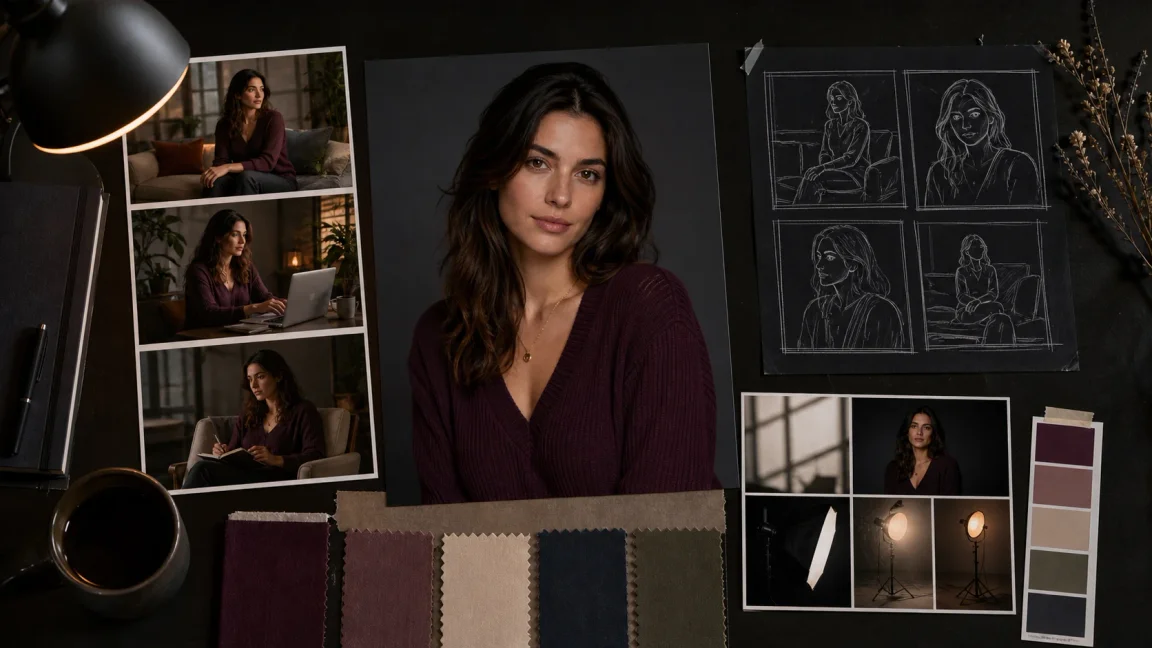
Use these prompts within the complete from-scratch AI influencer workflow, starting with one saved identity and reviewing each result.
Looking for ready-to-copy photo scenes? Explore eight trending AI photo prompt text ideas for portraits, lifestyle, fashion and travel.
Strong AI influencer prompts do more than describe a face, outfit, or background. They define a recognizable fictional adult identity, place that character in a specific content situation, and give the image or video a clear communication job.
The most useful prompts are not the longest. They separate stable character details from the scene details that should change, then give enough direction for one result to be reviewed. A prompt can guide the output; it cannot guarantee exact identity, flawless anatomy, audience growth, or campaign performance.
The four parts of a useful AI influencer prompt
A useful prompt usually answers four questions:
- 1. Who is the influencer? Include an adult age range, general appearance, personality, niche, and style direction.
- 2. Where are they? Describe the setting, lighting, season, time of day, or cultural context.
- 3. What are they doing? Give the action, pose, expression, product interaction, or scene goal.
- 4. How should it feel? Add mood, visual tone, camera treatment, and brand energy.
Prompt anatomy
[identity anchor] + [setting] + [action] + [camera and mood] + [essential exclusions]
A clearly fictional adult wellness creator with shoulder-length dark curls and a calm, practical presence; preparing breakfast in a warm city apartment; looking up from the counter with a relaxed expression; waist-up candid editorial framing, soft window light; no text, logo, watermark, or resemblance to a real person.
Define a character before you describe a post
One prompt can make one attractive image. A reusable AI influencer needs a compact identity system. Decide which details should recur before adding a new outfit or location.
Include details such as:
- Adult age range and general appearance
- Hair color, style, and grooming anchors
- Wardrobe logic, recurring colors, and accessories
- Personality traits such as calm, bold, playful, or elegant
- Content niche such as wellness, fashion, travel, gaming, or beauty
- Visual tone such as candid, editorial, cinematic, or minimalist
Avoid using ethnicity, body type, or beauty language as a substitute for an actual character idea. The character should also have a point of view, content role, and recognizable visual anchors. Keep the person clearly fictional unless every real-person reference is adult and authorized for the intended use.
Separate the identity anchor from the scene direction
The identity anchor is the part you repeat: face structure, hair, adult age range, signature wardrobe logic, and overall presence. The scene direction is the part you change: activity, environment, outfit, crop, light, and mood. Mixing both into a new description every time makes drift harder to diagnose.
On this site, a saved character or authorized reference is a stronger visual anchor than repeatedly rewriting facial details. It still does not guarantee pixel-perfect consistency. Review every result and reject or edit assets that no longer look like the same character.
A recorded kitchen prompt: reference first, scene second
Our July 30, 2026 production archive contains a completed GPT Image 2 image-to-image task with one selected fictional adult portrait as its input. The task used aspect ratio auto; vertical 9:16 was requested in the prompt. An explicit resolution is not recorded. This is an archived photo task, separate from the illustrative examples below.
Excerpt from the submitted scene direction
Preserve the exact face, freckles, eye color, hairline, hair color, age, and proportions from the reference. In the same sunlit Tribeca loft kitchen, she makes espresso at a stone counter while glancing toward the phone camera, oatmeal knit with sleeves casually pushed up, candid waist-up composition, realistic working hands, warm natural window light, authentic phone photo with slight grain. Vertical 9:16. No text, logo, watermark, branded objects, extra fingers, or plastic skin.
The full recorded prompt also names a fictional 29-year-old adult with gray-green eyes, faint freckles and champagne-blonde waves. For your own character, retain your approved reference and its defining features instead of copying that identity description. Change the coffee action or kitchen setting first; keep the framing and light stable so the next result is easier to compare.
Recorded result: the task returned a kitchen image, which was subsequently supplied as a video's first frame. This establishes the input-to-output connection, not a consistency score or proof that the prompt fixed a failed attempt. If your result drifts, compare it with the reference before changing one instruction; that is a recommended review method, not a measured repair from this archive.
Write photo prompts around one decisive frame
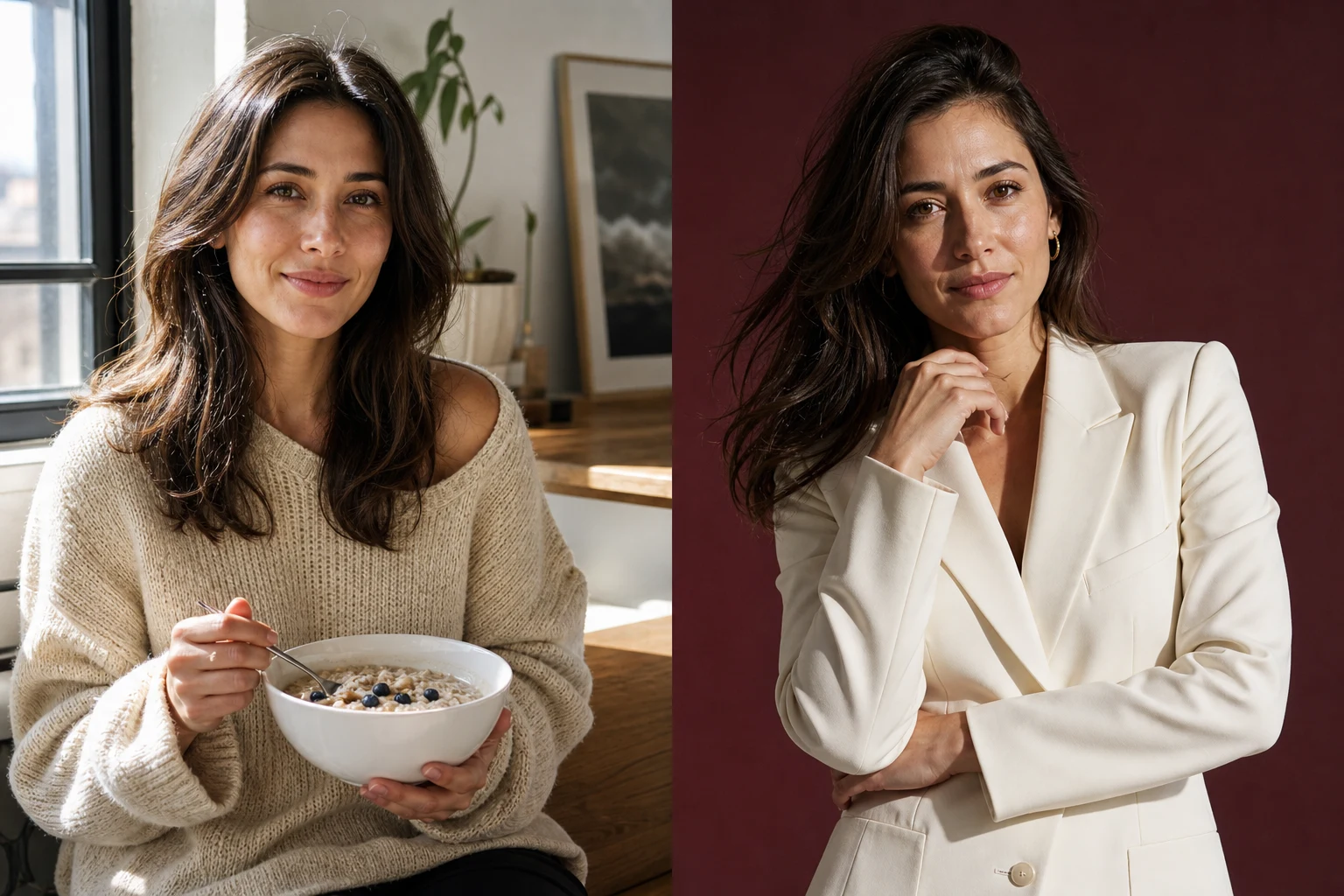
Photo prompts work best when the action can be understood in a still image. “Standing in a kitchen” is only a location. “Pouring iced coffee while glancing toward a phone on the counter” gives the frame a purpose.
Specify the crop and camera relationship when they matter: close portrait, waist-up environmental shot, full-body street image, low camera angle, eye-level candid frame, or wide editorial composition. Use light as a physical direction—soft north-facing window light, overcast afternoon, hard midday sun—not only as a quality adjective.
Give video prompts a beginning, movement, and end
Video prompts need time. A strong still-image description can leave a motion workflow unsure about what should change during the clip. Keep the action simple enough to remain readable and reviewable.
A simple structure for video prompts:
- 1. Opening frame: where the influencer starts and what viewers see first.
- 2. Action: the movement, gesture, or interaction during the clip.
- 3. Camera direction: static, slow push-in, handheld feel, tracking shot, or smooth pan.
- 4. Mood and finish: the expression, product reveal, or lifestyle moment that closes the action.
Text direction alone does not create a complete content strategy, guarantee a specific motion, add licensed music, publish the result, or analyze performance. Use supported Studio inputs and review the returned video before publication.
AI influencer prompt examples
Lifestyle photo prompt
A clearly fictional adult travel creator with a short dark bob and relaxed linen wardrobe, reading a folded city map at a quiet outdoor café just after sunrise, natural curious expression, waist-up environmental portrait, soft warm side light, subtle film texture, no logo, readable text, watermark, or real-person resemblance.
Fashion editorial prompt
The same saved fictional adult creator in a structured cobalt suit, standing against a sculptural concrete wall, composed expression and clean three-quarter pose, low eye-level camera, directional late-afternoon light, restrained magazine editorial finish, no brand marks or text.
Short video prompt
Open on the saved fictional adult creator at a kitchen counter holding an unbranded jar; she turns it once toward camera, sets it beside two ingredients, then ends with a calm direct look; static waist-up camera with a subtle push-in, warm morning light, factual product-demo mood, no testimonial claim or added text.
Product content prompt (adaptable example)
Use the saved fictional adult skincare educator and a clear authorized product reference. At a lived-in bathroom counter, the creator places the bottle beside a folded washcloth with one natural grip. Preserve the supplied package shape, pump, scale, and visible label details. Diffused window light, waist-up phone photograph; no invented claims, personal-use testimonial, or customer-review framing.
Use negative direction with restraint
Negative prompts or exclusions can help remove obvious conflicts, but support varies by workflow. Prioritize five or fewer observable boundaries that protect the asset: no readable text, no logo, no duplicate person, no extra product, no changed hair color. A long list of abstract negatives can compete with the scene direction.
Safety and rights are not solved by a negative prompt. Do not request celebrity likeness, unauthorized real-person identity, deceptive endorsements, fabricated product experience, or minor-coded subjects.
Refine one variable after each result
The first output is evidence, not failure or success. Review it in layers so you can identify the instruction that needs revision.
- Is the influencer recognizable from approved previous content?
- Does the scene fit the intended niche and audience?
- Are outfit, setting, light, and mood aligned?
- Is the action clear enough to give the asset a purpose?
- Are hands, anatomy, product details, and readable text acceptable?
- Can the prompt become shorter, clearer, or more focused?
Keep what worked and change only one weak variable. Multiple creative directions should be submitted and reviewed separately; do not assume one task will return a batch of approved variations.
Connect prompts to a repeatable content system
A useful prompt library stores stable identity anchors separately from reusable scene briefs. Organize directions by content job—education, product demonstration, lifestyle context, announcement, or campaign concept—rather than by vague aesthetic labels alone.
Prompts do not replace editorial judgment. Confirm product facts, licenses, permissions, disclosure, and channel rules outside the generation step. The FTC’s social-media disclosure guidance explains material-connection disclosure, while the U.S. Copyright Office AI initiative provides current official material on AI and copyright.
Frequently asked questions
Why is character consistency important for AI influencer prompts?
Recognition depends on recurring identity anchors. Repeat stable traits, use an approved reference or saved fictional adult character, and change only the scene-level details needed for each asset. A prompt can guide consistency but cannot guarantee an exact identity in every result.
What should I do if AI influencer images look generic or flat?
Replace broad adjectives with observable direction: a specific action, setting, wardrobe logic, light source, framing, and mood. Remove conflicting details, generate one reviewed result, then change one variable at a time.
How are photo prompts different from video prompts?
Photo prompts describe one decisive frame. Video prompts also need an opening frame, movement, camera behavior, ending state, and any identity or composition details that must remain stable through the clip.
When should negative prompts be used?
Use exclusions only when the selected workflow supports them or when essential boundaries can be stated in the main direction. Keep the list short and observable, such as no text, logos, duplicate people, or unwanted wardrobe changes.
What is the best way to improve a prompt after the first result?
Review identity, composition, action, lighting, anatomy, and unwanted details separately. Keep the parts that worked, revise one weak variable, and submit a new task. Do not treat regeneration as a guaranteed correction.
Can AI Influencer Generator write or publish a complete social strategy from a prompt?
No. The Studio can create and reuse fictional adult visual characters across supported image and video workflows. Editorial strategy, publishing, analytics, approvals, and disclosure remain the user's responsibility.
Starting from a blank content calendar? Use the AI video idea generator guide for five repeatable short-form concepts and a six-step path from hook to production brief.
Continue with the real workflow
Build the identity with the Consistent Character Generator, learn the broader process in the AI Influencer Guide, then create supported assets with the AI Influencer Image Generator or AI Influencer Video Generator. Before publishing, review commercial-use conditions and AI disclosure guidance.
Plan Content
Measure Engagement
Build Your Profile
Price Your Work
Write Post Copy
Brand Partnerships