
You can make money on Fanvue with an AI influencer through subscriptions, paid media, tips and custom content. Sustainable income comes from a clear offer, qualified traffic, repeat purchases and renewals—not simply generating more images. Start with one member collection, test an affordable subscription and one optional paid bundle, then track earnings after platform fees, production costs and your time. Some accounts never become profitable.
This guide is for operators who already have an AI character and want a business process. For character creation and account onboarding, use the Fanvue AI creator beginner guide. Here we focus on the first paying fan, a measurable acquisition funnel, pricing, retention and unit economics. We operate AI Influencer Generator; the worked examples are hypothetical, not our customer earnings.
1. Can AI Influencers Really Make Money on Fanvue?
Yes, there is a permitted payment route. Fanvue allows AI-generated content subject to disclosure, adult appearance, consent, rights and moderation rules. Its earnings policy covers subscriptions, tips, pay-per-view messages, bundles and custom content, with a standard 80% creator share and 20% platform fee unless otherwise agreed. These details were verified October 9, 2026.
The useful question is whether your particular offer can earn more than it costs to deliver. A recognizable face can attract attention. It cannot establish that someone will buy, that they will renew, or that your production process is affordable. Avoid treating a viral post, a public price or another creator’s revenue screenshot as proof of your own future income.
The official data worth understanding: Fanvue’s Subscription Pricing & Retention Guide, published August 10, 2026 and checked October 9, says that in creators’ first two months, subscriptions account for around 10% of earnings and paid messages in DMs around 60%.
The guide does not disclose sample size, selection method or an AI-only breakdown. These are observed revenue shares, not the percentage of followers who pay. They do not mean every AI creator earns six times their subscription income through messages. Our takeaway is to plan optional paid content alongside the recurring offer, then measure your own revenue mix. Do not infer the remaining 30% belongs to one particular revenue stream.
2. Five Ways to Monetize an AI Influencer on Fanvue
The following are five practical offer or delivery routes. Paid feed posts and paid DMs are both PPV; count a transaction once when reconciling revenue. The permitted paid-service categories come from the official earnings policy; feed and message mechanics come from the PPV strategy guide. Checked October 9, 2026.
| Route | What you sell | Make the boundary clear |
|---|---|---|
| 1. Monthly subscription | Access to a recurring library, an agreed publishing cadence and member participation. | State what is included before purchase; deliver the base promise without repeated extra charges. |
| 2. PPV messages | An optional collection or clip attached to a priced message. | Show an honest preview and price. A personal message is not automatically a custom deliverable. |
| 3. Paid feed posts or bundles | A separately priced themed set visible to the permitted audience. | Explain the contents and audience permissions; do not count a bundle sale again as several separate sales. |
| 4. Tips | Voluntary support or a clearly described supporter goal. | Do not imply a tip is required to receive something already included in the subscription. |
| 5. Custom content | A specific, feasible commissioned scene within your boundaries. | Agree scope, timing and revisions first; keep likeness, consent and content rules intact. |
Start with subscriptions and one optional PPV offer. Add custom work only after you know the cost and reliability of that scene type. A custom order requiring ten unsuccessful attempts can erase its margin. Tips should remain upside, not the cash you need to fulfill your standing promise.
3. How to Build an AI Influencer People Want to Follow
Since the character already exists, improve the reason to return. Give the audience a repeatable series, a point of view and a choice that affects future content. For a disclosed fictional city-styling character, that could mean a public outfit idea, a subscriber photo story explaining the look, and a member vote on the next setting.
Keep three layers distinct: identity stays recognizable, content changes meaningfully, and the paid promise stays dependable. Check the face and signature styling across scenes, while varying action, crop, light and environment. Ten near-identical portraits offer less variety than three scenes with a reason to exist.
A proposed non-explicit subscription might include two themed photo stories and one short motion post per week, plus a monthly theme vote. This is an editorial example, not a tested account. Publish that promise only when you can sustain it. The paid difference can be complete collections and useful creative context; it need not depend on explicit material or pretending the character is a real person.
Use the public Fanvue AI model examples to study positioning and visible offers. A public subscription listing proves an offer exists, not its sales. If your niche needs medical expertise, product testing or lived experience, supply genuine evidence rather than inventing it for the persona.
4. How to Get Your First 100 Followers
Define the target: here, 100 followers means 100 interested free followers on your Fanvue page, not 100 paying subscribers or 100 followers on a social account. It is a planning milestone, not a platform requirement or a condition you must reach before inviting a purchase.
Fanvue’s Follow for Free feature lets people see content made available to followers and receive your messages. Followers can buy priced message media and wall PPV when the wall post is available to “Followers and Subscribers”; they cannot see subscriber-only content. Verified October 9, 2026. A free follower can therefore make a one-off purchase without becoming a recurring subscriber.
- Choose one primary traffic channel. Instagram suits a styling carousel; TikTok can test a visual mini-story; X can pair a scene with a short character observation. Choose the format you can produce repeatedly.
- Prepare three public samples. Show different moments from the same series, with clear AI disclosure and an invitation to see the full collection or follow the page.
- Run a small publishing test. For example, publish four distinct samples over two weeks, compare relevant profile visits and link clicks, then make the next four based on what attracted interested visitors. This is a proposed experiment, not an algorithmic growth formula.
- Remove destination friction. The Fanvue bio and public samples should immediately match the promise in the social post. Use channel-specific link tags and dates where permitted.
Check each channel’s AI labeling, content and outbound-link rules before promotion. TikTok’s official guidance requires labels for realistic AI media. Do not assume every Fanvue promotion is eligible on every platform, buy followers or send unsolicited mass pitches. For Instagram mechanics, use our account and content guide.
A hypothetical funnel illustrates the work: 1,000 qualified Fanvue profile visits × a 10% free-follow rate = 100 followers. If 10 of those followers later subscribe, that is a separate 10% conversion among that cohort. Both rates are illustrative inputs, not Fanvue benchmarks. People can also subscribe directly, so do not force every purchaser through the free-follow path.
5. How to Convert Free Followers into Paying Fans
Make the first purchase understandable. Prepare the actual member collection, show a representative public sample, and explain the included benefit, subscription price and publishing schedule. The invitation should answer “Why pay?” with something more precise than “exclusive content.”
| Stage | Useful action | Measure |
|---|---|---|
| New free follower | Welcome them, point to a sample and ask which theme interests them. | Replies or sample engagement, where available. |
| Interested visitor | Explain the complete collection and what the subscription includes. | New subscriptions; separate direct subscribers from follower conversions when identifiable. |
| New subscriber | Orient them to the library and next release; deliver the promised base content. | Early feedback and whether the delivery promise was met. |
| Interested paid-content buyer | Offer one relevant, clearly optional PPV collection with an honest preview. | Unlocks, revenue and complaints; do not substitute pressure for demand. |
| Subscriber approaching renewal | Show the next collection and acknowledge a genuine renewal benefit. | Completed renewals among subscribers whose renewal date has arrived. |
Fanvue’s first-week guide recommends a welcome on day one, a low-pressure follow-up around day three when appropriate, and introducing priced content around day seven if an actual exchange has developed. Treat that as conditional guidance, not an automatic countdown to a sale. A silent follower is not permission to keep escalating messages.
Its messaging guide documents follower, subscriber, trial and renewal lists plus triggered welcome messages. It recommends relevant broadcasts over messaging merely to fill a schedule. Checked October 9, 2026. Review your actual account controls. If you use AI assistance, keep the character and operator roles clear; do not claim live personal attention or a real relationship that does not exist.
Retention begins with the first delivery. Keep a small content buffer, make the base subscription satisfying, and publish the next release date. Ask a narrow question such as “Which setting should the next story use?” rather than adding more random images. A renewal perk should reward staying, without making the original purchase feel incomplete. For feature eligibility and support, see Fanvue AI tools and support.
Measure actual cohort renewal: 12 completed renewals among 20 subscribers who reached their renewal date is 60%. That example is hypothetical. Auto-renew being enabled is not a completed renewal, and new subscribers who have not reached their due date do not belong in the denominator. Small cohorts need counts beside percentages; one cancellation can move the rate substantially.
6. Fanvue Subscription Pricing and PPV Strategies
Verified October 9, 2026: the official help guide allows subscriptions from $3.99 to $100/month and describes $9.99–$15 as performing best across the platform on average. Fanvue’s May 2026 pricing article gives $7.99–$14.99 as an early-stage testing bracket. These describe different guidance, not a controlled AI-specific price test. The best price for your offer remains unknown until you have relevant buyer behavior.
For the small non-explicit offer above, $9.99 per month is a reasonable initial test, provided the included library justifies it. Keep the offer and acquisition channel stable during a test, then compare conversion, revenue per visitor, subscriber feedback and renewals. Review after roughly 30 days or longer if traffic is too sparse. A handful of visitors cannot establish an optimum.
For optional PPV, the official strategy guide suggests $10–$15 as a sensible floor for a low-priced item and tying price to the content inside. That is vendor advice, not a mandatory minimum or a promise that a modest photo will sell at that price. Our modeled $12.99 themed bundle is a test hypothesis. Describe the actual item count, media type and theme, make the extra charge clear, and avoid reselling something already promised in the subscription.
Use a truthful preview. Do not imply a prerecorded AI scene is happening live, or that broadcast content was individually commissioned. Treat fan requests and purchases as evidence for which collection to make next. If nobody unlocks it, examine interest, clarity and delivery before concluding the price alone caused the result.
When raising the base subscription price, the official guide describes allowing existing subscribers to keep renewing at the old rate until they opt in, or forcing the change, which stops their existing auto-renewal and requires resubscription. Understand that consequence before choosing. Explain the new value and renewal price; avoid fake deadlines or perpetual discounts that hide what the fan will later pay.
7. How Much Does It Cost to Run an AI Influencer?
Track both cash and time. Your ledger should include tool subscriptions, any additional generation purchases, editing/storage, promotion, failed or rejected outputs, and operator hours. Keep platform fees and payout deductions separate so you can reconcile gross sales, creator earnings and cash actually received.
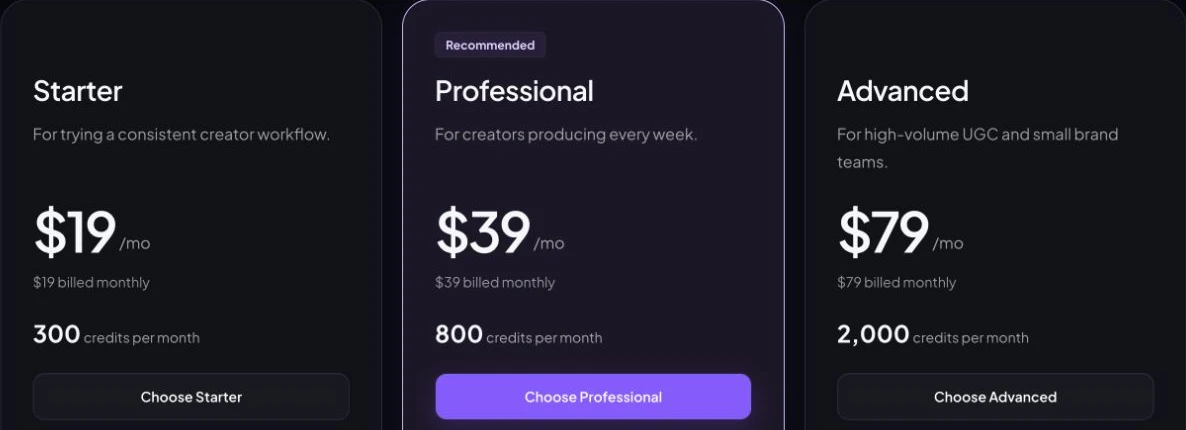
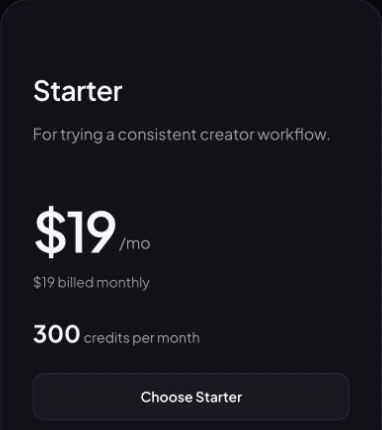
AI Influencer Generator’s current monthly plans are $19/300 credits, $39/800 credits and $79/2,000 credits, checked against the local product pricing configuration October 9, 2026. The real pricing captures below are dated form/page evidence, not a record of this article purchasing a plan. Recheck live pricing and the task quote before spending.
A hypothetical production budget makes rejection visible. At the retained example quotes of five credits for a single photo and 27 credits for a short silent Wan video, ten photo requests plus three video requests would quote 131 credits. If two photos and one clip were rejected, eight photos and two clips would remain: 13.1 quoted credits per accepted source. Four identical batches would quote 524 credits. These are arithmetic assumptions using dated quotes, not submitted jobs, observed rejection rates or guaranteed current charges.
The original archived character’s historical charged credits could not be verified, so we do not use them to estimate this business. This article triggered no paid generation. Actual quotes depend on model, resolution, duration and other settings. Unused plan credits are not cash earnings, and video prices can make a plan insufficient even when a photo-heavy example fits.
| Cost | Example assumption | Accounting treatment |
|---|---|---|
| Generation tool plan | $39 per month; 800 included credits in the checked Professional plan. | Include the plan cost once. Add actual top-ups separately; do not also charge included usage at an invented per-credit cash rate. |
| Editing and storage | $21 monthly allowance. | Assumed budget, not a quoted supplier price. |
| Other operating costs | $20 monthly reserve. | Assumed allowance; replace with actual expenses. |
| Cash operating budget | $80 per month in total. | Excludes payout charges, refunds, taxes and variable custom-work costs. |
| Operator time | 12 hours per month valued at $20/hour = $240. | Hypothetical economic cost, not necessarily a cash payment. |
Cost per accepted source = production cash allocated to the batch ÷ accepted sources. Track the rejected requests and review time too. For a subscription business, also measure monthly contribution after serving fans. Adding custom work or hundreds of conversations can change the labor budget; a fixed 12-hour assumption does not automatically scale with subscriber count.
8. Example Revenue Scenarios: 10, 50 and 100 Paying Subscribers
All figures below are hypothetical USD monthly scenarios, not measured income. Assume every subscriber pays the full $9.99 once in the month, no discounts, refunds or chargebacks, the standard 80% creator share, an $80 cash operating budget, and $240 of valued operator time. Payout/processing charges and tax are excluded. Actual labor and costs may rise with volume.
| Paying subscribers | Gross subscriptions | After 20% platform fee | After $80 cash costs | After $240 valued time too |
|---|---|---|---|---|
| 10 | $99.90 | $79.92 | -$0.08 | -$240.08 |
| 50 | $499.50 | $399.60 | $319.60 | $79.60 |
| 100 | $999.00 | $799.20 | $719.20 | $479.20 |
At ten subscribers, the model almost covers cash costs but does not pay for the assumed labor. Fifty subscribers produce a positive result after valued time under these assumptions, but that is not a promise that fifty people will subscribe or that you can serve them in 12 hours.
What if optional PPV sells? Add a separate assumption: 20% of the paying subscribers each buy one $12.99 bundle during the month. That means 2, 10 and 20 purchases respectively. No tips, custom orders or purchases by free followers are included. The 20% assumption is not derived from Fanvue’s 60% DM revenue share.
| Subscribers / PPV purchases | Gross including PPV | After platform fee and $80 cash costs | After valued time too |
|---|---|---|---|
| 10 / 2 | $125.88 | $20.70 | -$219.30 |
| 50 / 10 | $629.40 | $423.52 | $183.52 |
| 100 / 20 | $1,258.80 | $927.04 | $687.04 |
In the subscription-only model, contribution before other deductions is $9.99 × 80% = $7.992 per subscriber. Round up $80 ÷ $7.992: 11 subscribers cover the assumed cash budget. Including $240 of time requires rounding up $320 ÷ $7.992: 41 subscribers. These thresholds rise when extra costs, discounts or refunds apply; do not include unobserved PPV sales in your basic break-even calculation.
Use a fuller working equation for your ledger: operating contribution = eligible gross sales − platform fee − refund/chargeback adjustments − payout charges − operating cash costs. Then subtract valued operator time for an economic view, and account for tax separately. Reconcile actual statement entries once; do not subtract a refunded sale twice. Earnings in the dashboard and money available in your bank can differ. See the fees and payout guide and official payout terms.
9. A 30-Day AI Influencer Monetization Plan
This plan starts with an existing character and an eligible creator account. It tests an offer and delivery process; it does not repeat character design or KYC and does not guarantee 100 followers or a payday.
| Days | Work | Decision evidence |
|---|---|---|
| 1–3 | Audit existing media, disclosure and costs. Choose one included offer and one optional PPV idea. | A specific paid benefit; a cash/time budget; no unsupported performance claims. |
| 4–7 | Prepare the actual first member collection, public samples and a content buffer. Draft honest welcome messages. | The base offer is ready to deliver before accepting a subscriber. |
| 8–14 | Test one eligible traffic channel and $9.99 initial pricing; record visits, free follows and purchases separately. | Locate the drop-off instead of treating views as buyers. |
| 15–21 | Deliver the next collection. Offer the optional bundle to interested fans with clear contents and price. | Record actual unlocks, contribution and operator time. Keep the base promise complete. |
| 22–30 | Review feedback, first purchases and production costs; adjust one variable and prepare next-month releases. | Continue, revise or pause based on evidence. Measure renewals only as each cohort becomes due. |
Use a weekly scorecard: qualified Fanvue visits, free follows, new paid subscribers, non-subscriber PPV buyers, paid unlocks, gross sales by route, actual fees, cash costs, operator hours and due/completed renewals. Where attribution is unavailable, mark it unknown. Count recurring subscribers separately from people who bought only one bundle.
If posts get attention but no outbound clicks, test a clearer invitation or a better audience match. If clicks arrive but nobody buys, inspect the offer and public proof. If people buy but do not renew, inspect delivery and what the subscription promised. Do not lower price, raise message volume and change the content niche at the same time; you will lose the ability to tell what helped.
10. Common Mistakes and Realistic Expectations
- Buying production before proving interest. An existing library can support a small test. More outputs do not fix a weak reason to pay.
- Confusing followers with subscribers. A social follow, a Fanvue free follow, a one-off unlock and a renewal are different actions.
- Turning the 10%/60% statistic into a forecast. Revenue shares cannot tell you how many messages someone will buy or what your AI account will earn.
- Charging again for the base promise. Optional PPV should add something clearly separate, not reveal that the subscription buys little usable content.
- Hiding the AI identity or inventing intimacy. Disclosure and accurate expectations protect the offer’s credibility; a generated person has no real-world private relationship to sell.
- Optimizing the first purchase while ignoring churn. Aggressive messages, broken schedules and forced renewal-price changes can lose fans you already acquired.
- Calling gross revenue profit. Include rejected production, fees and time. A positive cash remainder can still represent poor compensation for your labor.
No universal time-to-income or subscriber target is supported here. A useful first-month result may be a small set of paying fans and a delivery process you can sustain; it may also be evidence to revise or stop. Scale only when the offer earns positive contribution and you can keep its promise to returning subscribers.
Frequently Asked Questions
Can an AI influencer make money on Fanvue?
Yes. Fanvue permits AI-generated content under its rules and supports subscriptions, pay-per-view content, tips and custom content. Permission to monetize is not proof of demand. Sustainable income requires qualified traffic, an honest offer, repeat purchases or renewals, and costs below earnings. Official sources checked October 9, 2026.
How do I get my first paying Fanvue fan?
Prepare a clear subscription promise and an actual member collection, share a disclosed public sample on one eligible promotion channel, and direct interested people to your Fanvue page. Welcome free followers with useful context, then explain the paid benefit. A follower count or a fixed posting schedule cannot guarantee a sale.
What should I charge for a Fanvue AI influencer subscription?
Fanvue allows $3.99–$100 per month. Its August 2026 help guide reports $9.99–$15 as a strong platform-wide range, while its May pricing article gives $7.99–$14.99 as an early-stage testing bracket. These are vendor guidance, not an AI-specific optimum. Match price to the included offer and test conversion, renewals and total contribution. Verified October 9, 2026.
Do subscriptions generate most new creators' Fanvue income?
Fanvue's August 10, 2026 Subscription Pricing & Retention Guide says subscriptions account for around 10% of observed first-two-month creator earnings and paid DMs around 60%. The article does not publish sample size or an AI-only breakdown. These are revenue shares, not buyer conversion rates or a forecast for your account.
Can free Fanvue followers buy paid content?
Yes. Fanvue documents that free followers can buy priced media in messages and wall PPV when the post is available to Followers and Subscribers. They cannot view subscriber-only content. A PPV buyer is not necessarily a recurring subscriber. Verified October 9, 2026.
How many subscribers do I need to break even?
Divide monthly costs by contribution per subscriber and round up, allowing separately for payout charges, refunds and taxes. In this guide's hypothetical subscription-only model, $9.99 at the standard 80% creator share contributes $7.992 before other deductions: an $80 cash budget needs 11 subscribers, or 41 when $240 of operator time is included. These are illustrative inputs, not measured business results.
Sources and Method
Dynamic Fanvue rules, fees and features checked October 9, 2026: AI content policy, earnings and payouts, August pricing/retention guide, May subscription-pricing article, PPV strategy, Follow for Free, audience messaging, and first-week onboarding. Source dates and verification dates are separate; check live controls before acting.
The 10%/60% figures are Fanvue’s observations, not our measurements or AI-only statistics. Pricing suggestions, the follower funnel, credit budget, revenue tables and 30-day plan are conditional editorial analysis. We did not run an account revenue experiment, purchase traffic, message fans or generate new media for this article. AI Influencer Generator prepares media; the operator reviews it and independently manages publishing, subscriptions and payments on Fanvue.
Plan Content
Measure Engagement
Build Your Profile
Price Your Work
Write Post Copy
Brand Partnerships