
- Audience sponsorship and content production sell different things.
- Relevant, reviewed work is stronger evidence than invented metrics.
- A useful pitch connects one brand objective to one specific deliverable.
- Price production, distribution and licensing separately.
Can AI Influencers Get Brand Deals?
Yes. AI influencers can secure commercial collaborations, but the buyer must understand what it is purchasing. A virtual identity can support sponsored content, brand-owned creative assets or character licensing. These models have different evidence requirements.
| Model | What the brand buys | Evidence needed |
|---|---|---|
| Sponsored Content | Posts on your creator account: production plus access to its real audience. | Relevant reach, audience fit, recent analytics and approved work. |
| Brand-Owned AI UGC | UGC-style images or videos delivered for agreed brand channels. No creator-account posting assumed. | Portfolio quality, product accuracy, reliable delivery and commercial permissions. Followers are not the product. |
| Character Licensing | Permission to use a distinctive virtual character/IP within a defined campaign. | Control of the character rights, a coherent identity and a negotiated license. |
Here, “AI UGC” means synthetic, creator-style production, not footage from a real customer. Never present it as a genuine testimonial. No followers can be a workable starting point for a production service, but it is weak evidence for selling distribution. For the wider business models, see how AI influencers make money.
Are You Ready for Your First AI Influencer Brand Deal?
Five questions to choose your next step. Guidance only; no success score or prediction.
Have you created an original AI influencer with a consistent identity?
What Do Brands Look for in AI Influencers?
Brands need relevant creative work, credible evidence and manageable risk. In IAB’s 2025 study, creator reputation and audience alignment were rated “very important” by 58% and 56% of respondents respectively. These are selection priorities, not sponsorship acceptance rates.
What Brands Look for When Selecting Creators
Share rating each criterion “very important” · n=453 U.S. decision-makers · 2025
Show positioning through a recognizable niche and point of view; audience fit through measured demographics when available; and quality through believable movement, consistent identity and accurate products. Brand safety also means transparent AI use, cleared assets and a responsible human contact.
For sponsored posts, report platform, dates, post count, typical views or reach and relevant saves, shares or clicks. Define the engagement denominator. Followers alone do not explain attention, and views are not unique people. For production-only work, emphasize formats, review standards and delivery instead of borrowing another account’s statistics.
Why Brands Invest in Creator Campaigns
Share selecting each objective among up to three goals · n=453 U.S. decision-makers · 2025
Match the proposal to the objective: awareness needs a clear concept and a reach plan; sales-focused work needs a relevant offer and agreed tracking. IAB’s findings do not prove that synthetic content produces those outcomes.
How to Get Your First AI Influencer Brand Deal: 8 Steps
Start with a small, well-defined paid pilot. A buyer should be able to assess fit, approve the concept and understand its permissions without decoding an open-ended “collab.”
1. Choose Your AI Influencer Niche
Choose a repeatable audience problem that connects to a real product category. “A virtual creator styling practical city outfits” gives an apparel buyer more to evaluate than “an AI lifestyle influencer.” Pick a character voice, visual signatures and three recurring content themes.
Check whether the category permits synthetic presenters. Avoid medical results, financial guarantees or personal experiences you cannot substantiate. Deliverable: a one-sentence positioning statement, three content themes and a shortlist of relevant product categories.
2. Build a Consistent Portfolio
Prepare 3–6 reviewed pieces showing the same original adult character. Include a contextual still, a useful detail and a short video if video is part of your offer. Label speculative examples “uncommissioned concept”; use authorized assets and never imply a brand approved them.
Build around an action, not a product held beside a smiling face. For example, a commuter adjusting a backpack can explain fit and access. Check face consistency, fingers, object contact, labels, shadows and the final mobile crop. Remove weak pieces. Deliverable: one public portfolio link with formats and concept labels.
Use the existing AI influencer image workflow for stills and our AI influencer UGC guide for product-content preparation. Generate from approved references and inspect every result.
3. Create an AI Influencer Media Kit
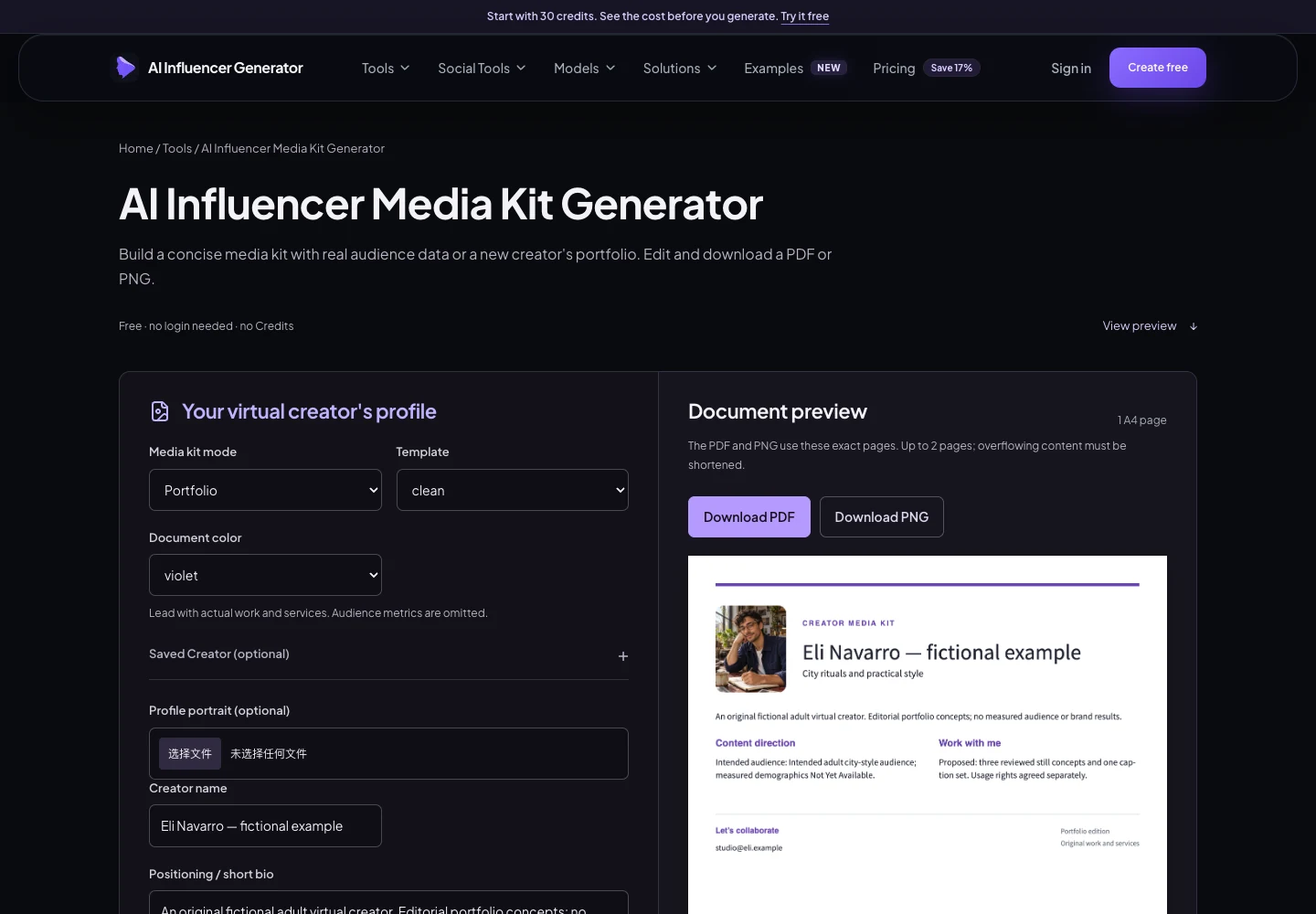
Summarize the character, operator, niche, work, offer and contact. Include native analytics only when you have them, with reporting dates. Without an audience, use Portfolio Mode and describe intended viewers as intended. Do not fill blank fields with industry averages.
Deliverable: a readable one- or two-page PDF plus a public work link. The AI influencer media kit template guide covers the complete document; keep this step focused on preparing it for a specific buyer.
4. Find Brands to Collaborate With
Look for public creator application pages, official partnership emails and agency briefs that allow synthetic talent. Review relevant competitors’ disclosed collaborations to discover buyers, then verify the contact and policy on the brand’s own website. A past virtual campaign signals interest, not automatic eligibility.
Create a short prospect sheet: brand, official contact URL, campaign observation, proposed idea, AI policy, contact date and next action. Mark unknown policies “unconfirmed” and ask before producing brand-specific assets. Deliverable: ten carefully qualified prospects, an editorial starting target rather than a guaranteed outreach formula.
5. Write a Personalized Brand Pitch
Lead with one verified observation and one creative idea. Example: “Your commuter collection could suit a three-frame bag-access concept for your own social channels.” Explain the fictional character and human operator, show relevant work, and ask whether the team accepts AI content.
Keep the first request small: confirm the right contact, objective, budget and intended usage. Do not attach huge files or invent compliments about using a product. Deliverable: one short email with a portfolio link. Use the Brand Pitch Generator for first contact, or adapt the email templates below.
6. Follow Up Professionally
As an editorial working cadence, wait roughly five to seven business days before one concise follow-up, unless the brand provides a timeline. Reply in the original thread and add a relevant example or simpler pilot scope. Ask whether another contact owns the brief.
Stop after a refusal or opt-out; silence is not consent to repeated messages. Deliverable: a dated outreach log with a clear next action or closed status. Once terms are being discussed, the Collaboration Email Generator helps reply to an existing conversation, rather than create the first cold pitch.
7. Negotiate Rates and Usage Rights
Get deliverables, approval dates, revision rounds, fee, currency, payment schedule and license scope into a written agreement. Define organic versus paid use, channels, territory, duration, editing and exclusivity. Character licensing and rights to train models or create new derivatives need explicit attention.
If the budget is too low, reduce scope or license length instead of quietly granting unlimited use. Agree what happens if the brief changes or the project is cancelled. Deliverable: an accepted scope and payment terms, not a vague DM saying “everything included.” Use the Brand Deal Calculator to compare scoped options.
8. Deliver Content and Build Long-Term Partnerships
Approve the concept first, then produce the agreed formats. Compare the product with authorized source images: shape, color, logo, label and functional details must survive review. A synthetic presenter must not claim personal testing. If an interaction remains implausible, propose a different scene instead of shipping it.
Deliver named files, captions, disclosure notes, license dates and an approval record. For sponsored posts, share the agreed native metrics after the reporting window. For brand-owned assets, request permitted campaign feedback; do not invent sales data. Deliverable: a delivery folder, invoice and recap with one evidence-based proposal for the next brief.
Real AI Influencer Brand Collaboration Example
COACH × imma demonstrates virtual-character IP licensing at campaign scale. According to Aww’s project account, imma led COACH’s Spring 2024 “Find Your Courage” global campaign, launched February 15, 2024. Aww supplied the imma IP license and supported her role as the protagonist traveling through five COACH Family members’ virtual worlds.
Confirmed: the campaign used films, COACH’s official website and social media. Commercial interpretation: a recognizable protagonist can connect a multi-part narrative across placements. That is a lesson in offering a distinctive creative role, not evidence that a beginner can sell the same package. This is an established virtual IP collaboration, not a disclosed example of a new AI account landing its first sponsored post. The source does not publish fees, revenue or conversion rates.
How Much Should You Charge for Brand Deals?
Quote for the work, distribution and permissions the buyer actually requests. There is no defensible universal AI influencer rate. A production-only pilot should not include an unexplained audience premium, while a sponsored account post may legitimately price verified distribution.
| Line item | What to define |
|---|---|
| Content production | Number of stills/clips, duration, concepts, variants, editing and included revisions. |
| Account posting | Named account, format, publication date and reporting. Omit for brand-only delivery. |
| Usage license | Assets covered, organic/paid channels, territory, term, edits and renewal. |
| Exclusivity / character IP | Competitor category, period and distinct character permissions; negotiate separately. |
For example, offer “three reviewed stills for specified organic brand channels, one revision round, agreed territory and term”; quote paid ads as an additional option. Put the currency, payment milestones, taxes where relevant and quote expiry in writing. Use the Brand Deal Calculator for detailed arithmetic and our AI influencer pricing guide for deeper scope decisions.
AI Influencer Brand Pitch Email Templates
Choose the template that matches your evidence, then personalize it. Edit the email below and copy your draft. These templates do not send emails. Remove every unsupported claim and test the portfolio link before sending.
Sell production capability. Replace every bracketed field and remove anything you cannot support.
Use native analytics with dates. Share measured reach and audience fit; omit unavailable fields.
Reply in the original thread. Keep the follow-up useful and respect a no or an opt-out.
Common Mistakes and Disclosure Rules
Keep the character identity, advertising relationship and product claims separately truthful. “AI-generated” describes the presenter; it does not tell someone that a brand paid for the post. Neither label makes a false testimonial acceptable.
- Fake evidence: never buy or invent followers, client logos, engagement, past deals or campaign results.
- Hidden synthetic identity: explain the fictional creator and responsible operator; follow destination-specific AI labeling rules.
- False product experience: a fictional character cannot honestly claim to have tested a treatment or experienced its effects. Use substantiated brand information without pretending to be a customer.
- Uncleared assets: confirm commercial permissions for references, likenesses, music, fonts and product imagery, including AI-service terms.
For U.S. endorsements, FTC guidance calls for clear, conspicuous disclosure of material connections, including payments and free products. Place understandable language such as “Ad” or “Sponsored” with the endorsement, not only in a bio or behind “more.” Video disclosures should appear in the video; audio and visual disclosure together are more likely to be noticed.
This is U.S. guidance, not a global rulebook. FTC guidance also addresses posts from abroad that foreseeably affect U.S. consumers. Check applicable local laws and platform requirements; a platform label alone may be insufficient.
Frequently Asked Questions
Can AI influencers get brand deals?
Yes. Brands can commission sponsored posts, license an established virtual character, or buy brand-owned AI content. Acceptance depends on the brief, rights, brand policy and quality; an AI identity alone is not a reason to pay.
Can I get brand deals with no followers?
You can pitch content production without followers. Sell reviewed assets for the brand’s channels, disclose the synthetic presenter and leave account distribution out of the offer. Some brands require human creators or genuine product testimonials, so check eligibility first.
How many followers do I need for an AI influencer sponsorship?
There is no universal minimum. Sponsored posts need credible audience value, which depends on relevant reach, audience fit and campaign goals. A brand can set its own threshold. Brand-owned production is a different service and does not require selling reach.
Where can I find brands open to AI influencer collaborations?
Start with public creator application pages, official partnership contacts and agencies whose briefs explicitly allow virtual or synthetic creators. Existing virtual-character campaigns are useful leads, but they do not prove that a brand accepts unsolicited pitches or beginners.
What should an AI influencer brand pitch include?
Include the responsible operator, fictional character and niche, one verified brand observation, one concrete idea, relevant evidence and a small next-step request. Use portfolio work when audience data is unavailable. Never invent previous sponsors or a product-use story.
Should I give a brand unlimited usage rights?
Only if the agreement and compensation deliberately cover that scope. Define channels, territory, duration, paid advertising, editing, exclusivity and any character rights. A file delivery does not automatically settle those permissions. Ask for qualified contract advice when the rights are broad or unclear.
Do AI influencers need to disclose sponsorships?
Where applicable, yes. U.S. FTC guidance calls for clear disclosure of material brand connections, including payment and free products. Saying that a character is AI-generated does not disclose sponsorship. Other markets and platforms may impose additional requirements.
How long does getting a first brand deal take?
There is no reliable universal timeline. Portfolio readiness, brand fit, procurement and budgets all matter. Track qualified pitches, replies, scoped briefs and paid pilots in your own outreach log. Neither this quiz nor a pitch template predicts a signed deal.
Ready to Land Your First AI Influencer Brand Deal?
Create a consistent character, make relevant brand-content examples, and prepare an honest offer. Your first milestone is a clear paid pilot with agreed rights and a delivery standard you can meet.
Create Your AI InfluencerCreate and save your character through our existing account flow. Brand acceptance and commercial results depend on your work and the buyer’s requirements.
Plan Content
Measure Engagement
Build Your Profile
Price Your Work
Write Post Copy
Brand Partnerships