

In this article · jump to a section
| Platform | Weekly starting range | Source and scope |
|---|---|---|
| 3–5 total Feed posts | Buffer, Aug. 13, 2025; photos, Reels and carousels combined. Stories excluded. | |
| TikTok | 2–5 videos | Buffer, Oct. 8, 2025; general accounts, not a promise for each video. |
| YouTube | 1 long-form video | Buffer guide, Jan. 13, 2026; editorial guidance, not the two studies below. |
| YouTube Shorts | 1–3 Shorts | Same guide; assess separately from long-form uploads. |
Key Takeaways
- Consistency creates learning opportunities; volume alone does not establish quality.
- Instagram reach and TikTok views are different metrics.
- Count publications per platform, not just source assets or calendar themes.
- Choose the cadence that supports useful work and audience interaction.
What Does the Data Say About Posting Frequency?
Buffer’s observational research associates higher frequency with stronger Instagram reach and TikTok views, with diminishing gains at higher volumes. It does not prove that posting more causes growth for every creator. The studies concern general platform accounts, not AI influencers. Use their findings to choose a sensible experiment, then judge your own audience response and production costs.
Instagram Posting Frequency vs. Reach
Approximate relative difference in median reach per post versus 1–2 Feed posts/week. Shared scale: 0–40%; not percentage-point changes in a reach rate.
TikTok Posting Frequency vs. Views
Reported approximate view lift, described by Buffer as up to these values, versus 1 post/week. Per-post views, not Instagram reach or guaranteed results. Scale: 0–40%.
Reach counts accounts exposed to a post; views count recorded plays under the destination’s rules. Do not add either platform’s numbers to create a unique-person audience total.
On Instagram, Buffer also reported a positive association with follower growth. That is a separate outcome from reach. On TikTok, median views stayed relatively flat while breakout posts helped the modeled gains. More publishing creates more chances to find a successful idea, but does not make each attempt better.
The TikTok estimates rise from 29% to 34% at the highest bin: five percentage points of additional relative lift, not another 34% compounded on the previous bin. These ranges cannot identify the return from one extra post. Stop increasing volume when review quality or useful output per production hour deteriorates.
Best AI Influencer Posting Frequency by Platform
Use one primary platform’s starting range, then adapt selected ideas to secondary channels. A weekly Instagram target includes all Feed formats together; YouTube Shorts and long videos need separate targets. The allocations below are editorial operating suggestions. They reflect differences in production effort, not evidence that synthetic creators receive different distribution rules.
Instagram: Feed, Reels, carousels and Stories
Start with three Feed posts: one Reel, one useful carousel and one strong photo. Expand toward five when each addition has a purpose. Photos usually need fewer production steps; Reels add motion review and editing. Try Stories on three to five days for questions or updates—an editorial suggestion outside the Feed study. For discovery tactics, see our Instagram growth guide.
TikTok: distinct short-video ideas
Begin with two to five videos weekly. Spend effort on the opening, payoff and pacing before adding uploads. Batch scene preparation, but review every animation for identity and movement errors. Treat breakout potential as an opportunity, not a predictable viral probability; the study supplies no AI-creator-specific odds.
YouTube: separate Shorts from long-form work
Buffer’s general guide suggests one long video and one to three Shorts weekly. Long videos need stronger scripting and editing; a new solo operator may choose one every two weeks instead. Use Shorts for focused ideas that stand alone. Do not call a schedule successful merely because short uploads conceal missed long-form commitments.
X: lightweight publishing plus conversation
Try three to five original posts weekly, with replies on active days, if X is secondary. This is our capacity-conscious starting plan, below Buffer’s broader three-to-four-posts-per-day guidance. Adapt one image with a specific observation or question. Writing is cheaper than rendering video, but useful replies still take time.
How Often Should New vs. Established AI Influencers Post?
Account maturity should change how much experimentation your team can support, not create a mandatory posting quota. New accounts need a dependable baseline; growing accounts can test added slots; established accounts need a production process that preserves audience expectations. The ranges below are adjustable editorial plans, not validated optimal frequencies for AI influencers.
| Account stage | Instagram / TikTok weekly test | Operating priority |
|---|---|---|
| New: still finding a repeatable format | Instagram: 3; TikTok: 2–3 | Build a reviewable baseline; record production time. |
| Growing: repeatable ideas and returning viewers | Instagram: 3–5; TikTok: 3–5 | Test an extra slot while preserving topic and format mix. |
| Established: reliable production and audience expectations | Test Instagram: 6–9 or TikTok: 6–10 only if justified | Increase capacity before promises; keep the lower cadence if it works better. |
“Established” describes a repeatable operation, not a follower threshold. A small team can remain at three excellent posts indefinitely. More budget does not automatically produce more distinctive content.
A Realistic 7-Day AI Influencer Posting Schedule
Plan source material first and publications second. The example below creates three Instagram Feed posts, two TikToks and one Short from a small set of approved scenes. It also reserves review and interaction time. This is a seven-day operating example, not a research-derived optimum or an instruction to launch every platform at once.
| Day | Platform and format | New material? | Main objective |
|---|---|---|---|
| Monday | Instagram photo: one city-style observation | Yes: approved still brief A | Establish the week's theme. |
| Tuesday | TikTok: a short styling explanation | Yes: video brief B | Test a useful hook; answer comments. |
| Wednesday | Instagram carousel: explain Monday's outfit choice | Partial: A plus supporting detail C | Earn saves through a clear explanation. |
| Thursday | YouTube Short: adapted Tuesday idea | No new scene; new edit and opening | Test the idea with a different audience. |
| Friday | Instagram Reel: tighter cut of brief B | No new scene; platform-specific edit | Reach viewers who prefer motion. |
| Saturday | TikTok: answer a question using A and C | Reuse reviewed stills; write a new response | Turn audience feedback into useful content. |
| Sunday | No primary upload; optional Story and replies | No; review the week's data | Protect quality and plan the next test. |


Keep the approved character, visual world and topic; change the reason to watch. Reuse does not mean publishing identical captions everywhere. Check crops, audio rights and disclosures for each destination. For a full month, use the separate 30-day content plan; for topic selection, read what an AI influencer should post.
How to Find Your Ideal Posting Frequency
Run a four-week operational test on one platform, comparing a baseline cadence with a modest increase. Keep the content direction, format mix and measurement age as similar as practical. Track both outcomes and effort. This small experiment can inform your next decision, but cannot eliminate seasonality, changing audience behavior or other confounders, and cannot prove causation.
- Weeks 1–2: set the baseline. Use your current manageable pace, such as three Feed posts weekly. Write down your primary outcome and maximum production hours before starting.
- Weeks 3–4: test the increase. Try five instead of three. Keep the niche, core formats, paid support and usual publishing windows broadly comparable. Record unavoidable changes.
- Log every publication. Capture platform, format, date, topic, reach, views, saves, engagements, net follower change and production minutes. Include failed generations, revision time and replies.
- Compare the same age. For example, measure every post seven days after publication. Wait until the final week’s posts reach that age. Compare similar formats separately.
- Choose the next cadence. Review weekly totals, median per-post results and outcomes per production hour. Maintain, increase or reduce frequency based on the trade-off. Repeat before treating one month as a stable pattern.
Define engagement consistently: likes, comments, saves and shares where available; label missing metrics. Net follower growth equals ending followers minus starting followers over the same interval. Attribution to individual posts is limited. If one video dominates the result, show it separately rather than silently treating it as typical.
How to Plan AI Influencer Posts With AI Influencer Generator
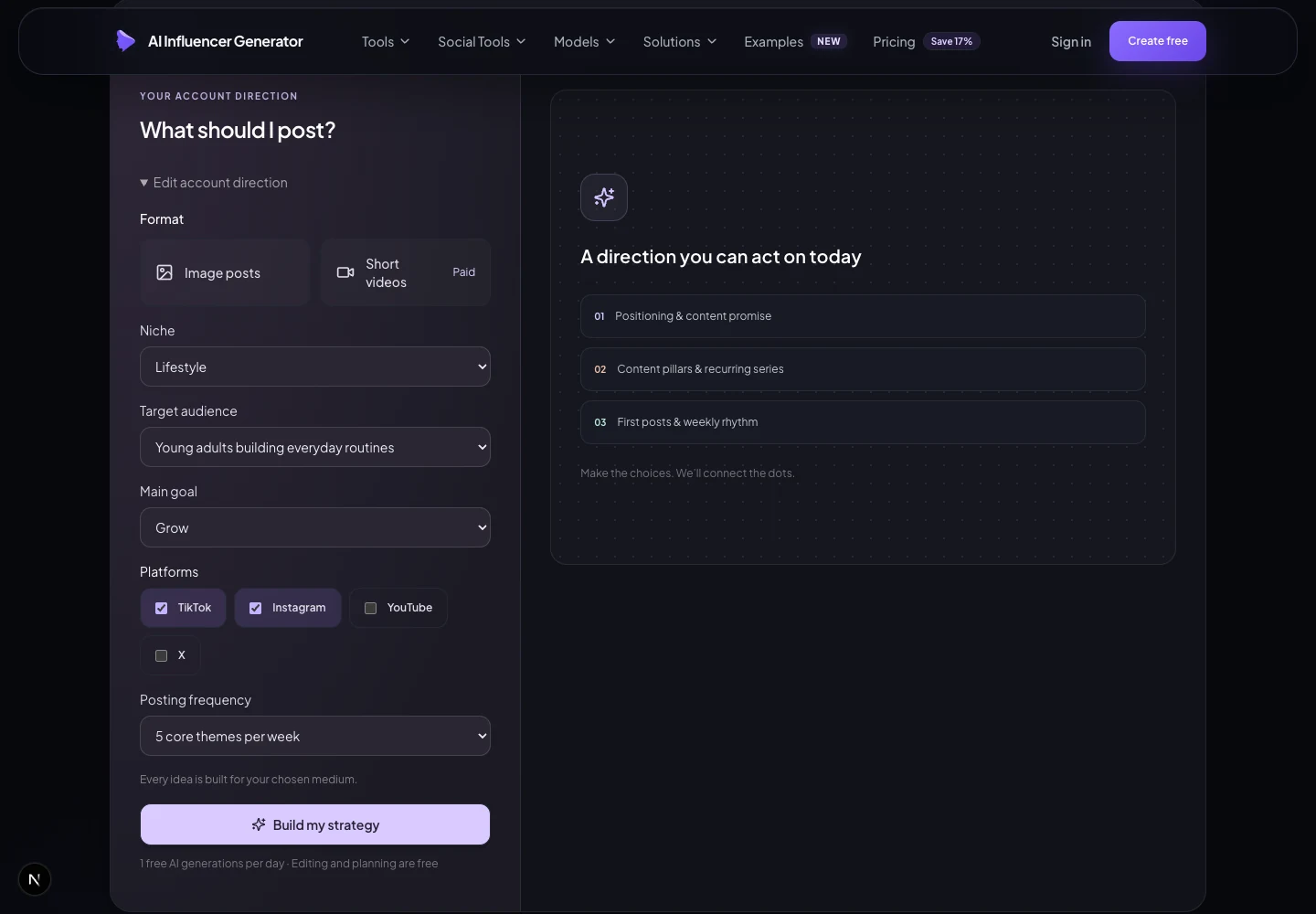
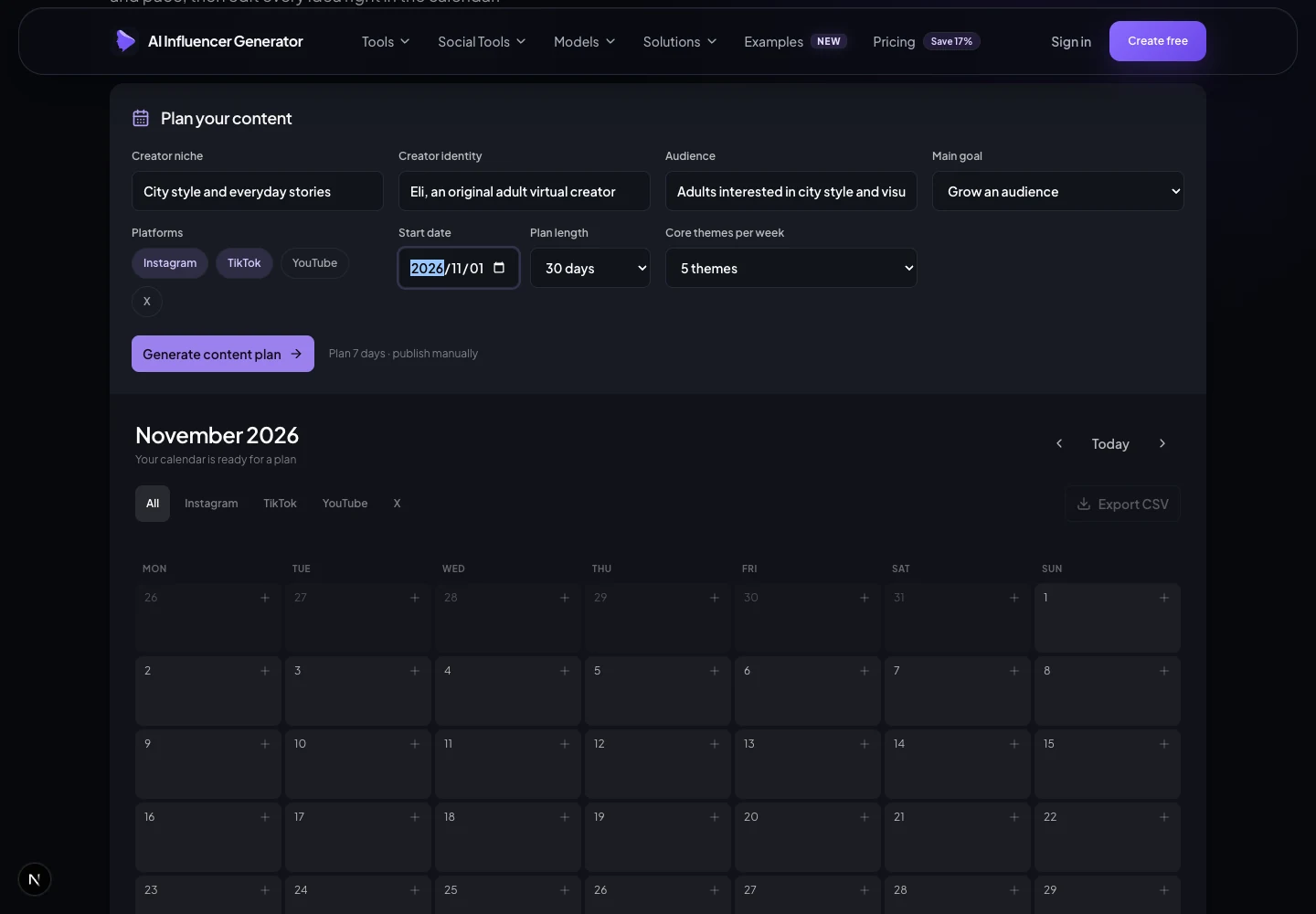
Use the strategy tool to draft a direction and the calendar to organize reviewed ideas into dates. Both support planning; neither chooses a proven optimal frequency from your account analytics. The public calendar supports editing and CSV export, not automatic publishing. Prepare images and videos separately after reviewing the brief, identity and production budget.
- Define the creator. Choose an audience, niche, goal and recognizable adult identity. Start with one primary platform.
- Draft a strategy. In the AI Influencer Strategy Generator, set the direction, formats, platforms and weekly pace. Review its AI-generated pillars, ideas and visual guidance; it does not validate performance claims.
- Arrange the week. Open the Content Calendar Generator. Choose 7, 14 or 30 days and three, five or daily core themes. Review each platform entry: themes are not a guaranteed count of finished posts per channel.
- Edit and export. Adjust ideas and dates, then export CSV. The public plan is stored in that browser; export a copy before relying on it elsewhere.
- Produce and publish. Prepare approved images and videos in Studio, review each export, then publish manually or through your chosen publishing workflow.
If you lack distinct ideas for the extra slots, browse 100 AI influencer content ideas before increasing your publishing commitment.
Common Posting Frequency Mistakes
The most expensive cadence mistake is committing to output that your review process cannot support. More renders do not guarantee more useful posts, and a busy calendar can hide weak ideas. Protect originality, audience interaction and character consistency first. When a schedule repeatedly forces rushed exports or neglected comments, reduce the commitment before adding another platform.
- Daily duplicates: repeated crops and generic captions create activity without a new payoff.
- Mechanical cross-posting: an unchanged video may have the wrong opening, pacing or audio rights for its destination.
- Ignoring comments: schedule response time alongside production; a post is not the end of the conversation.
- Identity drift: compare face, hair, styling and voice with the approved reference across the series.
- Skipping review: inspect hands, labels, subtitles, claims and AI disclosures before export.
- Confusing totals: five themes, five source assets and five Instagram publications are different commitments.
Frequently Asked Questions
The right AI influencer posting frequency depends on the platform, your production capacity and the audience response you observe. Treat general studies as starting evidence, not account-level predictions. These answers address common cadence decisions; they do not establish a universal algorithm rule or substitute for measuring your own posts at comparable ages.
Should AI influencers post every day?
Daily posting is optional. Begin with a sustainable weekly plan and add days only when you can maintain useful content, visual consistency and replies. An artificial character does not make production, editing or audience attention unlimited.
Is posting three times a day too much?
It can be, especially for a small team. Twenty-one weekly posts exceed the starting ranges in this guide. Test smaller increases first, and keep that pace only if comparable-age results and production costs justify it. Three posts are not inherently spam; repetitive low-value posts are the problem.
How often should an AI influencer post on Instagram?
Start with three to five total Feed posts per week across Reels, carousels and photos. Add Stories when you have something useful to share. The Buffer feed-frequency study excludes Stories, and its findings are not specific to AI influencers.
How many TikToks should an AI influencer post per week?
Two to five is a reasonable starting test based on Buffer’s general TikTok analysis. Increase beyond that when you have distinct ideas and a reliable review process. The reported view lift does not guarantee that the typical video will perform better.
Should AI influencers post more Reels or photos?
Choose the format for the idea. Reels suit motion and demonstrations; carousels suit sequences and explanations; photos suit a strong visual moment. The frequency study pools Feed formats and cannot establish an ideal Reels-to-photo ratio.
Does posting more often increase followers?
Higher posting frequency was associated with stronger Instagram follower growth in Buffer’s analysis. That does not establish a guaranteed causal effect for your account. Track net followers, content quality and time alongside reach, rather than assuming that every additional post creates growth.
Can AI influencers reuse the same content across platforms?
Yes, when the rights permit it. Reuse the approved identity, scene or topic, then adapt the opening, pacing, crop, caption and audio for the destination. Count each platform publication separately and avoid presenting repeated crops as genuinely new ideas.
What is the best time to post?
Use your audience’s active times as a starting point, then compare similar posts at consistent intervals after publication. Match the audience’s time zone and avoid changing timing during a frequency test. No universal hour guarantees engagement across niches, countries and formats.
Plan Content
Measure Engagement
Build Your Profile
Price Your Work
Write Post Copy
Brand Partnerships