
What Is a Color Script?
A color script puts a story’s visual changes in order. Each small frame is a decision about the dominant colors, the light and dark shapes, the source of light and the place your eye should go. Viewed together, the frames reveal the emotional rhythm before you spend time polishing individual images.
It can support an animated film, a short video, a photo-led creator story or a product commercial. It is usually rougher than final artwork: the point is to test whether the sequence feels coherent and whether important changes are visible.
In the Pixar in a Box color-script exercise, readers compare moods and explore different color treatments of the same drawing. The useful lesson for AI creators is the same: decide what the shot should make the audience notice and feel before asking for a polished render.
Color Script vs Storyboard, Moodboard & Color Grading
| Method | Main question | Useful output |
|---|---|---|
| Color script | How should color and light change with the story? | An ordered sequence of color and value studies. |
| Storyboard | What happens, where is the camera, and how do shots connect? | Staging, action, framing and shot transitions; it can also include color. |
| Moodboard | What visual world are we aiming for? | A collection of references for materials, atmosphere, palette and style. |
| Color grading | How should captured or rendered shots look and match? | Adjusted exposure, contrast and color in the finished footage. |
Use a moodboard to collect possibilities, a storyboard to stage the action, and a color script to test the progression. Later, grading can bring the footage closer to those decisions. These jobs overlap; none replaces the others.
How Color, Light & Value Carry Emotion
“Blue means sad” is too simple to direct a scene. A cool frame can feel peaceful in a sunlit room or isolating beside an empty wall. Context, facial expression, surrounding shots and the amount of contrast change the reading.
- Hue sets relationships
- Warm and cool areas can separate a welcoming interior from a quiet street. Their relationship matters more than one isolated swatch.
- Value directs attention
- A lighter face against a darker wall can remain readable when the colors disappear. Similar values may make the subject blend in.
- Saturation controls emphasis
- A cobalt cup can stand out in a restrained kitchen. If the towel, wall and background signs are equally saturated, they compete.
- Color area changes the balance
- A tiny amber window in a large blue night has a different effect from a frame filled with amber light.
Build continuity with a color bridge: a recurring wardrobe color, prop or practical light that helps one shot lead into the next. Blender Studio’s notes on Coffee Run show how a color script can evolve while shared colors keep the sequence connected.
How to Make a Color Script with AI
Write the story beats before choosing colors
Reduce the story to meaningful changes: an idea, an interruption, a decision, an action and a payoff. One frame should earn its place by advancing the story or changing the visual state.
Map the emotional progression
Give each beat a short intention such as tentative, curious, hesitant or relieved. Write what changes between neighboring beats. A row of “cinematic” frames is not yet an emotional arc.
Choose the palette and a believable light source
Start with three to five working colors. Decide what stays consistent and what shifts in temperature, saturation or value. Tie light to a window, sun angle, lamp or sign that belongs in the scene.
Generate the keyframes from stable references
Choose one adult identity reference and reuse it for every shot. For a product sequence, keep the same product reference too. In the AI influencer image workflow, select your creator, choose a wide frame such as 16:9 and generate one shot at a time. Keep wardrobe and identity instructions stable while changing the action, setting and light.
Check the sequence in grayscale
Look for the face, action or product without relying on hue. If it disappears, adjust the key light, background brightness or composition. Increasing saturation alone will not repair weak value separation.
Review transitions and revise the weakest shot
Read the entire strip at thumbnail size, then inspect each frame large. Check identity, costume, props, light direction and time of day. Return to the original references for revisions rather than repeatedly editing the previous shot.
The AI photoshoot prompt guide helps with the complete creative brief. For light direction and shadow contrast, sketch the arrangement in the Lighting Diagram Maker.
Color Script Example 1: AI Influencer Storytelling
Story: Ari prepares a small photography display, doubts his work, tries one more frame and finishes the evening with a quieter sense of relief. Six keyframes move through morning, midday, open shade, sunset, blue hour and neon night.
The olive overshirt and green bag are stable anchors. Warmth arrives at the turning point, becomes the window light in the next shot, and remains as a small amber note in the ending.

Original AI concept sequence with a fictional adult creator. Palettes are working selections from the frames, not a requirement to force every pixel into five colors.
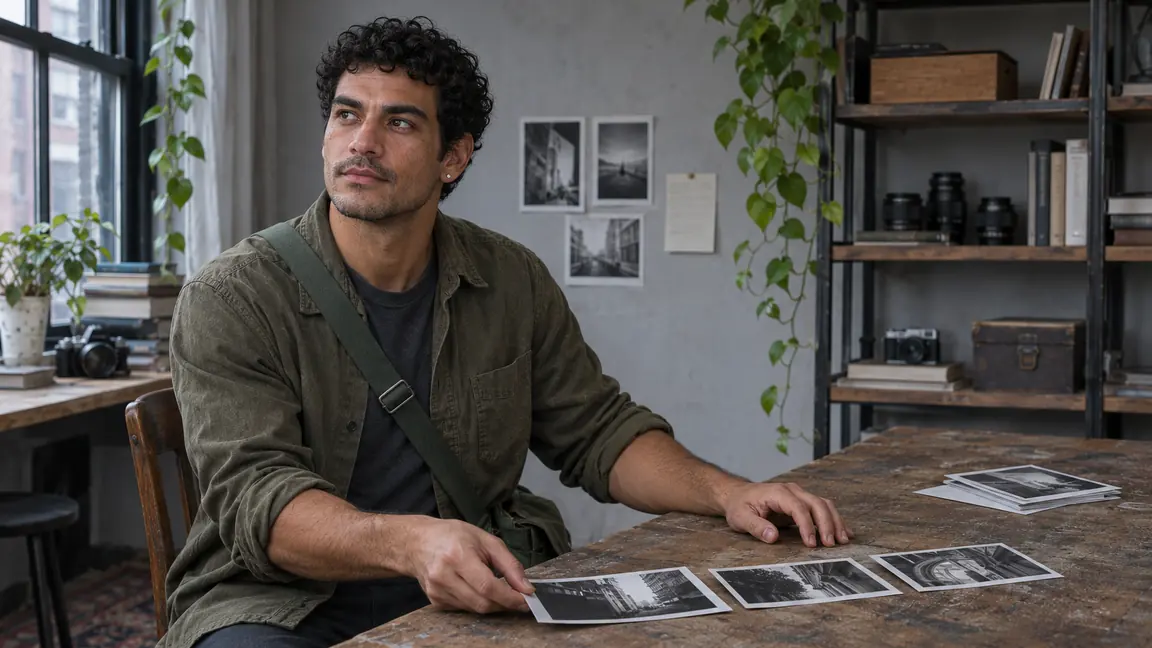
01. An idea takes shape
08:30 · Morning#283033#78838A#B6BCC0#5E6251#A68A6F
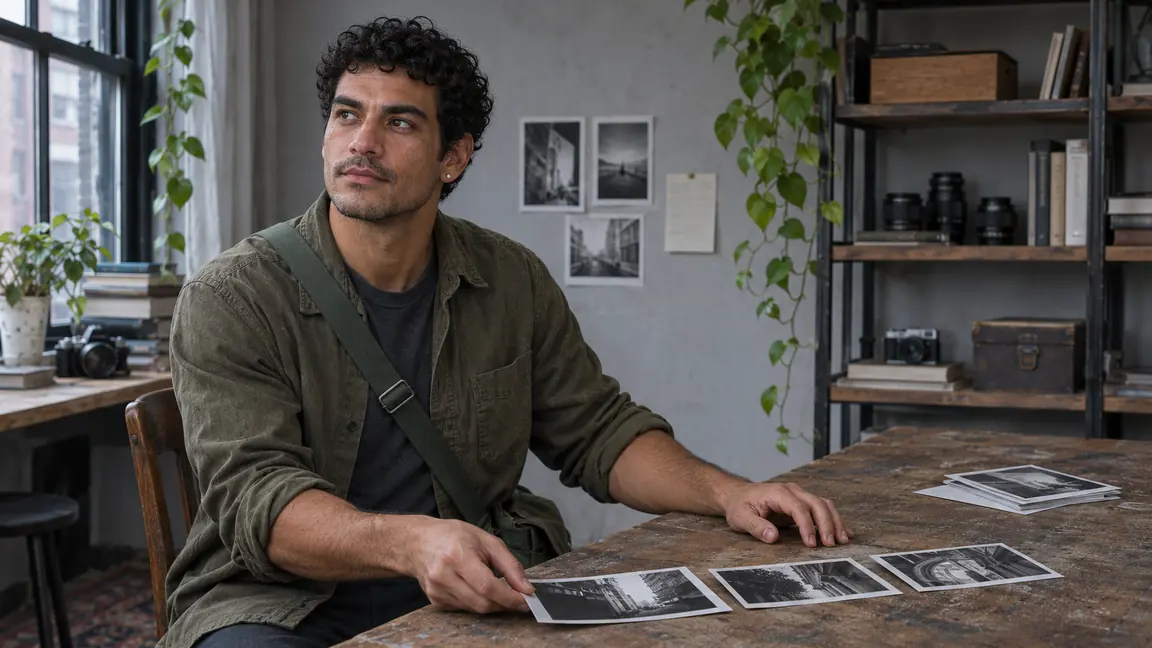
Ari sorts prints for a small photography display. Tentative focus. Cool room tones and restrained saturation leave the story room to grow.
- Light & focus
- Soft north-window light; cool gray-blue room shadows with a little warmth in the wood. The face, the hand moving a print and the row taking shape on the table.
- Continuity
- Introduce the olive overshirt, green strap and black-and-white prints.
View & copy this shot’s prompt
Use the same original fictional adult man, Ari, age 32, from the supplied identity reference: warm medium-tan skin with natural texture, dark brown eyes, a broad softly squared jaw, short dense black curls, faint moustache and close stubble, and a small silver stud in his left ear. Keep his olive cotton overshirt over a charcoal T-shirt, indigo jeans and forest-green canvas crossbody bag consistent. Morning in a modest creative apartment. Ari sits at a used wooden worktable, sliding one black-and-white architectural print into a short row with one hand while the other rests on the table. He looks thoughtfully toward the window. Eye-level medium-wide photograph, Ari left of center, the print arrangement visible at right. Soft cool north-window light from camera-left, slate-gray shadows, muted olive clothing and subdued tan wood. Quiet midtone contrast and low saturation. Preserve recognizable facial details, plausible paper contact and natural skin. One wide 16:9 keyframe; no text, logos, UI, palette graphics or collage.
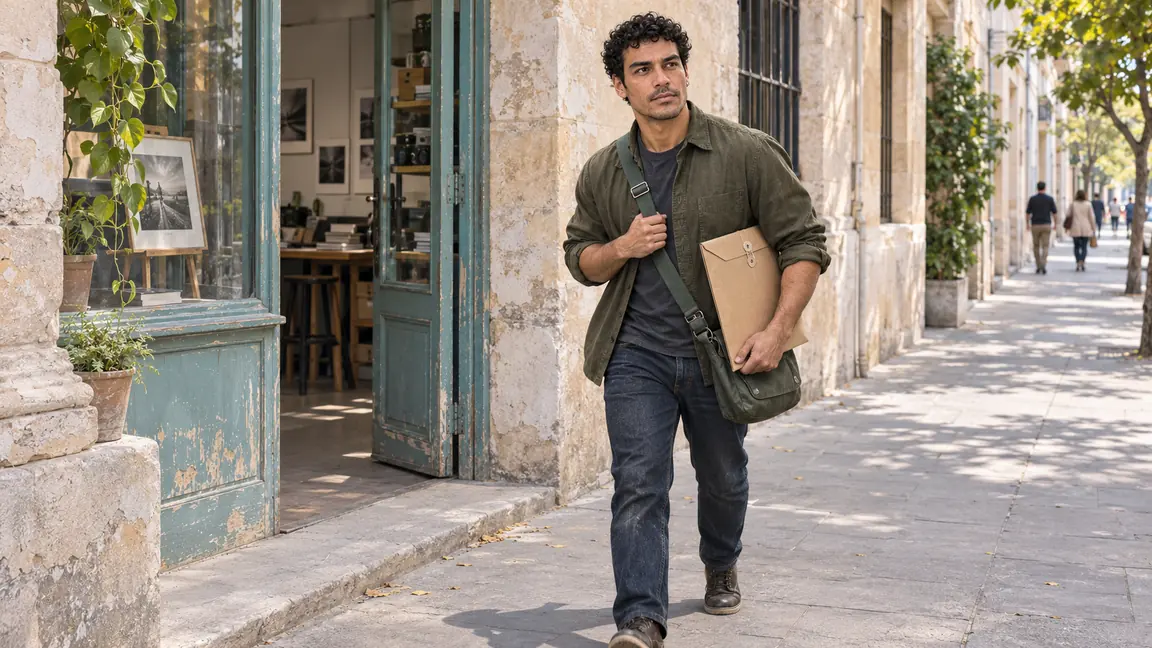
02. Step into the day
12:30 · Midday#3F4945#6D827C#B5AE9C#D9CEB9#9B8060
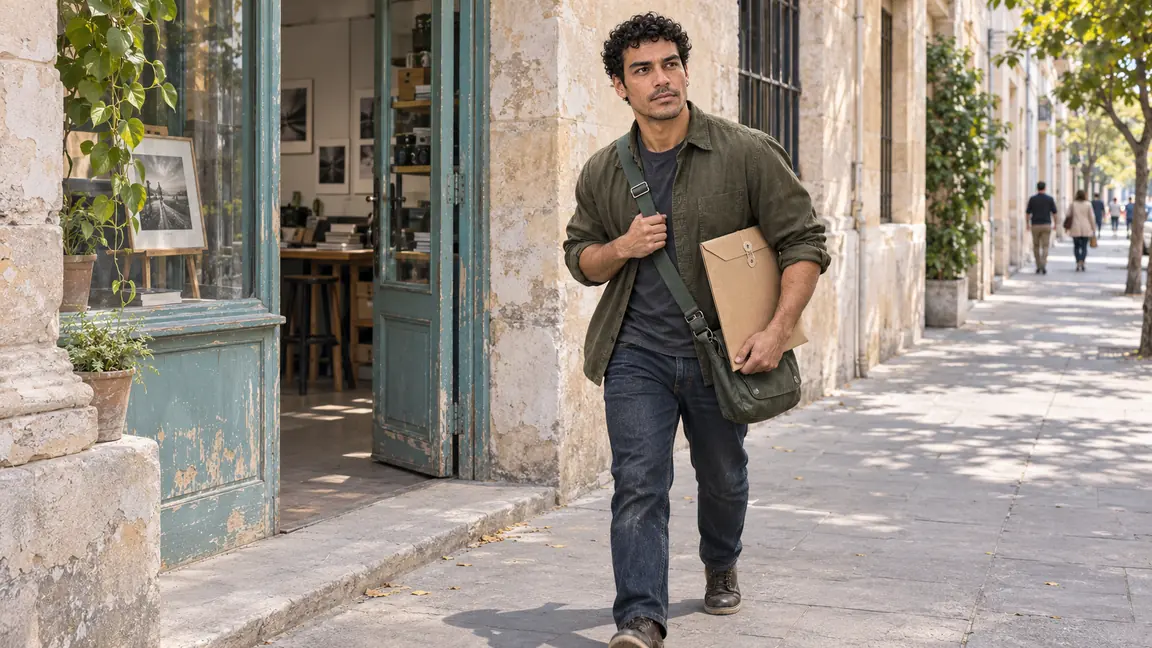
He carries the prints out into the neighborhood. Curiosity. Lighter stone and more open exposure make the world feel available.
- Light & focus
- Neutral daylight with warm stone bounce and soft sky shadows. Ari's gaze and walking direction, followed by the kraft print envelope.
- Continuity
- Repeat the green strap; introduce the weathered teal storefront used again later.
View & copy this shot’s prompt
Use the same original fictional adult man, Ari, age 32, from the supplied identity reference: warm medium-tan skin with natural texture, dark brown eyes, a broad softly squared jaw, short dense black curls, faint moustache and close stubble, and a small silver stud in his left ear. Keep his olive cotton overshirt over a charcoal T-shirt, indigo jeans and forest-green canvas crossbody bag consistent. Midday on a neighborhood street with weathered pale stone walls and a faded teal shop doorway. Ari walks with a flat kraft photo-print envelope tucked under one arm and one hand steadying his bag strap, glancing toward the next street. Candid eye-level wider photograph, with room in his walking direction. Neutral daylight, warm reflected stone and soft blue sky shadows; a more open exposure than the morning interior. Restrained cream, ochre and teal surroundings. Keep the original face, clothing, envelope contact and walking anatomy believable. One wide 16:9 photograph; no readable signs, captions, UI or collage.
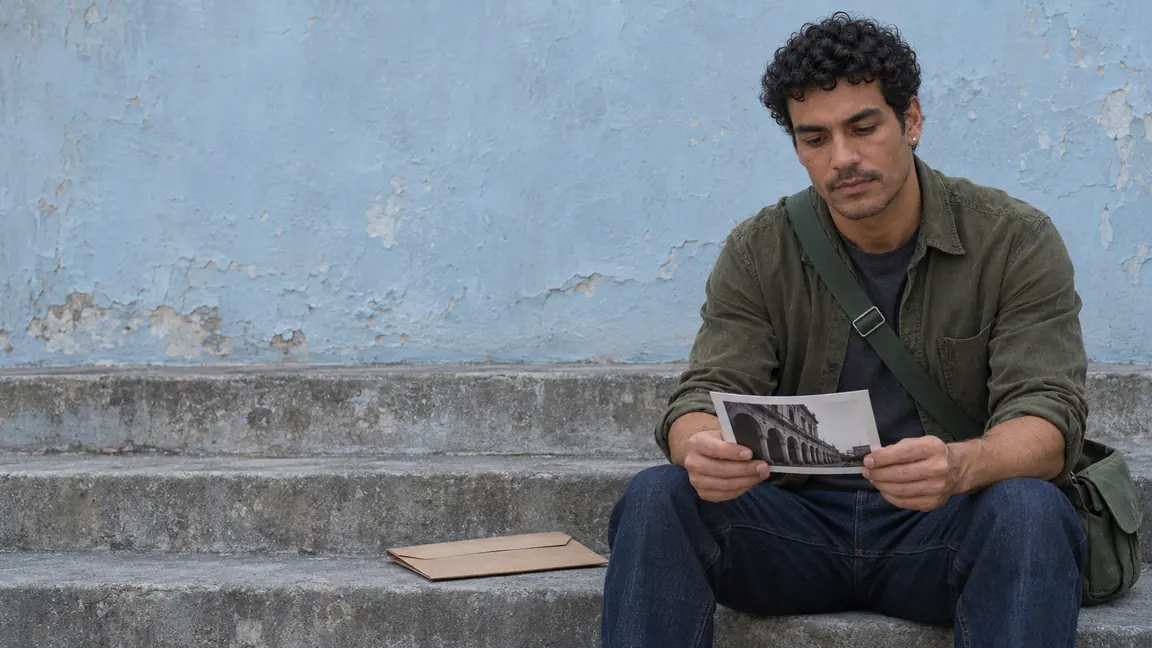
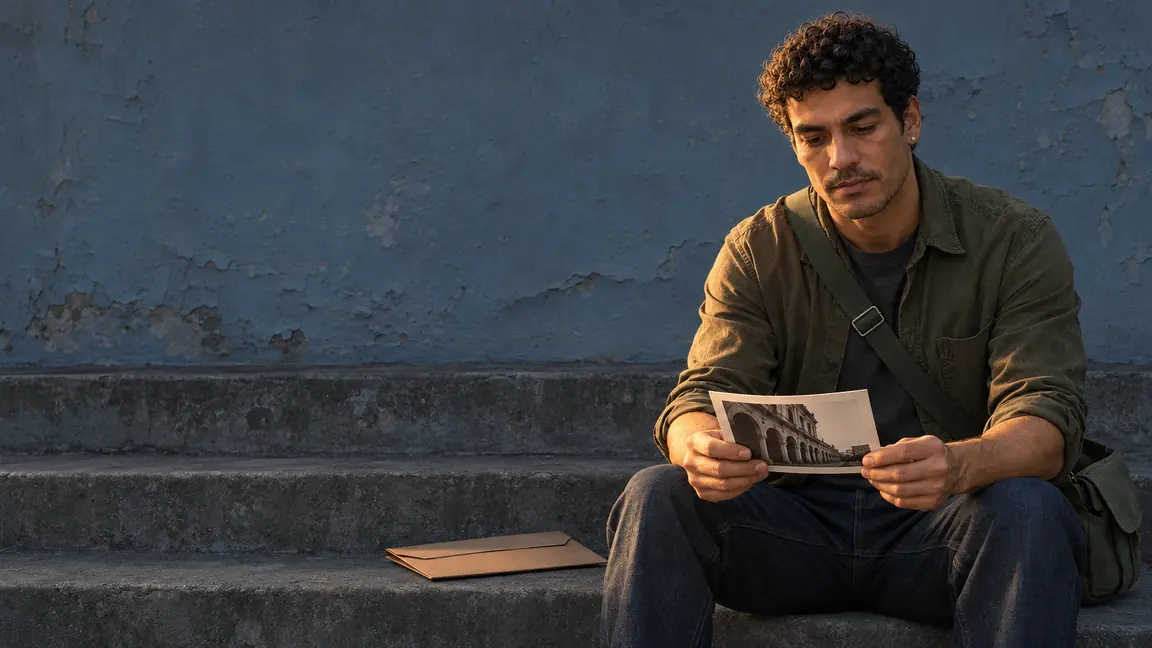
03. A moment of doubt
16:00 · Open shade#A4BAC9#737C7F#3F493F#24313D#AF8E76
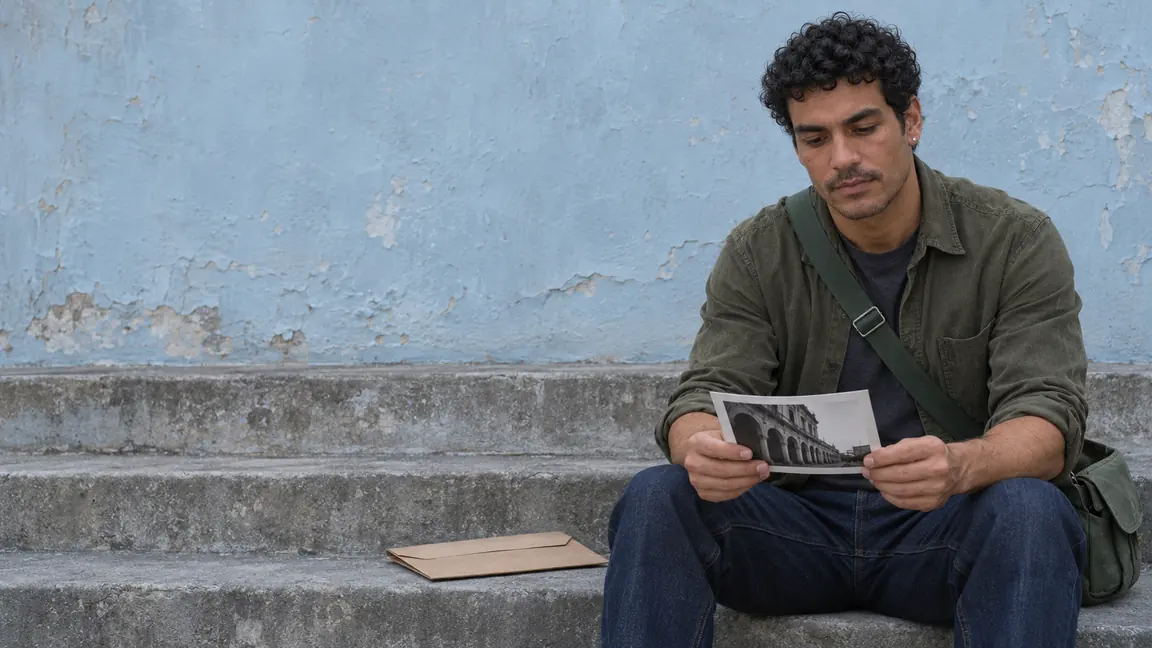
On the steps, he pauses over one photograph. Hesitation. The large cool wall and compressed midtones slow the visual rhythm.
- Light & focus
- Cool sky fill in open shade; no direct sun on the subject. The downward gaze and the print in his hands, with deliberately modest separation.
- Continuity
- Keep the same envelope, bag, outfit and architectural prints.
View & copy this shot’s prompt
Use the same original fictional adult man, Ari, age 32, from the supplied identity reference: warm medium-tan skin with natural texture, dark brown eyes, a broad softly squared jaw, short dense black curls, faint moustache and close stubble, and a small silver stud in his left ear. Keep his olive cotton overshirt over a charcoal T-shirt, indigo jeans and forest-green canvas crossbody bag consistent. Afternoon in cool open shade. Ari sits on worn concrete steps beside a weathered pale-blue wall, looking down at one black-and-white architectural print held naturally in both hands at lap level. The kraft print envelope rests on the step beside him. Eye-level medium-wide photograph, Ari on the right third and quiet negative space at left. Muted slate-blue ambient light, subdued olive clothes, gentle medium-low contrast, readable skin and eye detail. Keep the geometry simple and the hands in believable contact with the paper. One wide 16:9 frame; no direct sun, text, color swatches, UI or collage.

04. Try one more frame
18:10 · Golden hour#E5BF80#B57643#777E80#4D5144#2D3438
He raises the camera for another photograph. Resolve. A clear arrival of warm light marks the turning point.
- Light & focus
- Low sunlight on the cheek and hair edge, against cooler rooftops and shadow masses. The lit face and hands around the camera, rather than the whole skyline.
- Continuity
- The olive clothing stays recognizable; warmth now becomes the transition color.
View & copy this shot’s prompt
Use the same original fictional adult man, Ari, age 32, from the supplied identity reference: warm medium-tan skin with natural texture, dark brown eyes, a broad softly squared jaw, short dense black curls, faint moustache and close stubble, and a small silver stud in his left ear. Keep his olive cotton overshirt over a charcoal T-shirt, indigo jeans and forest-green canvas crossbody bag consistent. Golden hour on an ordinary rooftop terrace behind a waist-high parapet. Ari holds a small unbranded mirrorless camera at chest level before lifting it, one hand on the grip and the other supporting the lens, gaze lifted toward the skyline. Eye-level three-quarter medium photograph. Low warm sunlight from camera-left lights his cheek and hair edge; layered terracotta and cool blue-gray rooftops recede behind. Amber highlights against restrained cool shadows signal renewed resolve. Keep the camera geometry, hand contact, original face and textured clothing coherent. One wide 16:9 frame; no exaggerated flare, readable UI, captions or collage.
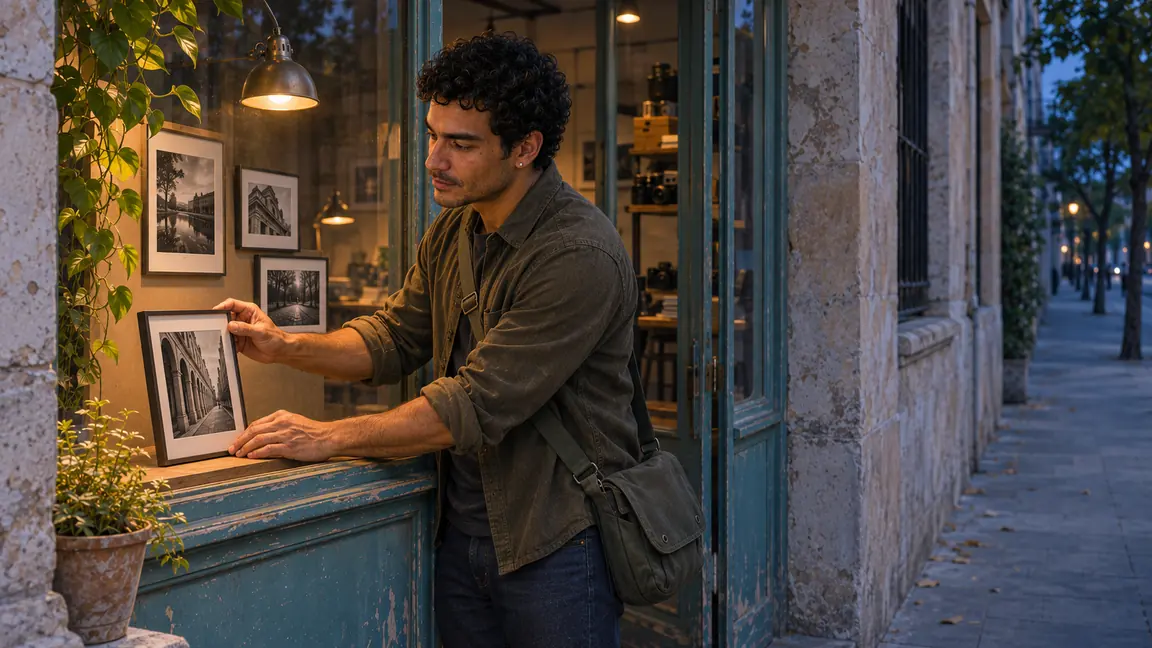
05. Make the invitation
19:15 · Blue hour#153448#3E626B#C58A42#6F6548#282C2B
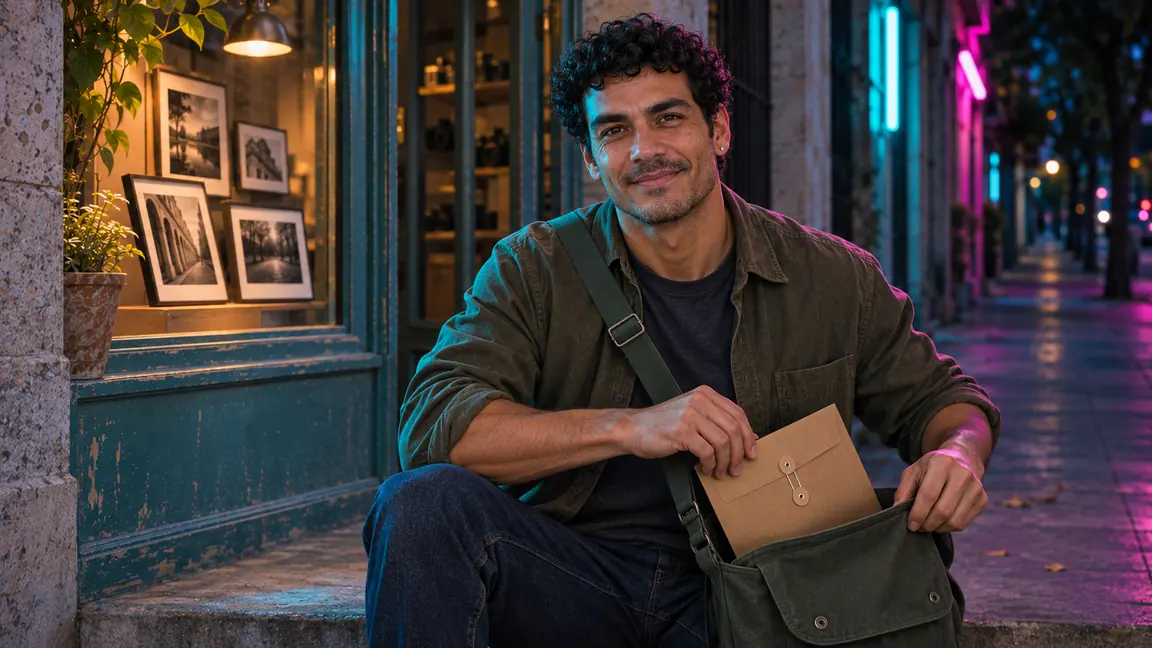
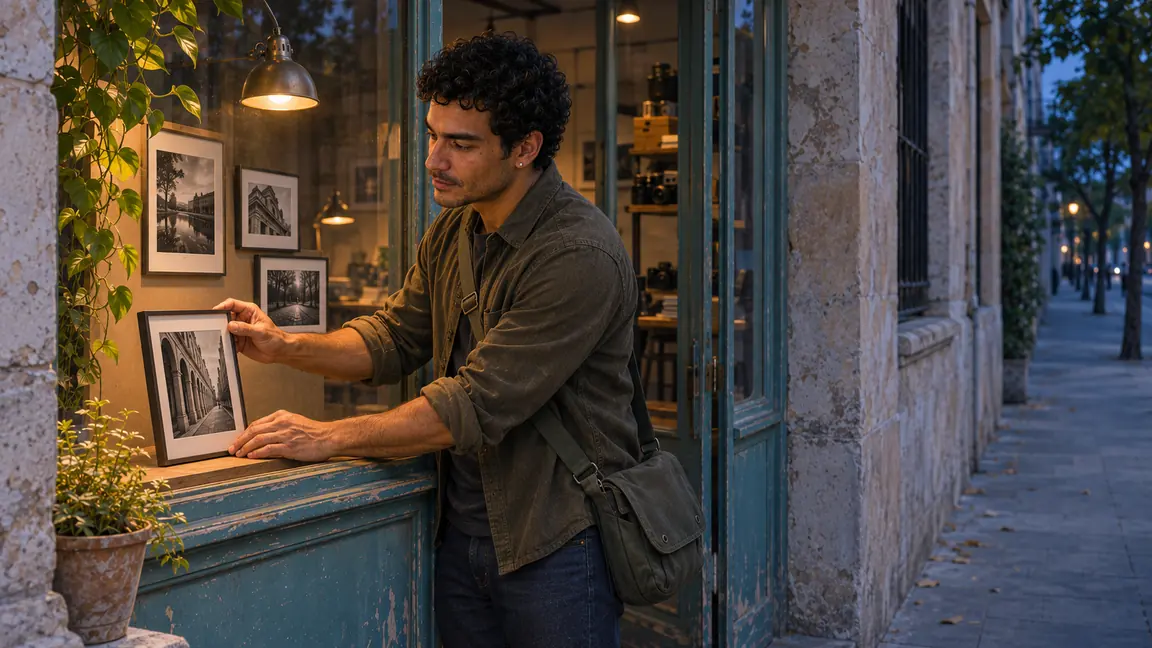
Ari places a framed print in the small studio window. Anticipation. A pool of amber light feels inviting within the cooling street.
- Light & focus
- Visible warm practical lamps inside; cobalt dusk and teal paint outside. The face, hands and framed photograph in the warm window light.
- Continuity
- Carry sunset warmth into the lamps; return to the teal storefront from shot 02.
View & copy this shot’s prompt
Use the same original fictional adult man, Ari, age 32, from the supplied identity reference: warm medium-tan skin with natural texture, dark brown eyes, a broad softly squared jaw, short dense black curls, faint moustache and close stubble, and a small silver stud in his left ear. Keep his olive cotton overshirt over a charcoal T-shirt, indigo jeans and forest-green canvas crossbody bag consistent. Blue hour at the weathered teal storefront introduced earlier. Ari carefully places a small framed black-and-white architectural photograph on the inside wooden window ledge, one hand supporting the base and the other steadying its side. Three small prints are visible behind him. Medium-wide eye-level photograph from the sidewalk, face readable in three-quarter view. Dark desaturated cobalt dusk outside, visible amber practical lamps inside casting warm light on the face, hands and wood. Teal paint is a recurring color bridge. Preserve physically plausible frame support, reflections, identity and clothing. One wide 16:9 frame; no duplicate people, readable labels, metrics, UI or collage.
06. Let the evening settle
21:00 · Neon night#102732#147D8E#AD3B85#C18A46#464B3C
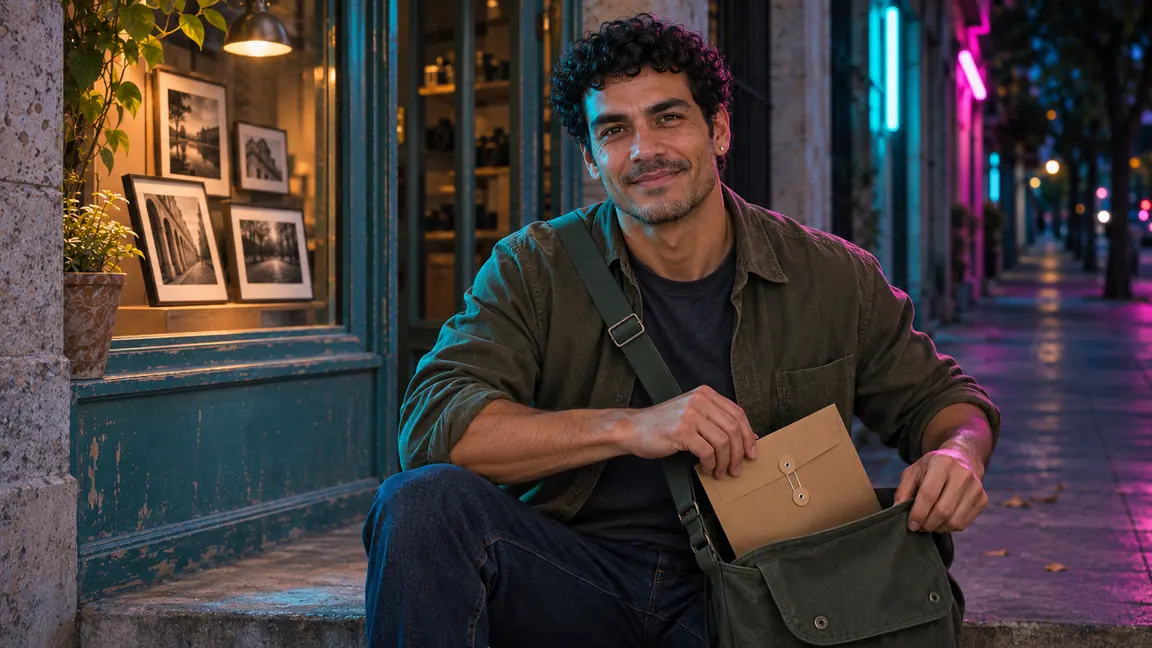
He packs the envelope away and looks up, relieved. Release. More saturated local color closes the arc without losing the face.
- Light & focus
- Cyan on one side, a restrained magenta edge and a small amber window behind. The readable face and hands packing the bag; the signs remain secondary.
- Continuity
- The warm window, teal door, envelope and green bag connect the ending to earlier frames.
View & copy this shot’s prompt
Use the same original fictional adult man, Ari, age 32, from the supplied identity reference: warm medium-tan skin with natural texture, dark brown eyes, a broad softly squared jaw, short dense black curls, faint moustache and close stubble, and a small silver stud in his left ear. Keep his olive cotton overshirt over a charcoal T-shirt, indigo jeans and forest-green canvas crossbody bag consistent. Night outside the same small teal studio. Ari sits on a low stone step, sliding the kraft print envelope into his open green canvas bag, then looks up toward a friend with a small relieved smile. Eye-level medium photograph. Neighboring out-of-focus cyan and magenta neon tubes provide local light: soft cyan on one cheek and sleeve, restrained magenta on the opposite hair and shoulder edge. Keep a small amber gallery window behind as a color bridge. Dark indigo surroundings, readable natural skin, coherent hands and paper contact. One wide 16:9 frame; no audience, readable signs, performance metrics, UI, captions or collage.

Color Script Example 2: AI UGC Commercial
Concept: a four-shot morning routine built around one cobalt reusable coffee cup. Context leads to use, a product detail and a relaxed closing moment. The same creator appears throughout; the cup remains blue while the surrounding light becomes warmer and more open.
Give the product a clear visual job. Here, a restrained environment makes the blue body easy to find; a neutral enough key keeps the gray lid and cup material readable. The hands are pouring, closing or carrying rather than simply displaying an object beside the face.

Fictional AI advertising concept and product, with no claimed customer experience or product-performance result.
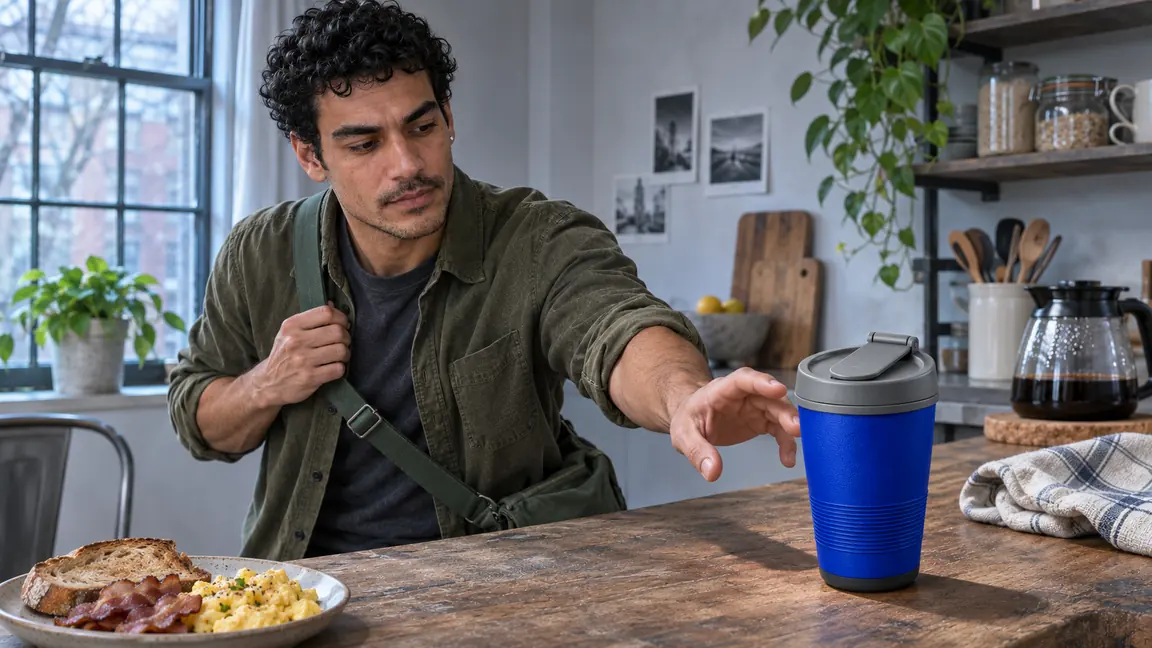
01. Establish the morning
Context#8FA6B5#485143#A48567#1846C6#C4C6C5
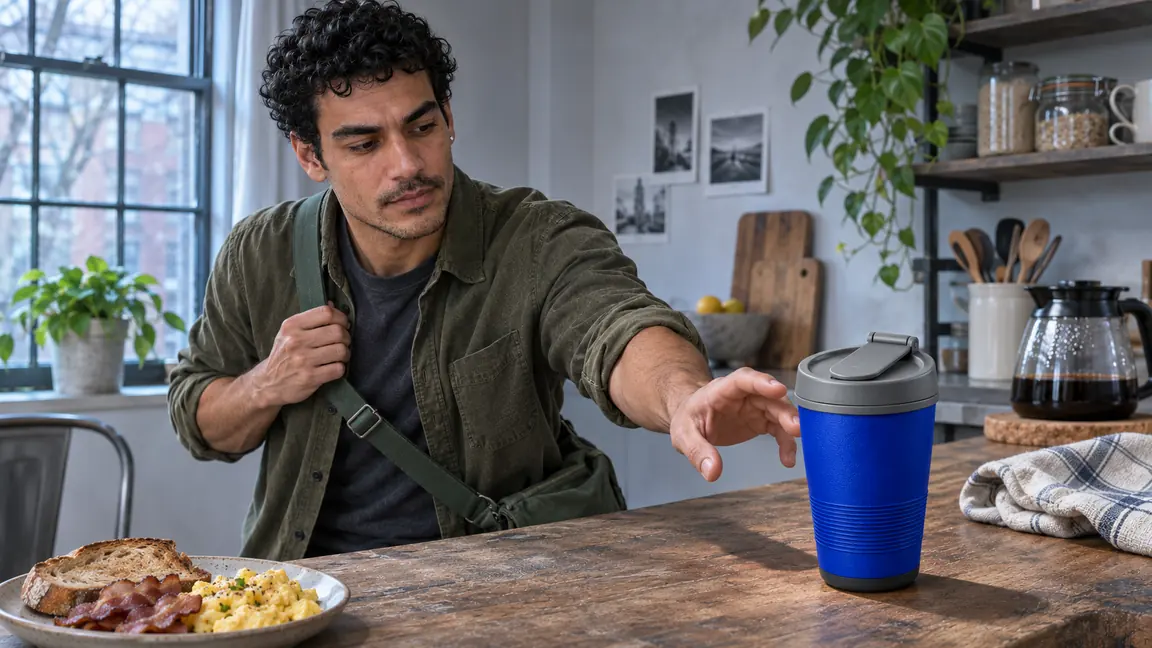
Ari reaches for the cup while preparing to leave. A familiar, slightly hurried routine; the product has a clear place in it.
- Light & focus
- Cool soft window light, with neutral enough illumination to keep the blue product recognizable. The reaching hand and cobalt cup, supported by the visible face.
- Continuity
- Introduce the cup silhouette, gray lid and blue accent that recur throughout the sequence.
View & copy this shot’s prompt
Use the same original fictional adult man, Ari, age 32, from the supplied identity reference: warm medium-tan skin with natural texture, dark brown eyes, a broad softly squared jaw, short dense black curls, faint moustache and close stubble, and a small silver stud in his left ear. Keep his olive cotton overshirt over a charcoal T-shirt, indigo jeans and forest-green canvas crossbody bag consistent. Use the same fictional compact cobalt-blue reusable coffee cup: a subtly tapered textured body, a ribbed grip band around the lower third, a charcoal rubber base and a gray screw-on lid with one hinged flip flap. Preserve the cup's shape, color, lid mechanism and scale from the product reference. Cool morning kitchen context. Ari stands behind a used wooden counter preparing to leave, one hand holding his bag strap and the other reaching toward the closed cup, not yet gripping it. Cup in the right foreground, Ari at left in a readable three-quarter view. Soft blue-gray window light, a glass coffee carafe, dish towel and breakfast plate. Keep the background muted and the cup clearly cobalt blue with a plausible contact shadow. Candid eye-level medium-wide photograph, natural depth of field and skin texture. One wide 16:9 frame; no packaging, logos, readable words, claims, review, UI or collage.
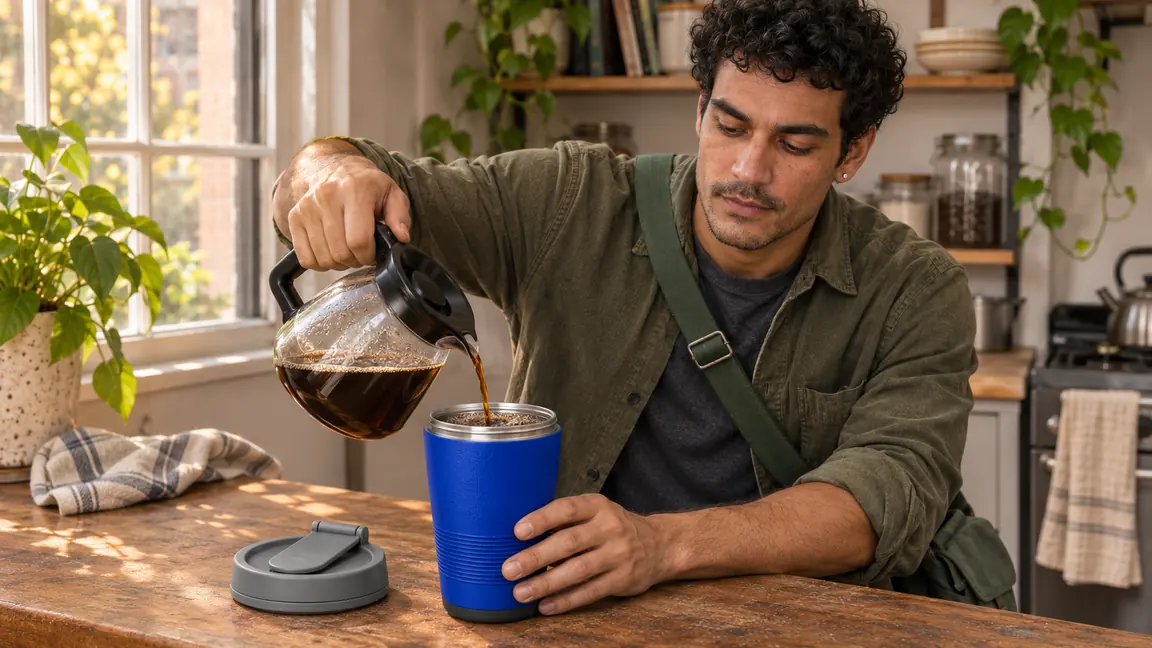
02. Give the product a purpose
Ritual#D5B886#A87342#4D5944#1746B6#6F7370
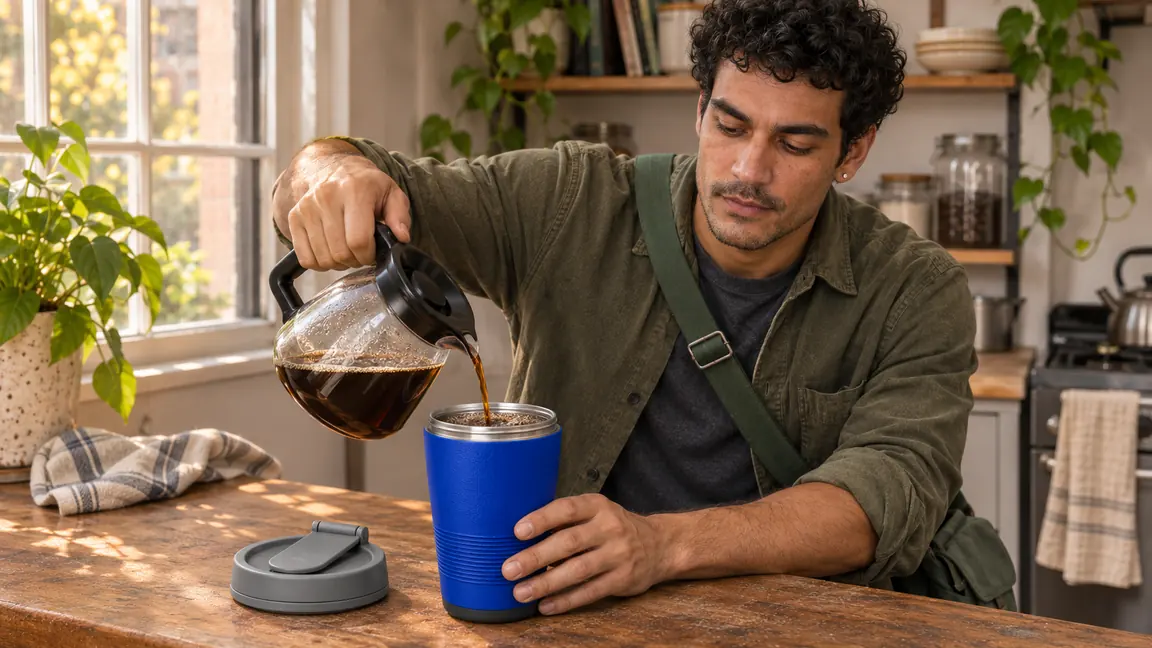
He pours coffee into the open cup. A small, unhurried ritual replaces the initial rush.
- Light & focus
- Warm-neutral window light and wood, with the blue cup remaining the saturated accent. The coffee stream entering the cup and the hand stabilizing it.
- Continuity
- The whole gray lid is set beside the cup; body, ribbing and base stay consistent.
View & copy this shot’s prompt
Use the same original fictional adult man, Ari, age 32, from the supplied identity reference: warm medium-tan skin with natural texture, dark brown eyes, a broad softly squared jaw, short dense black curls, faint moustache and close stubble, and a small silver stud in his left ear. Keep his olive cotton overshirt over a charcoal T-shirt, indigo jeans and forest-green canvas crossbody bag consistent. Use the same fictional compact cobalt-blue reusable coffee cup: a subtly tapered textured body, a ribbed grip band around the lower third, a charcoal rubber base and a gray screw-on lid with one hinged flip flap. Preserve the cup's shape, color, lid mechanism and scale from the product reference. A genuine coffee-pouring action in the same kitchen. The blue cup body stands open on the wooden counter; the entire unscrewed gray lid rests beside it. Ari holds a glass carafe by its handle and pours one coherent thin stream into the opening while his other hand lightly steadies the lower cup body. His face is visible, watching the pour. Slightly elevated three-quarter medium photograph. Warm-neutral window light, amber wood and quieter cream reflections; preserve true cobalt blue rather than tinting the product orange. Physically plausible grip, liquid and lid geometry. One wide 16:9 frame; no text, brand, testimonial, performance claim, UI or collage.
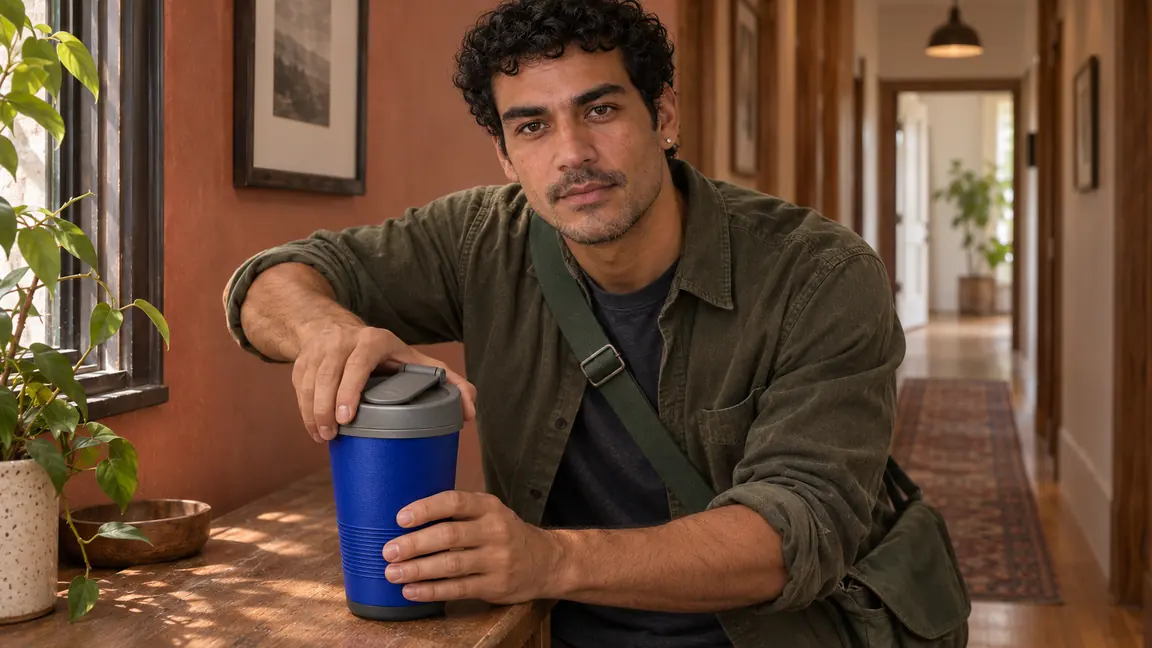
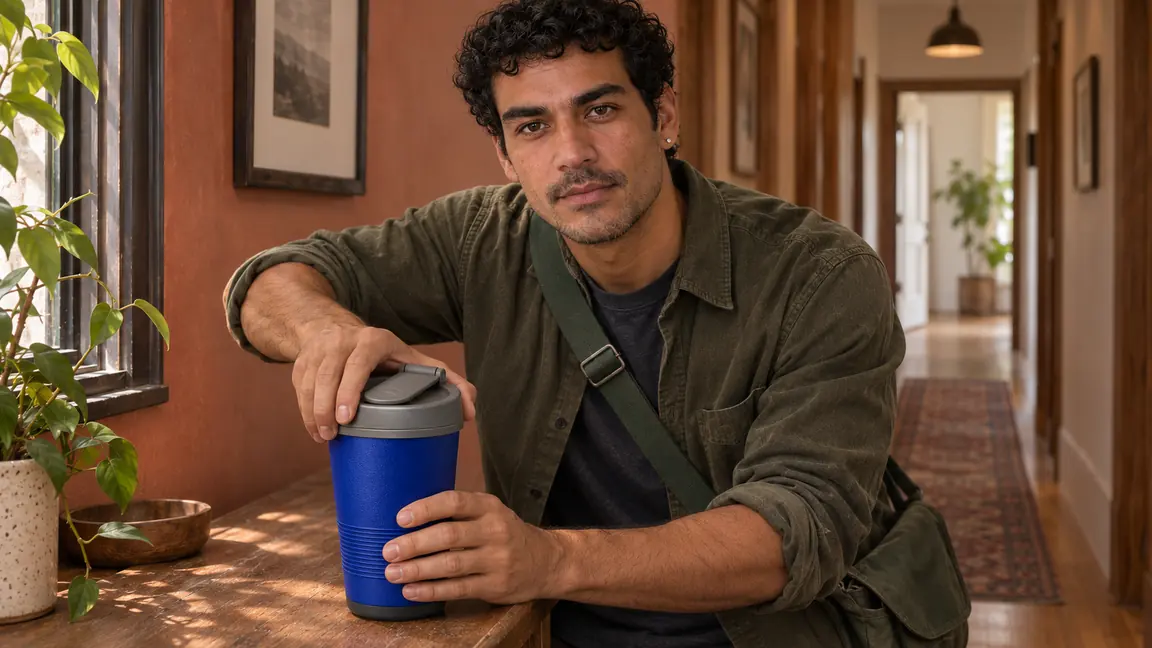
03. Make the detail readable
Product action#A6684B#D1AF8A#4E5543#1444B3#8B8D85
He tightens the lid before heading out. Prepared and deliberate. A quieter background gives the action priority.
- Light & focus
- A neutral directional key on the cup, with warm terracotta and dark olive support. The gray lid mechanism and blue body, then the creator's face.
- Continuity
- Keep the same cup proportions and hinged flap; show one hand on the lid and one on the body.
View & copy this shot’s prompt
Use the same original fictional adult man, Ari, age 32, from the supplied identity reference: warm medium-tan skin with natural texture, dark brown eyes, a broad softly squared jaw, short dense black curls, faint moustache and close stubble, and a small silver stud in his left ear. Keep his olive cotton overshirt over a charcoal T-shirt, indigo jeans and forest-green canvas crossbody bag consistent. Use the same fictional compact cobalt-blue reusable coffee cup: a subtly tapered textured body, a ribbed grip band around the lower third, a charcoal rubber base and a gray screw-on lid with one hinged flip flap. Preserve the cup's shape, color, lid mechanism and scale from the product reference. At a narrow wooden hallway table, Ari steadies the blue cup with one hand and naturally tightens the gray lid around its outer rim with the other; the hinged flap is closed. Include his recognizable face, upper torso, both hands and the full cup in a slightly low three-quarter medium-close photograph. A soft neutral directional window key keeps the product blue and gray readable against darker olive clothing. The receding hallway uses muted terracotta and honey wood. Product blue is the strongest saturated accent. Keep believable finger contact, exact lid mechanism and material detail. One wide 16:9 frame; no packaging, claims, captions, UI or collage.
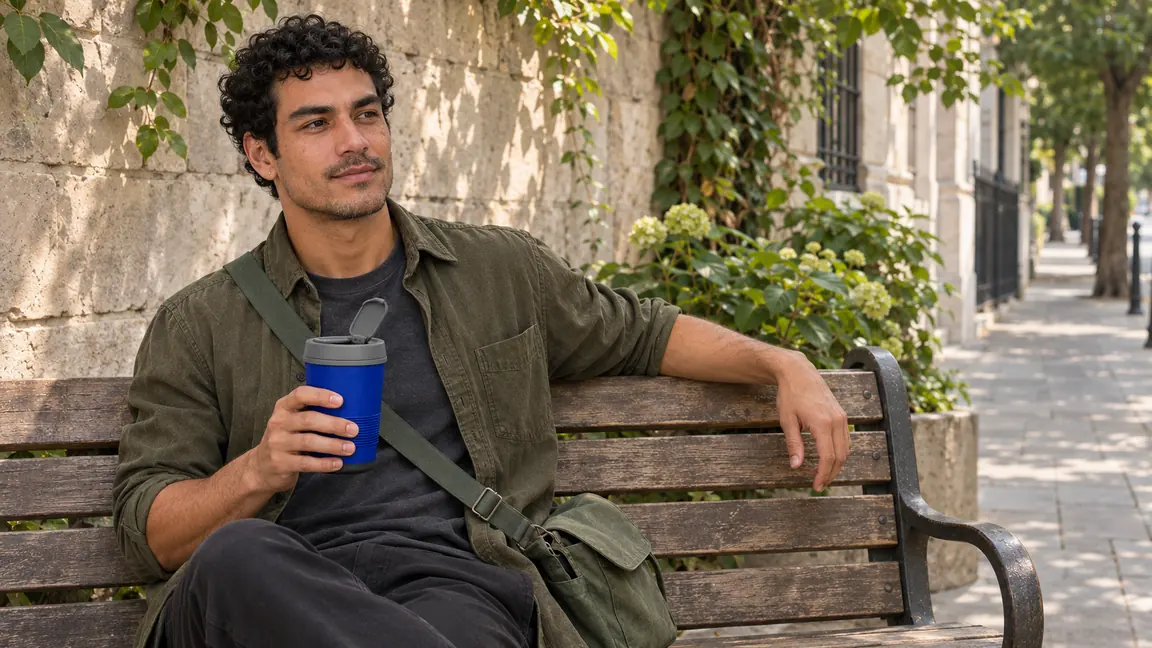
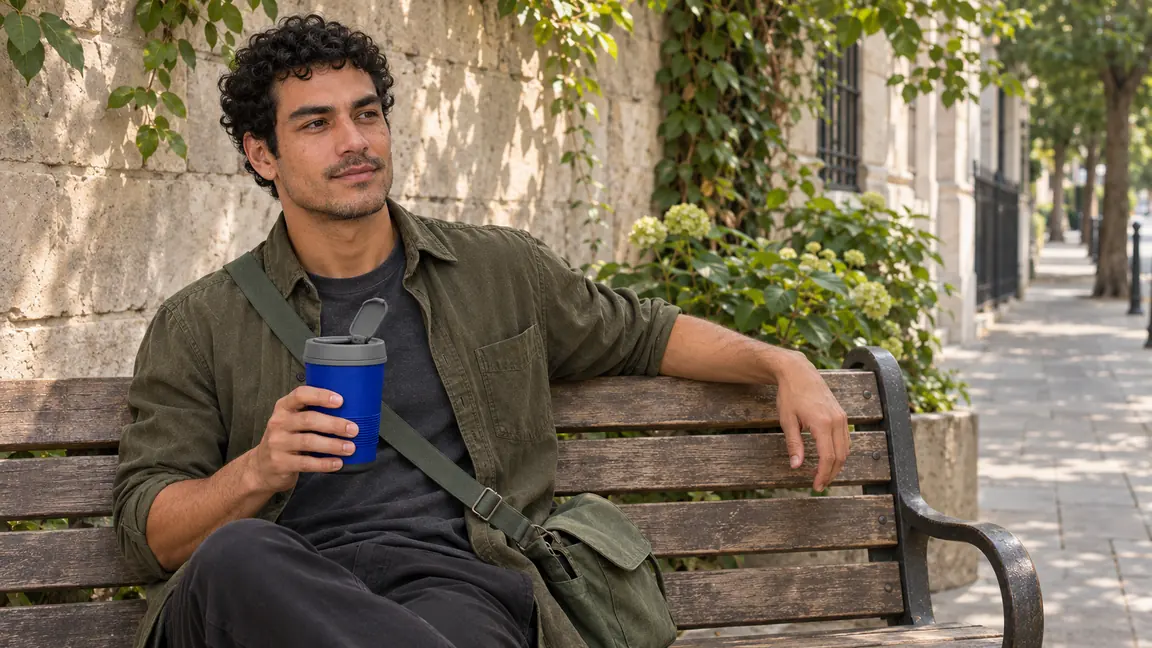
04. End in the user's world
Payoff#C5B795#8B9671#4B5643#1744B4#6F777A
Ari lowers the cup during a quiet outdoor pause. Ease, expressed by posture and open space rather than a claimed product benefit.
- Light & focus
- Soft warm-neutral daylight, gentle leaf shadows and muted stone and sage surroundings. The face and blue cup; the background remains supportive.
- Continuity
- The gray flip flap is open, while the body color, base, bag and outfit remain recognizable.
View & copy this shot’s prompt
Use the same original fictional adult man, Ari, age 32, from the supplied identity reference: warm medium-tan skin with natural texture, dark brown eyes, a broad softly squared jaw, short dense black curls, faint moustache and close stubble, and a small silver stud in his left ear. Keep his olive cotton overshirt over a charcoal T-shirt, indigo jeans and forest-green canvas crossbody bag consistent. Use the same fictional compact cobalt-blue reusable coffee cup: a subtly tapered textured body, a ribbed grip band around the lower third, a charcoal rubber base and a gray screw-on lid with one hinged flip flap. Preserve the cup's shape, color, lid mechanism and scale from the product reference. A late-morning pause on an ordinary wooden city-garden bench beside an old pale stone wall. Ari has just lowered the cup after a sip; one hand grips the lower blue body at mid-torso height, gray flip flap open on its hinge, other arm relaxed along the bench. His full face is visible, looking toward the street with a quiet content expression. Candid eye-level three-quarter medium-wide photograph. Warm-neutral daylight, gentle leaf shadows, muted sage greenery and warm stone; cobalt remains the clearest saturated accent. Preserve cup scale, hand contact, adult identity and natural skin. One wide 16:9 frame; no brand, text, testimonial, ratings, performance claims, UI or collage.
One Shot, Two Color Directions — Then a Value Check
The seated-step shot can support two readings. In the cool version, the wall and subject sit in a quieter, narrower range. In the alternate version, a warm key reaches the face, hands and print while the wall stays in darker blue-gray shade.
Remove color to see what the light is doing
That difference comes from light and dark, as well as hue. Choose the version that serves the beat: hesitation can be intentional, while a decision may need a clearer focal emphasis.
Copy the alternate color-direction prompt
Keep this exact adult identity, face, expression, pose, hands, printed photograph, envelope, blue wall, steps, wardrobe and camera framing. Change only the light and color relationship: a warm low-angle key from camera-left reaches the face, hands and print, while the wall and steps stay in darker cool blue-gray shadow. Make the subject and action separate in value as well as hue. Preserve natural skin, physical geometry and all object positions. No orange filter, smoothing, flare, new props, text or collage.
Use the original frame as a reference in the AI photo editor when exploring a different light or palette without starting a new composition.
Keep the Character, Product & Color Bridges Consistent
A stable reference is more useful than repeating a name. Keep the same adult face, hair, signature accessory and baseline wardrobe, then vary the story action. With a product, compare the silhouette, lid, material, color and scale across all frames.
Use the same original fictional adult man, Ari, age 32, from the supplied identity reference: warm medium-tan skin with natural texture, dark brown eyes, a broad softly squared jaw, short dense black curls, faint moustache and close stubble, and a small silver stud in his left ear. Keep his olive cotton overshirt over a charcoal T-shirt, indigo jeans and forest-green canvas crossbody bag consistent.
Use an identity block like this alongside the same reference image. Check recognizable features and object contact after each generation; a similar written description does not guarantee the same person. A new frame should continue the story while preserving the anchors that make it belong.
- Keep: the face, hair, signature accessory, wardrobe world and product geometry.
- Change with intent: action, camera distance, light source, surrounding palette and emotional emphasis.
- Bridge the cut: carry one meaningful color or object forward, then let the new scene introduce its own light.
Free Color Script Template
Use the six-frame worksheet to plan the sequence before rendering. For each shot, fill in the story beat, emotional intent, palette, key light or value plan, focal point and continuity anchor. Start with rough images; polish after the strip reads as a story.
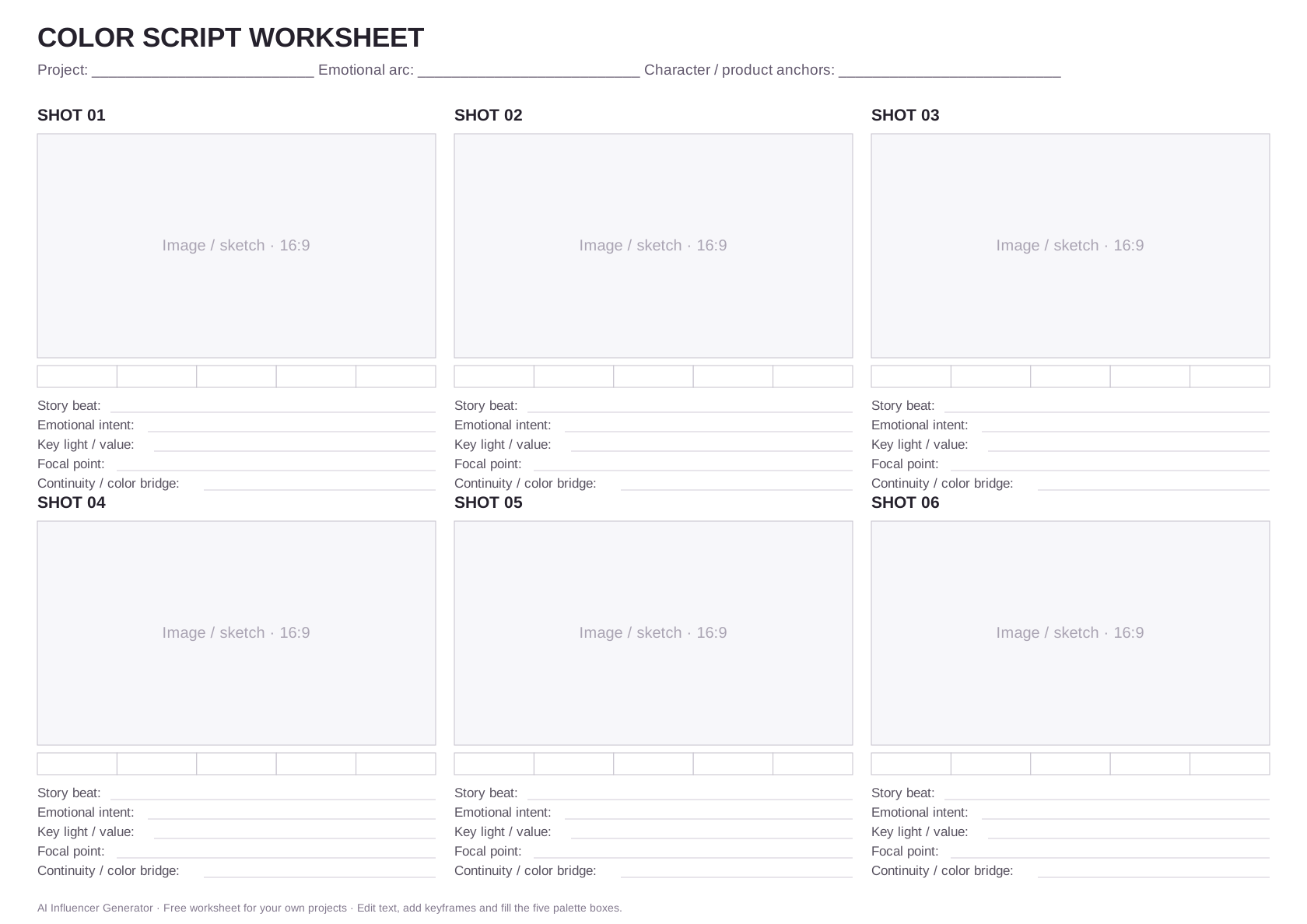
Free downloads, no sign-in required. Use the worksheet for your own projects.
Common Color Script Mistakes
- Every frame has the same intensity. Reserve a visible shift for a turning point; quieter frames give that shift meaning.
- The palette changes without a story reason. Explain the transition through time, location, mood or a recurring color bridge.
- Everything is saturated. Give the focal color a quieter environment instead of adding more competing accents.
- The face or product disappears in grayscale. Revisit value, light direction or background brightness.
- The character or object drifts. Return to the same original references and repair the changed feature before accepting the shot.
- Each frame looks good alone but the strip feels disconnected. Compare neighboring frames for exposure, recurring colors, wardrobe and visual direction.
Frequently Asked Questions
What is a color script?
A color script is an ordered sequence of small visual studies that plans how color, light and value change across a story. It helps you see the emotional arc and continuity before finishing every shot.
How many frames should a color script have?
Use enough frames to cover meaningful changes in mood, place, time or lighting. Four to six keyframes are a practical starting point for a short creator story or ad. A longer film needs more story beats, not a fixed universal frame count.
Can I create a color script with AI?
Yes. Plan the beats first, keep a stable character reference, generate each keyframe with explicit lighting and palette instructions, then review the complete sequence. AI helps make the studies; you still choose the story, transitions and final frames.
Is a color script the same as a storyboard?
No. A storyboard primarily describes action, staging and camera choices. A color script primarily describes the progression of color, light and emotional emphasis. The two can share compositions and inform one another.
Should I use the same palette in every shot?
Keep recurring anchors, not identical colors everywhere. Repeat a wardrobe color, product color or practical light while changing the surrounding temperature, value or saturation when the story calls for it.
Why check a color script in grayscale?
Grayscale helps reveal whether the face, action or product separates from its surroundings in light and dark. Different hues can look distinct in color while remaining too similar in value.
Is the color script template free?
Yes. Download the editable SVG worksheet, printable PDF or CSV shot planner without signing in. The worksheet has six frames and fields for the story beat, emotion, palette, light, focal point and continuity.
Continue Studying Color & Light
Try the Pixar in a Box color-script exercise for mood exploration, read Blender Studio’s Coffee Run color-scripting notes for sequence development, and explore Profoto’s product-setting examples for how props and light support a product story.
For your next sequence, start with the free color script template, choose one reference identity and write the change between each pair of shots.
Plan Content
Measure Engagement
Build Your Profile
Price Your Work
Write Post Copy
Brand Partnerships